Budgeting: How to make a family budget: what a family of four spends, and a plan
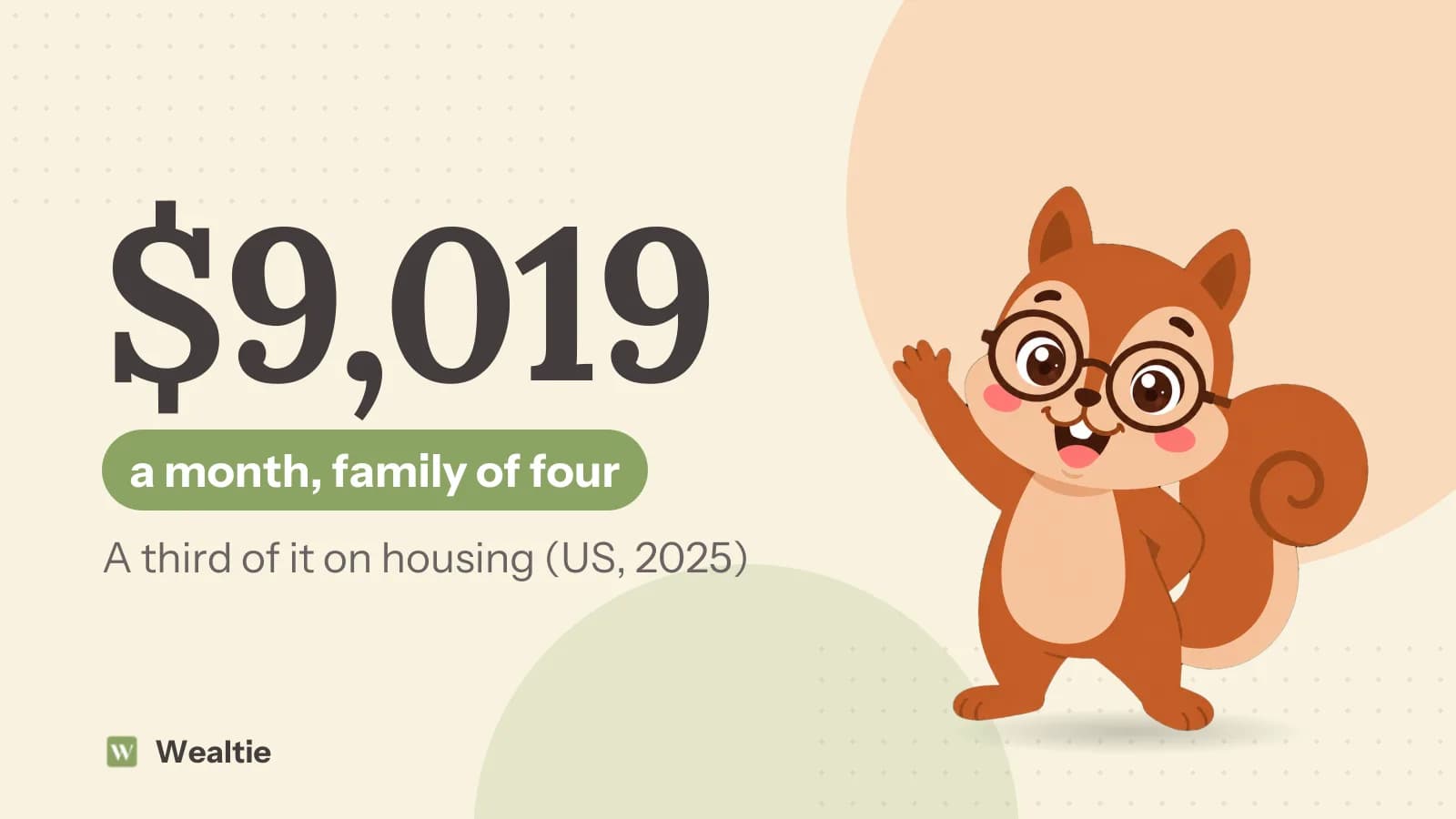
To make a family budget, start from take-home pay, take off fixed bills and savings, then give every other category a monthly amount based on your last three months. For scale, US four-person households spent about $9,019 a month in 2025, by BLS data, a third of it on housing.
 By Wealtie Team · 2 min read
Key takeaways
- US four-person households spent an average of $108,233 in 2025, about $9,019 a month, according to the BLS Consumer Expenditure Survey.
- Housing took about $2,936 a month, 32.5% of spending, followed by transportation at $1,553 and food at $1,254.
- Personal insurance and pensions, mostly Social Security and retirement contributions, were $1,368 a month, 15.2%.
- Build your family budget from your own last three months, not the average, then use the average as a check.
- Run it as a household: one shared view of family spending, a personal amount for each adult, and a monthly check-in.
How do you make a family budget?
Start from take-home pay, take off fixed bills and savings, then give every other category a monthly amount based on what your family spent in the last three months. Check it mid-month and review it together once a month.
A family budget is a normal budget with more moving parts: more people spending, more categories, and costs like childcare and school that single people don't have. The method is the same; the conversation is bigger.
What does a family of four spend?
About $9,019 a month, or $108,233 a year, for four-person US households in 2025, according to the Bureau of Labor Statistics' Consumer Expenditure Survey.
| Category | Per year | Per month | Share |
|---|---|---|---|
| Housing (shelter, utilities, household) | $35,229 | $2,936 | 32.5% |
| Transportation | $18,641 | $1,553 | 17.2% |
| Personal insurance and pensions | $16,415 | $1,368 | 15.2% |
| Food | $15,051 | $1,254 | 13.9% |
| Healthcare | $7,284 | $607 | 6.7% |
| Entertainment | $4,125 | $344 | 3.8% |
| Education | $2,865 | $239 | 2.6% |
| Clothing and services | $2,816 | $235 | 2.6% |
| Cash contributions | $1,657 | $138 | 1.5% |
| Personal care | $1,254 | $105 | 1.2% |
| Everything else | $2,896 | $241 | 2.7% |
| Total | $108,233 | $9,019 | 100% |
Food split into $743 a month on groceries and $512 eating out. "Personal insurance and pensions" is mostly Social Security and retirement contributions, much of it taken from pay before it arrives. The same households had an average income before taxes of $164,387.
These are averages across very different families, so use them as a check on your own numbers, not as targets.
Step 1: start from take-home pay
Add up what actually reaches your accounts each month, from both adults if there are two earners. Use the lower months if income varies.
Step 2: take out fixed bills and savings first
Rent or mortgage, utilities, insurance, childcare, minimum debt payments and the savings transfer. These leave on fixed dates, so set them up first and automate what you can.
Step 3: set the flexible categories from your real spending
Look at the last three months and set each flexible category from the average: groceries, eating out, transport, kids' activities, clothing, personal spending. Here's a worked example in round numbers, the same in any currency, for a family taking home 7,000 a month:
| Category | Monthly |
|---|---|
| Housing and utilities | 2,300 |
| Childcare and school | 900 |
| Groceries | 900 |
| Transport | 700 |
| Insurance and health | 450 |
| Eating out and family outings | 350 |
| Clothing and kids' activities | 300 |
| Personal spending (two adults) | 300 |
| Irregular costs (gifts, repairs) | 200 |
| Savings | 600 |
| Total | 7,000 |
The irregular line is the one families forget. Birthdays, school trips and car repairs come every year; spread them across the months with a sinking fund. If groceries keep running over, how to stop overspending covers the categories that usually leak.
How do you run a family budget together?
Make shared spending visible to both adults, give each adult the same personal amount nobody needs to explain, and check the numbers together once a month. Agree how shared costs are split if you keep separate money; how to split bills as a couple compares the options.
Older children can help too: a small allowance with its own rules teaches more than any lecture about money.
In Wealtie, a shared account lets both adults see and log family spending, with pooled or per-person balances; the account owner needs Pro to invite, and the partner can join on any plan, Free included. Set the family's monthly budget by category, and Budget Health warns you mid-month if spending is on pace to go over, while there's still time to adjust.
Questions people ask
About $9,019 a month in 2025, or $108,233 a year, for four-person US households, according to the BLS Consumer Expenditure Survey. Housing was the largest share at about $2,936 a month.
Start from monthly take-home pay, subtract fixed bills and savings, and set an amount for each remaining category from your last three months of spending. Check it mid-month and review it monthly.
Housing, utilities, groceries, eating out, transport, childcare and school, healthcare, insurance, clothing, personal spending for each adult, irregular costs, savings and debt payments.
Four-person US households spent about $1,254 a month on food in 2025: $743 on groceries and $512 eating out, by BLS figures. USDA's food plans put a home-cooked diet for a family of four at $1,024 to $1,682 a month.
Agree how shared costs are split, keep shared spending in one place both can see, give each adult the same personal spending amount, and check the budget together once a month.
Sources
- Consumer Expenditures in 2025, table 1400: Size of consumer unit · U.S. Bureau of Labor Statistics · checked 3 November 2026
This article is general information, not financial, tax or legal advice. Your situation is your own; check the numbers that apply to you before you act on them.