Money as a couple: How to budget for caring for elderly parents
To budget for caring for elderly parents, list the costs you're likely to cover, agree with siblings who pays what, check what support your parent can claim, and protect your own savings and pension. Small regular costs add up fast.
 By Wealtie Team · 3 min read

Key takeaways
- List the costs you're likely to cover, including travel, shopping, help at home and time off work.
- In a worked example, helping a parent costs 420 a month, often spread across family members.
- Check what benefits, allowances and support your parent and you as a carer may be entitled to.
- Keep your own emergency fund and pension contributions going, since your future matters too.
How do you budget for caring for elderly parents?
Write down the costs, share them fairly, check support, and protect your own finances. Caring often starts with small things, like a weekly shop or a lift to appointments, and grows gradually. Planning early makes it easier to keep going without damaging your own money or relationships.
What costs come up?
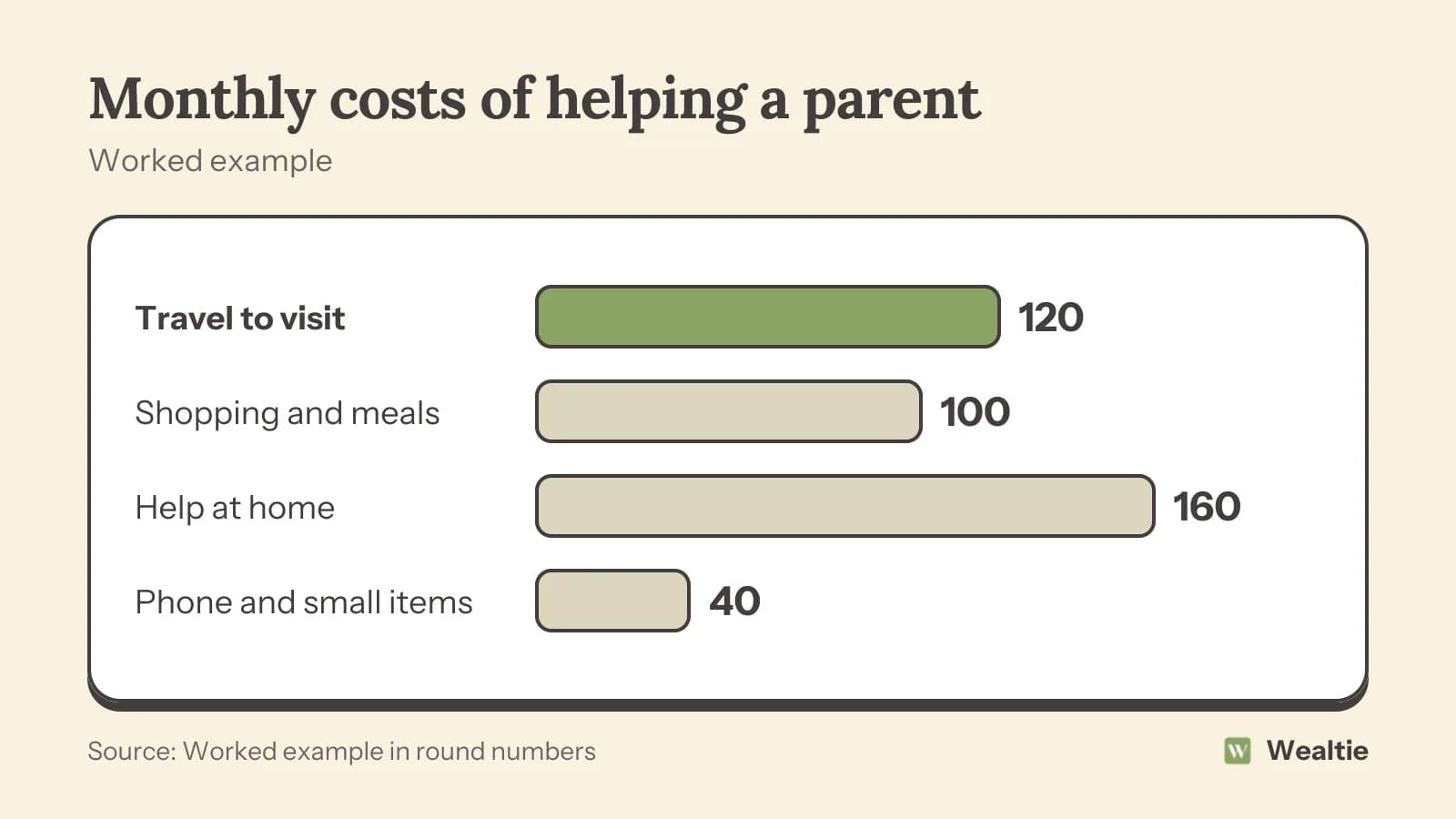
More than people expect. Here's a worked example of monthly costs in round numbers that work in any currency:
| Cost | Per month |
|---|---|
| Travel to visit | 120 |
| Shopping and meals | 100 |
| Help at home, like a cleaner or carer | 160 |
| Phone, small equipment, prescriptions | 40 |
| Total | 420 |
Other costs come up less often: home adaptations like grab rails, a mobility aid, or paying for a few days of extra care when you can't be there. The biggest hidden cost can be your own income, if you reduce your hours or take time off to help. Track the costs for two or three months before agreeing a split, since early estimates are often too low.
How should siblings share the costs?
Talk about it early, with numbers. Split the 420 three ways and it's 140 each. But contributions aren't only money. One sibling might live nearby and give time, while another lives far away and contributes more money. Both are real contributions. If one sibling is giving a lot of time, the others might cover more of the money, or pay for some outside help so that sibling gets a break.
Agree what each person covers, write it down, and review it every few months. A shared record of what's been spent helps avoid resentment. How to talk about money with a partner has tips that work for family conversations too.
What support should you check?
Your parent may be entitled to benefits, allowances or a care assessment that could provide or pay for help. You may be entitled to support as a carer, such as an allowance or credits toward your own state pension. Rules differ a lot between countries, so check official sources and local services.
Asking your parent's doctor or the local authority about a needs assessment is often the route to practical help. Local charities and community groups often provide meals, transport, befriending or advice for free. They can take some pressure off.
Should your parent's money pay for their care?
Often, if they can afford it. Many families find it easier to keep a parent's money separate and use it for their costs, rather than mixing it with their own. If your parent needs help managing money, there may be legal arrangements, like a power of attorney, that let you do so properly. Get advice before you start handling someone else's money.
Keep a simple log of money spent on their behalf, with dates, and keep receipts for anything you pay, so you can be repaid or show where the money went.
How do you protect your own finances?
Keep your own emergency fund and pension contributions going if you possibly can. If you cut your hours, find out how it affects your pension and any benefits, and ask your employer whether it offers carer's leave or flexible working. Caring can last years, and it's easy to give more than you can afford.
Set a monthly amount you can sustain, and stick to it. If costs grow beyond that, it's a sign to look for more support or a different arrangement. How much should be in an emergency fund helps you protect your own cushion.
How do you plan for bigger changes?
Talk with your parent, while they can take part, about what they'd want if their needs grow: staying at home with more help, moving closer to family, or residential care. Knowing their wishes makes decisions easier later. Find out roughly what the options cost where they live, so nothing comes as a shock. Ask how long-term care is funded there, since the rules can affect what happens to their home and savings.
How do you share caring costs in Wealtie?
A shared account lets siblings see what's been spent and who's paid what, with owner, editor and viewer roles. You can split an expense using current shares or custom amounts, to the cent, and choose pooled or per-person balances. The account owner needs Pro to invite, and others can be on any plan. The shared accounts page has more, and a monthly limit in the budget tracker keeps your own spending on track.
Questions people ask
It varies widely. A worked example of travel, shopping, help at home and small items comes to 420 a month, often shared among family.
Talk early with real numbers, recognise time as well as money, write down who covers what and review it every few months.
Often, depending on where you live. Your parent may qualify for allowances or a care assessment, and you may qualify for carer's support.
Keep your emergency fund and pension contributions going, set a sustainable monthly amount, and look for more support if costs grow beyond it.
This article is general information, not financial, tax or legal advice. Your situation is your own; check the numbers that apply to you before you act on them.