Budgeting: Average monthly expenses for one person: the 2025 numbers
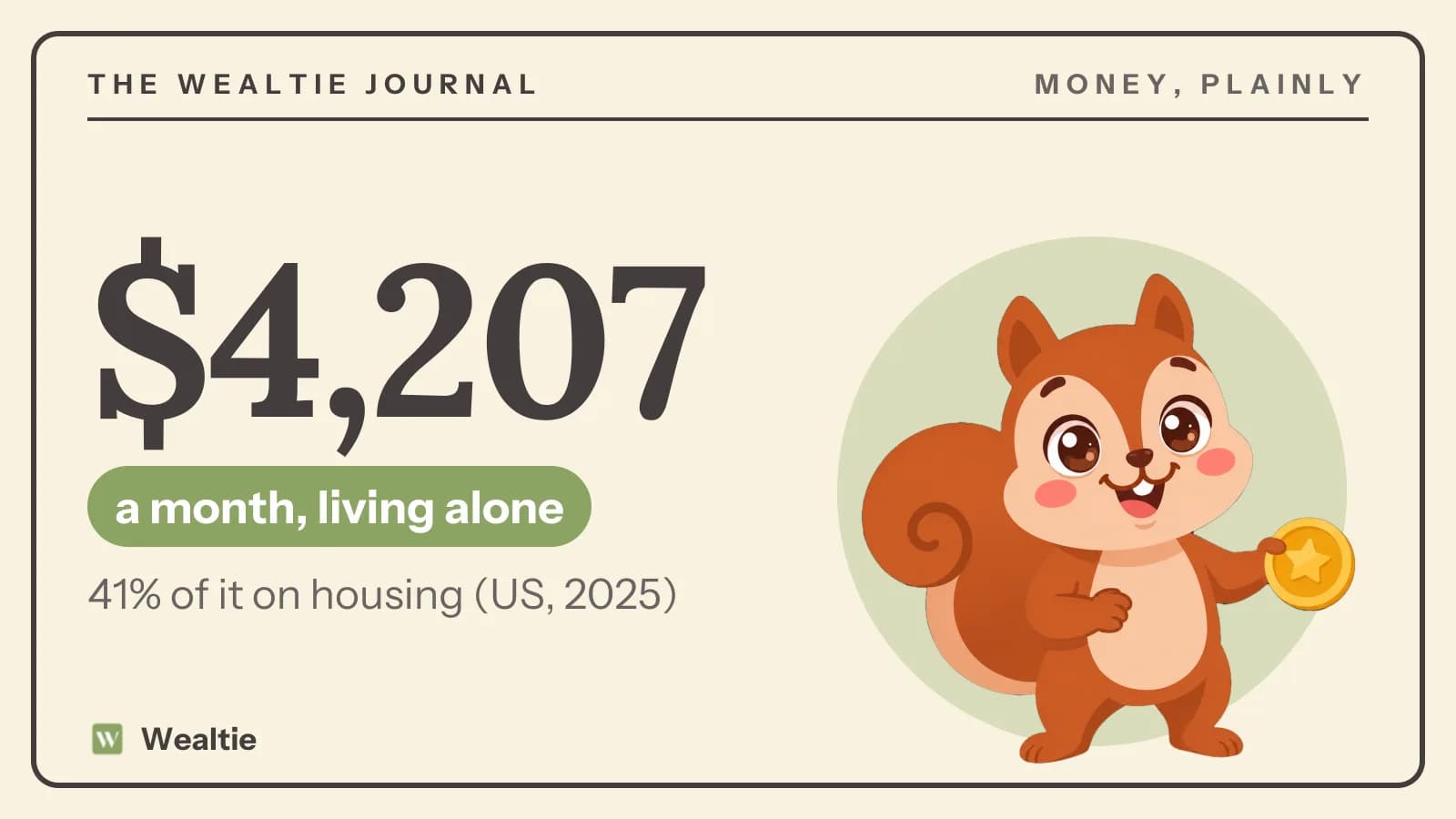
The average monthly expenses for one person living alone in the US were about $4,207 in 2025, according to the Bureau of Labor Statistics: $50,479 for the year. Housing took $1,708 a month, 41% of the total, followed by transport at $592 and food at $474.
 By Wealtie Team · 3 min read
Key takeaways
- One-person households in the US spent an average of $50,479 in 2025, about $4,207 a month, according to the BLS Consumer Expenditure Survey.
- Housing was 40.6% of that, about $1,708 a month, including shelter, utilities and household costs.
- Transportation came next at about $592 a month, then food at $474, of which $282 was groceries and $192 eating out.
- Living alone costs more per person than sharing: a two-person household spent $84,124 a year, about $42,062 each, against $50,479 for one person.
- Averages include very different lives, so use them as a check on your own budget, not as a target.
What are the average monthly expenses for one person?
About $4,207 a month, or $50,479 a year, for one-person households in the US in 2025, according to the Bureau of Labor Statistics' Consumer Expenditure Survey.
Here's where it went:
| Category | Per year | Per month | Share |
|---|---|---|---|
| Housing (shelter, utilities, household) | $20,492 | $1,708 | 40.6% |
| Transportation | $7,098 | $592 | 14.1% |
| Food | $5,693 | $474 | 11.3% |
| Personal insurance and pensions | $4,615 | $385 | 9.1% |
| Healthcare | $4,218 | $352 | 8.4% |
| Entertainment | $2,248 | $187 | 4.5% |
| Cash contributions | $1,898 | $158 | 3.8% |
| Clothing and services | $969 | $81 | 1.9% |
| Education | $850 | $71 | 1.7% |
| Personal care | $571 | $48 | 1.1% |
| Everything else | $1,828 | $152 | 3.6% |
| Total | $50,479 | $4,207 | 100% |
"Personal insurance and pensions" is mostly Social Security and retirement contributions, so part of it never feels like spending: it comes out of the paycheck. The same survey puts average income before taxes for one-person households at $56,302.
How much does a single person spend on housing?
About $1,708 a month in 2025, 40.6% of spending. That's the biggest line by far.
Inside it, shelter (rent, or mortgage interest, property tax and upkeep for owners) was $14,172 a year, about $1,181 a month, and utilities, fuel and public services were $3,170, about $264 a month. Half of one-person households rented and half owned, so the shelter figure mixes the two.
If your rent alone is well above $1,181, that's normal in many cities, but it means the rest of the budget has less room than the average suggests. A common test is to keep rent to about 25% to 30% of take-home pay.
How much does one person spend on transport and food?
Transport was about $592 a month and food about $474.
Transport included $2,352 a year on vehicle purchases, $1,316 on fuel, $1,243 on vehicle insurance and $783 on public transport. Without a car, this line can be a fraction of the average.
Food split into $282 a month on groceries and $192 on eating out. Both are easier to change than housing. How much to spend on groceries compares your grocery figure with USDA's food plans.
Is living alone more expensive?
Per person, yes. Two-person households spent $84,124 in 2025, about $42,062 each, against $50,479 for someone living alone.
The difference is mostly shared costs: one rent, one set of utilities, one internet bill. Living alone means paying all of them yourself. That's not a reason not to, but it explains why a single person's budget can feel tight on a salary that would be comfortable for two.
What does a one-person budget look like?
Here's a worked example in round numbers, the same in any currency, for someone taking home 3,500 a month who rents.
| Line | Monthly |
|---|---|
| Rent | 1,000 |
| Utilities, internet and phone | 220 |
| Groceries | 300 |
| Transport | 250 |
| Insurance and health | 150 |
| Eating out and entertainment | 300 |
| Personal spending and clothing | 230 |
| Irregular costs (gifts, repairs) | 150 |
| Savings | 600 |
| Debt above the minimum | 300 |
| Total | 3,500 |
Rent is 29% of take-home here. Fixed needs (rent, utilities, groceries, transport, insurance) come to 1,920, just under 55% of take-home, which is slightly above the 50% the 50/30/20 rule aims for, and normal for someone living alone. The budget calculator runs the same split on your own pay.
How do you compare your spending with the average?
Track one normal month, sort it into the same categories, and put it next to the first table.
The average is a check, not a target. A big gap in one category is worth a look: why is transport double, or food half? Sometimes there's a good reason, like a long commute or a cheap rent. Sometimes it's a category that has quietly grown. How to make a budget turns that month into a plan.
Keep in mind that averages hide very different lives. A 25-year-old renting in a city and a 70-year-old owning a paid-off house both count as one-person households. The average one-person household head was 57.
How do you build a budget for one person?
Start from take-home pay, take off rent and fixed bills, set aside savings, then split what's left by category, using your own last month rather than the national average.
In Wealtie, the Free plan includes a monthly budget split across up to ten categories, with Budget Health warning you mid-month if your spending pace will take you over. Log spending in a few taps, cash included, and the month's totals by category sit next to the budget, ready to compare with the table above.
Questions people ask
About $4,207 a month on average in the US in 2025, or $50,479 a year, according to the BLS Consumer Expenditure Survey of one-person households. Housing was $1,708 of that.
Housing: about $1,708 a month, or 40.6% of spending, for one-person US households in 2025. That includes rent or mortgage costs, utilities and household supplies.
About $474 a month in 2025, by BLS figures: $282 on groceries and $192 on eating out. USDA's food plans put a home-cooked diet for one adult at $305 to $584 a month.
With a roommate, usually. US two-person households spent $84,124 in 2025, about $42,062 a person, against $50,479 for someone living alone, because rent and bills are shared.
Enough take-home pay to cover your own costs plus savings. One-person households averaged $56,302 in income before taxes in 2025 and spent $50,479, but your city and rent matter more than the average.
Sources
- Consumer Expenditures in 2025, table 1400: Size of consumer unit · U.S. Bureau of Labor Statistics · checked 1 November 2026
This article is general information, not financial, tax or legal advice. Your situation is your own; check the numbers that apply to you before you act on them.