Budgeting: The 70/20/10 budget rule: how it works and when it beats 50/30/20
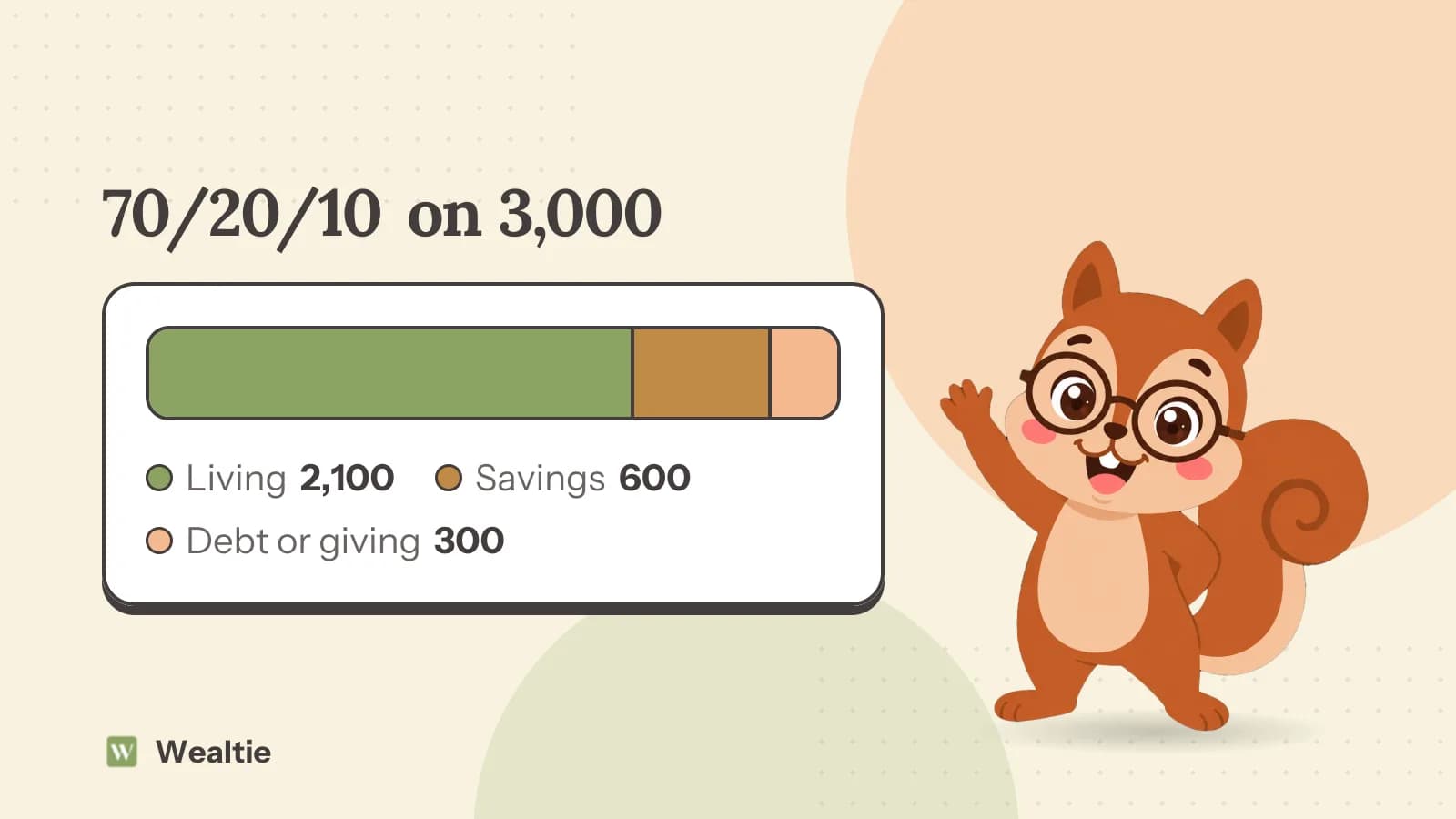
The 70/20/10 budget rule splits take-home pay three ways: 70% for everything you live on, needs and wants together, 20% for savings and 10% for paying off debt or giving. On 3,000 a month, that's 2,100, 600 and 300. It suits people whose rent and bills leave no room for the 50% needs line of the 50/30/20 rule.
 By Wealtie Team · 3 min read
Key takeaways
- The 70/20/10 rule puts 70% of take-home pay towards living costs, 20% towards savings and 10% towards extra debt payments or giving.
- Unlike 50/30/20, it doesn't separate needs from wants: both share the 70%.
- On 3,000 a month of take-home pay, the split is 2,100 to live on, 600 to save and 300 for debt or giving.
- It suits people with high fixed costs, who can't fit needs into 50%, and people who'd rather not argue about what counts as a want.
- If 20% savings doesn't fit, a 80/10/10 split is a reasonable start, rising as pay grows.
What is the 70/20/10 budget rule?
A three-way split of your take-home pay: 70% for everything you live on, 20% for savings, and 10% for paying off debt faster or, once you're debt-free, for giving.
Here's what it looks like on a few incomes, in round numbers, the same in any currency:
| Monthly take-home pay | 70% living costs | 20% savings | 10% debt or giving |
|---|---|---|---|
| 2,500 | 1,750 | 500 | 250 |
| 3,000 | 2,100 | 600 | 300 |
| 4,000 | 2,800 | 800 | 400 |
| 5,000 | 3,500 | 1,000 | 500 |
The 70% covers needs and wants together: rent, bills, groceries, transport, insurance, eating out, clothes, entertainment and personal spending. Minimum debt payments usually go here too, with the 10% for anything above the minimum.
How is 70/20/10 different from 50/30/20?
The 50/30/20 rule splits living costs into needs (50%) and wants (30%), with 20% for savings and extra debt payments. 70/20/10 merges needs and wants into one 70% and gives debt its own 10%.
On 3,000 a month:
| 50/30/20 | 70/20/10 | |
|---|---|---|
| Needs | 1,500 | 2,100 (needs and wants together) |
| Wants | 900 | |
| Savings | 600 (shared with extra debt payments) | 600 |
| Extra debt payments or giving | 300 |
Both save 20%. The difference is in the details: 50/30/20 caps wants, while 70/20/10 lets you decide the balance between needs and wants yourself, and it sets aside a separate 10% so debt payoff doesn't compete with savings.
When does the 70/20/10 rule work better?
When your fixed costs are high. In many cities, rent and bills alone take more than half of take-home pay, so the 50% needs line in 50/30/20 is out of reach from day one. 70/20/10 doesn't ask you to fit needs into half your pay; it just asks that everything you live on fits in 70%.
It also suits people who'd rather not debate whether a gym membership or a phone upgrade is a need or a want. Everything lives in one pot with one limit.
And it suits anyone paying off debt, because the 10% is a dedicated line. Debt payoff doesn't have to fight savings for the same 20%.
Which costs go in which part?
A quick guide for the usual grey areas:
- Minimum debt payments: the 70%. They're a cost of living until the debt is gone.
- Payments above the minimum: the 10%.
- Pension or retirement contributions taken from your pay: they count towards the 20%, even though you never see them in your account.
- Emergency fund and sinking funds: the 20%.
- Yearly bills paid monthly into a pot: the 70%, because they're living costs spread out.
What's the catch?
The 70% can hide a problem. If needs take most of it, there's little left for anything else, and the rule won't flag it.
Continuing the example, on 3,000 take-home: rent 1,100, utilities 180, groceries 400, transport 150 and insurance 120 come to 1,950. That leaves 150 of the 2,100 for everything else: eating out, clothes, gifts, entertainment. It fits the rule, but it's a tight month. If that's your situation, the real question is whether the fixed costs can come down, not which rule to use. How to make a budget goes through setting each line from your real spending.
What if 20% savings doesn't fit?
Start with 80/10/10: 80% for living costs, 10% for savings, 10% for debt. Then move a point from living costs to savings with each pay rise until you reach 70/20/10.
A split you keep is worth more than a better one you abandon. The budget calculator shows what different splits look like on your own pay.
What do you do with the 10% when you're debt-free?
Give it a new job. Common choices are giving to causes you care about, adding it to savings for a 30% savings rate, or a specific goal like a deposit, a car or a holiday fund. If you'd like every unit of pay to have a named job, zero-based budgeting takes the same idea further.
How do you set up a 70/20/10 budget?
Move the 20% and 10% out on payday, then set the 70% as your monthly spending budget.
- On payday, transfer 20% to savings and send the 10% to your highest-interest debt.
- Set your monthly budget to the remaining 70%.
- Split the 70% into categories if you'd like more control, or keep it as one number.
- Check mid-month whether spending is on track.
In Wealtie, set your monthly budget to the 70% figure and split it by category if you want, and Budget Health warns you mid-month if your spending pace will take you past it. The savings transfer counts as a transfer between your own accounts, not as spending, so the budget shows only what you spent.
Questions people ask
A way to split take-home pay: 70% for living costs, needs and wants together; 20% for savings; and 10% for extra debt payments, or giving once you're debt-free.
It's better if your rent and bills take more than half your take-home pay, because it doesn't ask you to fit needs into 50%. It saves the same 20%. 50/30/20 is better if you want a separate limit on wants.
Everything you live on: rent, utilities, groceries, transport, insurance, phone, eating out, entertainment, clothes and personal spending. Minimum debt payments usually go here too.
Use the 10% for giving, for extra savings, or for a specific goal like a holiday or a deposit. Some people simply move it into the 20% and save 30%.
Multiply your monthly take-home pay by 0.7, 0.2 and 0.1. On 4,000, that's 2,800 for living costs, 800 for savings and 400 for debt or giving.
This article is general information, not financial, tax or legal advice. Your situation is your own; check the numbers that apply to you before you act on them.