Budgeting: Kakeibo: the Japanese budgeting method, and how to use it today
Kakeibo is a Japanese household budgeting method built on a written ledger: set a savings goal at the start of the month, sort every purchase into four categories (needs, wants, culture and unexpected), and answer four questions at the end. The writing is the point: it makes you look at each purchase twice.
 By Wealtie Team · 3 min read
Key takeaways
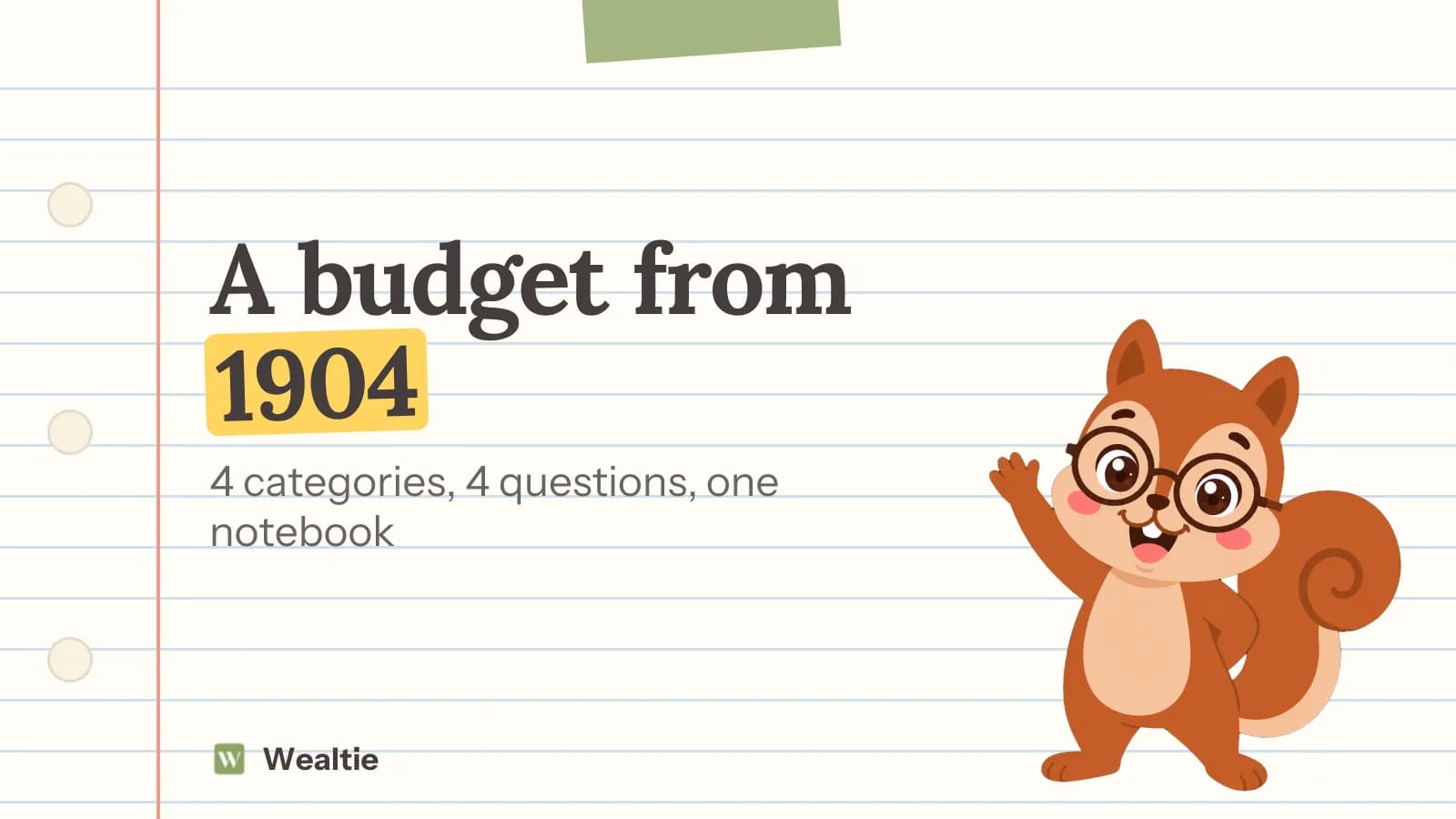
- Kakeibo is a household ledger method from Japan, credited to journalist Hani Motoko, who published it in 1904.
- It sorts spending into four categories: needs, wants, culture and unexpected.
- Each month starts with income, fixed costs and a savings goal, and ends with four questions about how the month went.
- Writing every purchase by hand slows spending down, which is most of why it works.
- The same structure works in an app: four categories, a monthly savings goal, and a monthly review.
What is kakeibo?
A Japanese household budgeting method built around a written ledger. Each month you set a savings goal, record every purchase in one of four categories, and finish with four questions about how the month went.
Kakeibo (pronounced kah-keh-bo) means household account book. The first one is credited to Hani Motoko, a Japanese journalist, who published it in 1904 for women running household budgets, and versions of it have been sold in Japan ever since. It became popular elsewhere more recently, partly because it's simple: no formulas, few categories, and a habit of looking back.
What are the four kakeibo categories?
Every purchase goes into one of four:
| Category | What goes in it | Examples |
|---|---|---|
| Needs | What you need to live and work | Rent, groceries, bills, transport, medicine |
| Wants | Nice to have, not essential | Eating out, takeaway, shopping, treats |
| Culture | Things that feed your mind | Books, museums, courses, concerts, music |
| Unexpected | Costs you didn't plan for | Repairs, gifts you forgot, a medical bill |
The four categories are broad on purpose. You don't need to decide whether a coffee is "dining" or "snacks"; you decide whether it was a need or a want, which is the question that matters.
How does a kakeibo month work?
It starts with a plan, runs on a daily record, and ends with a review.
At the start of the month:
- Write down your income for the month.
- Subtract fixed costs: rent, utilities, insurance, subscriptions.
- Set a savings goal, and subtract it.
- What's left is the month's spending money for the four categories.
During the month: write every purchase in its category, with the date and the amount.
At the end of the month: total each category and answer the four questions.
Here's a worked example in round numbers, the same in any currency.
| Start of month | Amount |
|---|---|
| Income | 3,000 |
| Fixed costs | −1,500 |
| Savings goal | −300 |
| Left for the four categories | 1,200 |
The 1,200 might be planned as 600 for needs, 300 for wants, 100 for culture and 200 for unexpected. The plan isn't a strict limit for each category in traditional kakeibo; the total is what matters, and the review shows where it went.
What are the four kakeibo questions?
- How much money do I have? (Start of the month: income.)
- How much do I want to save? (Start of the month: the goal.)
- How much am I spending? (End of the month: the four category totals.)
- How can I improve? (End of the month: one or two changes for next month.)
The last question is the one that makes kakeibo work over time. Not "spend less", but something specific: "the wants category went over because of three takeaways in the last week; plan two next month."
Why does writing it down help?
Because it slows spending down. Writing a purchase by hand takes a moment, and a moment is often enough to ask whether you wanted it. Many people find they buy less once they know they'll have to write it in the book.
The review matters just as much. Most budgets look forward. Kakeibo builds in a monthly look back, and the "how can I improve?" question turns what happened into one change for next month.
What if the unexpected category keeps growing?
Then some of it isn't unexpected. Look back over three months. If car repairs, birthdays or a yearly subscription show up again and again, move them out of "unexpected" and plan for them: a small monthly amount set aside in a sinking fund turns the surprise into a line you saw coming. What stays in "unexpected" should be the rare things only, and the category gets smaller and more honest each month.
Can you do kakeibo in an app?
Yes. The structure, four categories, a savings goal and a monthly review, works anywhere. What an app adds is logging on the go, so nothing waits until the evening, and totals that add themselves up.
In Wealtie, create four expense categories for needs, wants, culture and unexpected; the Free plan has room for ten. Set your monthly budget to what's left after fixed costs and savings, and log purchases as they happen, cash included. Budget Health warns you mid-month if your pace will take you over. Keep the four questions for the last day of the month, in a notebook if you like. Writing the answers by hand keeps the part of kakeibo that matters most.
If you'd rather give every unit of pay a job instead of four broad categories, zero-based budgeting is the stricter cousin.
Questions people ask
A Japanese household budgeting method based on a written ledger. You set a savings goal each month, record every purchase in one of four categories, and review the month with four questions.
Needs (rent, groceries, transport, bills), wants (eating out, shopping, treats), culture (books, museums, courses, music) and unexpected (repairs, medical costs, gifts you didn't plan).
How much money do I have? How much do I want to save? How much am I spending? How can I improve? You answer the first two at the start of the month and the last two at the end.
Traditionally, yes, and writing is part of why it works. But the structure, four categories, a savings goal and a monthly review, works in a spreadsheet or app too, especially if you log every purchase as it happens.
Yes. Four categories are simpler than most budgets, and the monthly questions turn the review into a short habit rather than a spreadsheet exercise.
This article is general information, not financial, tax or legal advice. Your situation is your own; check the numbers that apply to you before you act on them.