Budgeting: Zero-based budgeting: give every dollar a job, with an example
Zero-based budgeting means giving every dollar of your take-home pay a job before the month starts, until income minus bills, spending, saving and debt payments equals zero. Savings and debt payments count as jobs, so a zero-based budget doesn't mean spending everything. Here's how to set one up on $3,000.
 By Wealtie Team · 5 min read
Key takeaways
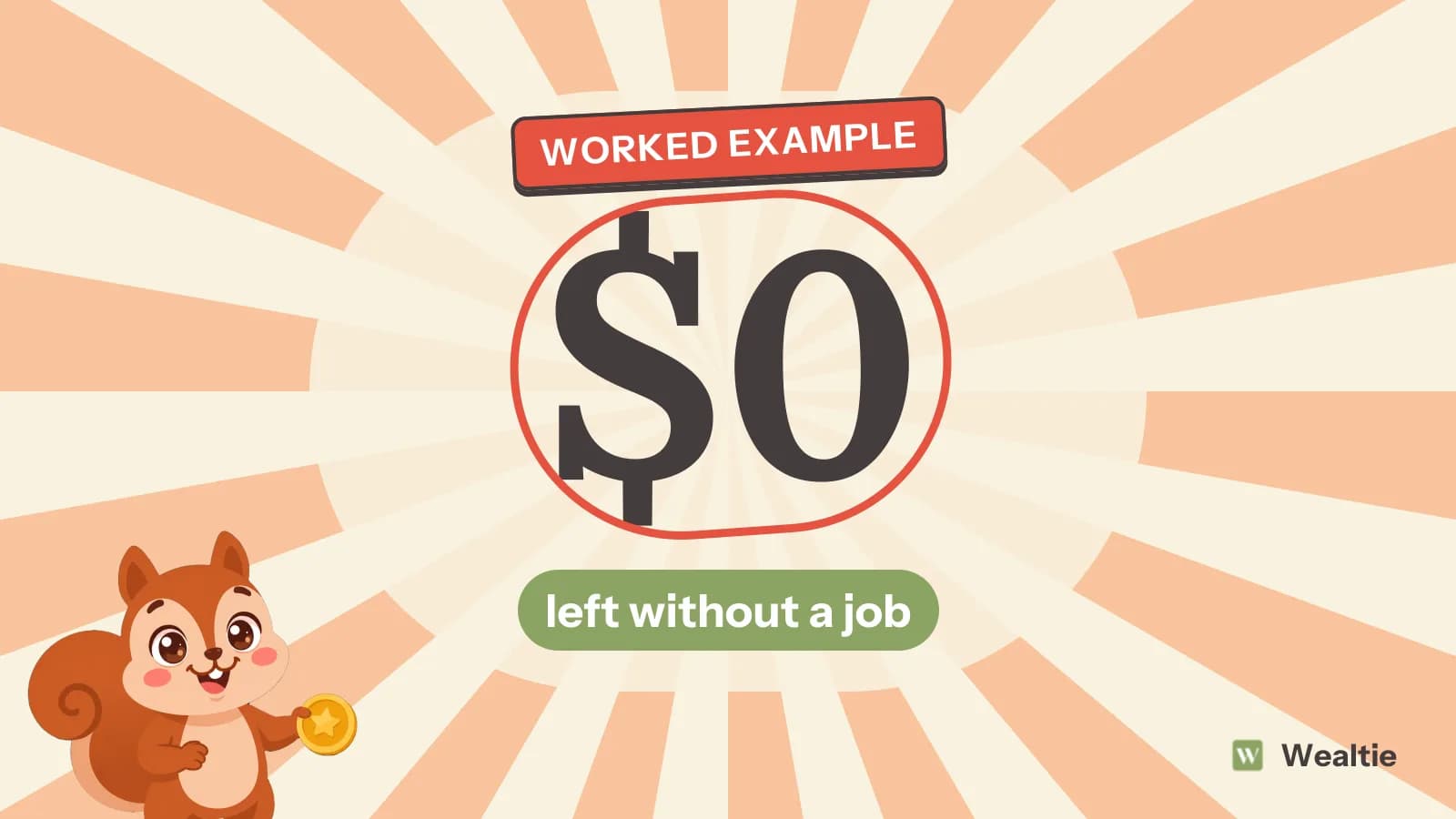
- A zero-based budget assigns every dollar of take-home pay to a bill, a spending category, savings or a debt payment until the amount left without a job is zero.
- Savings and extra debt payments are jobs too, so zero means nothing is unassigned, not that your account is empty.
- Assign the fixed bills first, then savings, then flexible spending, and put whatever remains in a buffer line.
- When a category runs out mid-month, move money from another category so the total still comes to zero.
- It takes more setup than the 50/30/20 rule, a number for every category instead of three percentages, and shows exactly which category went over.
What is zero-based budgeting?
A zero-based budget gives every dollar of your take-home pay a job before the month starts, until the amount left without a job is zero.
The sum is one line: take-home pay minus every job equals zero. A job is anything the money will do this month. Rent is a job. So are groceries, a credit card payment, a transfer to savings and $100 kept for the things you'll forget.
The name comes from budgeting in companies and governments, where it means building each budget from nothing instead of copying last year's and adjusting it. Jimmy Carter ordered it across the US federal government in 1977, after using it in Georgia as governor, as a way of judging "the importance of each operation performed". At home it works the same way. Each month's budget starts from the pay you have, not from last month's numbers.
How do you make a zero-based budget?
List your take-home pay, then assign it in five passes, from the jobs that can't move to the ones that can.
- Write down the pay you're sure of this month. Take-home pay, after tax. Not the overtime you might get.
- Fill in the fixed bills. Rent, utilities, insurance, phone, subscriptions and the minimum payment on every debt.
- Give savings and extra debt payments their amount next. Before groceries and eating out, because whatever goes last gets squeezed.
- Split what's left across the flexible categories. Groceries, transport, eating out, gifts, personal spending.
- Assign the remainder until you reach zero. Put it in a buffer line for the costs you didn't list, or add it to savings.
If the jobs add up to more than your pay, cut the flexible lines first. Rent won't move this month. Eating out will.
Your first zero-based budget will be wrong in places, because nobody knows their grocery bill to the dollar. Use last month's spending for the flexible lines, if you have it. How to make a budget covers pulling those figures out of a bank statement.
A zero-based budget example on $3,000
Here's a November on $3,000 of take-home pay. Round numbers, and they work the same in pounds or euros.
| Job | Amount | Kind |
|---|---|---|
| Rent | $1,100 | Fixed |
| Utilities and phone | $170 | Fixed |
| Insurance | $120 | Fixed |
| Student loan, minimum payment | $150 | Fixed |
| Subscriptions | $40 | Fixed |
| Emergency fund transfer | $300 | Saving |
| Extra student loan payment | $100 | Debt |
| Groceries | $420 | Flexible |
| Transport | $160 | Flexible |
| Eating out | $120 | Flexible |
| Gifts, including Black Friday | $150 | Flexible |
| Personal and household | $70 | Flexible |
| Buffer | $100 | Flexible |
| Total | $3,000 | |
| Left without a job | $0 |
That's $1,580 of fixed bills, $400 of saving and extra debt payments, and $1,020 of flexible spending.
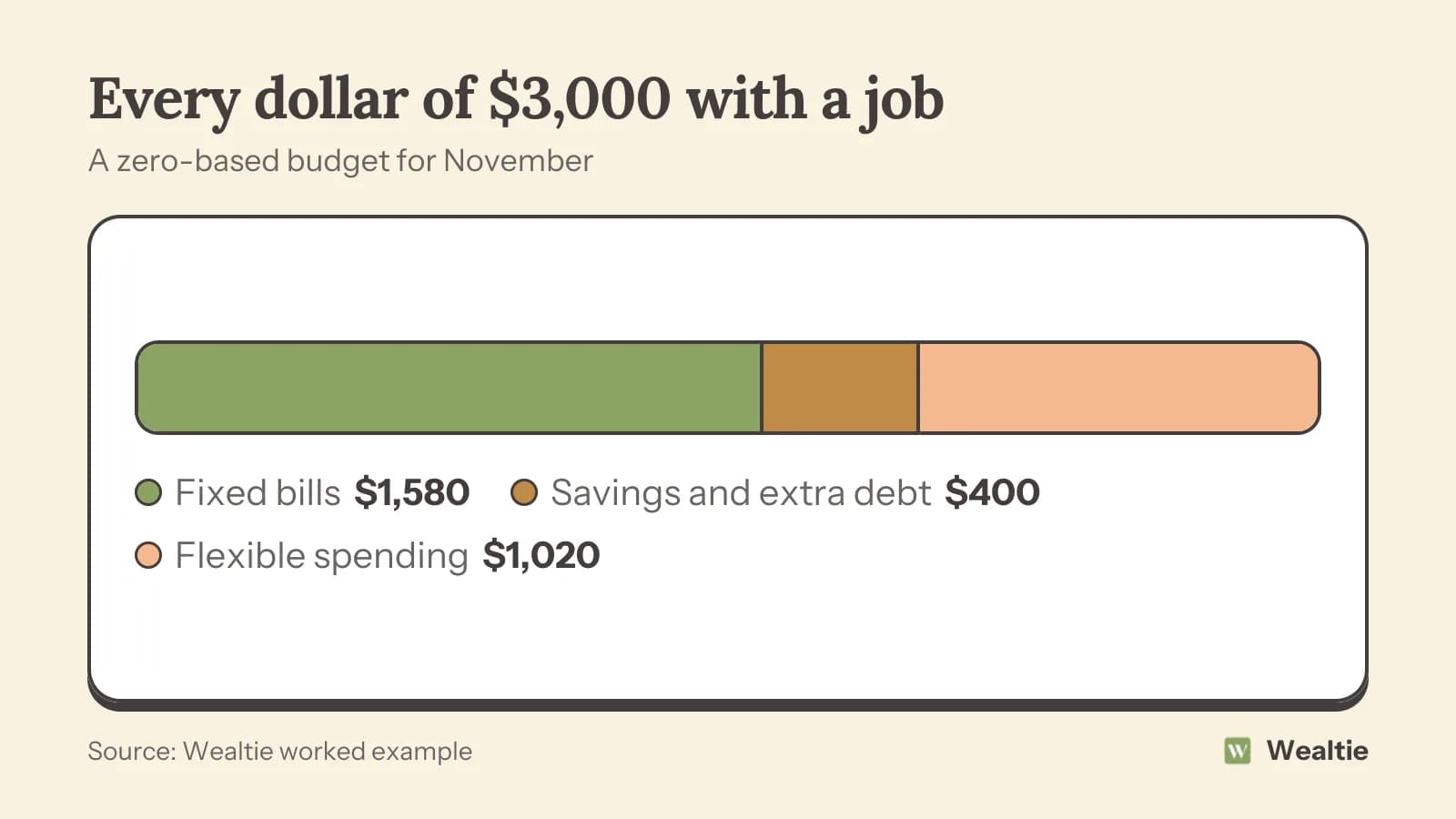
Two lines do most of the work. The $150 for gifts is there because November has Black Friday on the 27th and December's presents get bought in it. Without its own line, that spending comes out of groceries. The $100 buffer catches the costs nobody lists, like a parking fine or a prescription.
What if a category runs out before the month does?
Move money from another category, so the total still comes to zero.
Say groceries hit $420 on the 24th. You move $40 from eating out, where you've spent $70 of $120. Groceries is now $460, eating out $80, and the budget still adds up to $3,000. You've added no money. You've decided which job matters more this month.
The first two or three months take a few of these moves while the numbers settle. If the same category runs out every month, its number is wrong, so raise it next month and take the difference from somewhere else. If the overspend keeps winning, why budgets fail goes through the usual causes.
What do you do with money left over at the end of the month?
Give it a job in next month's budget, usually savings.
A zero-based budget doesn't let money sit unassigned, and that includes money you didn't spend. If November ends with $60 left in eating out, December's budget starts with $60 extra to assign. Moving it to savings is the default. Moving it to a line that's coming, like car insurance due in March, works too, and what is a sinking fund shows how to size those.
The same goes for money you didn't plan for. Overtime, a refund or a gift gets a job the day it lands, before it gets absorbed into spending.
Zero-based budgeting or the 50/30/20 rule?
Zero-based budgeting gives you a number for every category. The 50/30/20 rule gives you three.
| Zero-based budget | 50/30/20 rule | |
|---|---|---|
| Numbers to set | One per category | Three: needs, wants, savings |
| Setup each month | Every line, before the month starts | Usually nothing, until your pay changes |
| Shows you | Exactly which category is over | Whether needs, wants or savings are over |
| Fits | Tight months and paying off debt | A first budget, people who want less to track |
They also work together. Use 50/30/20 to set the totals, then split the needs and wants totals into zero-based lines. On $3,000 that's $600 for savings first, and $2,400 to split across the categories.
Does zero-based budgeting work on an irregular income?
Yes, if you only assign money you've already been paid or your lowest normal month.
Freelancers and people paid on commission can't fill in step one with a monthly figure they're sure of. Two ways round it. Budget the lowest month you'd call normal, and give anything above it a job when it lands, savings first. Or budget from the money already in your account at the start of the month, which means building a month's buffer first. The guide to how to budget on irregular income walks through both.
How do you run a zero-based budget in an app or a spreadsheet?
A spreadsheet needs one formula. An app needs one spending limit, split by category.
In a spreadsheet, put your take-home pay in one cell and every job with its amount below it. Then add a cell that takes the total of the jobs away from the pay, like =B1-SUM(B3:B15). Change the amounts until that cell shows 0. The catch is that a spreadsheet only knows what you type in, so checking where you stand on the 15th means entering every purchase by hand.
In Wealtie, the monthly budget is everything you'll spend. In the example that's $2,700: the $3,000 minus the $300 that goes to savings. Split it across your expense categories, so each line has its own share. The $300 goes from your everyday account to your savings account as a transfer, and a transfer between your own accounts never counts as spending. Then the budget tracker does the mid-month check: Budget Health warns you when your spending pace will take you over the limit, while there's still time to change course.
The Free plan has 10 categories, which fits a zero-based budget if you group a few, like utilities, phone and insurance as Bills. Pro has no limit on categories.
Questions people ask
You give every dollar of your take-home pay a job (a bill, a spending category, savings or a debt payment) until there's nothing left to assign. Take-home pay minus all the jobs equals zero.
No. Savings and extra debt payments count as jobs, so in a $3,000 example $400 goes to them. Zero is the amount left without a job, not your account balance.
Zero-based budgeting is good if you'll set it up before each month and move money between categories when one runs out. The cost is time: a number for every category instead of the three percentages of the 50/30/20 rule.
Put your take-home pay in one cell, list every job with its amount below it, and add a cell that subtracts the total of the jobs from the pay, like =B1-SUM(B3:B15). Change the amounts until that cell shows 0.
Companies and governments use it to build each budget from nothing instead of adjusting last year's figures, so every cost has to be justified again. Jimmy Carter ordered it across the US federal government in 1977, after using it in Georgia.
Sources
- Memorandum for the Heads of Executive Departments and Agencies on Zero-Base Budgeting for the Fiscal Year 1979 Budget (February 14, 1977) · The American Presidency Project, UC Santa Barbara · checked 24 October 2026
This article is general information, not financial, tax or legal advice. Your situation is your own; check the numbers that apply to you before you act on them.