Budgeting: How to stop living paycheck to paycheck, one month at a time
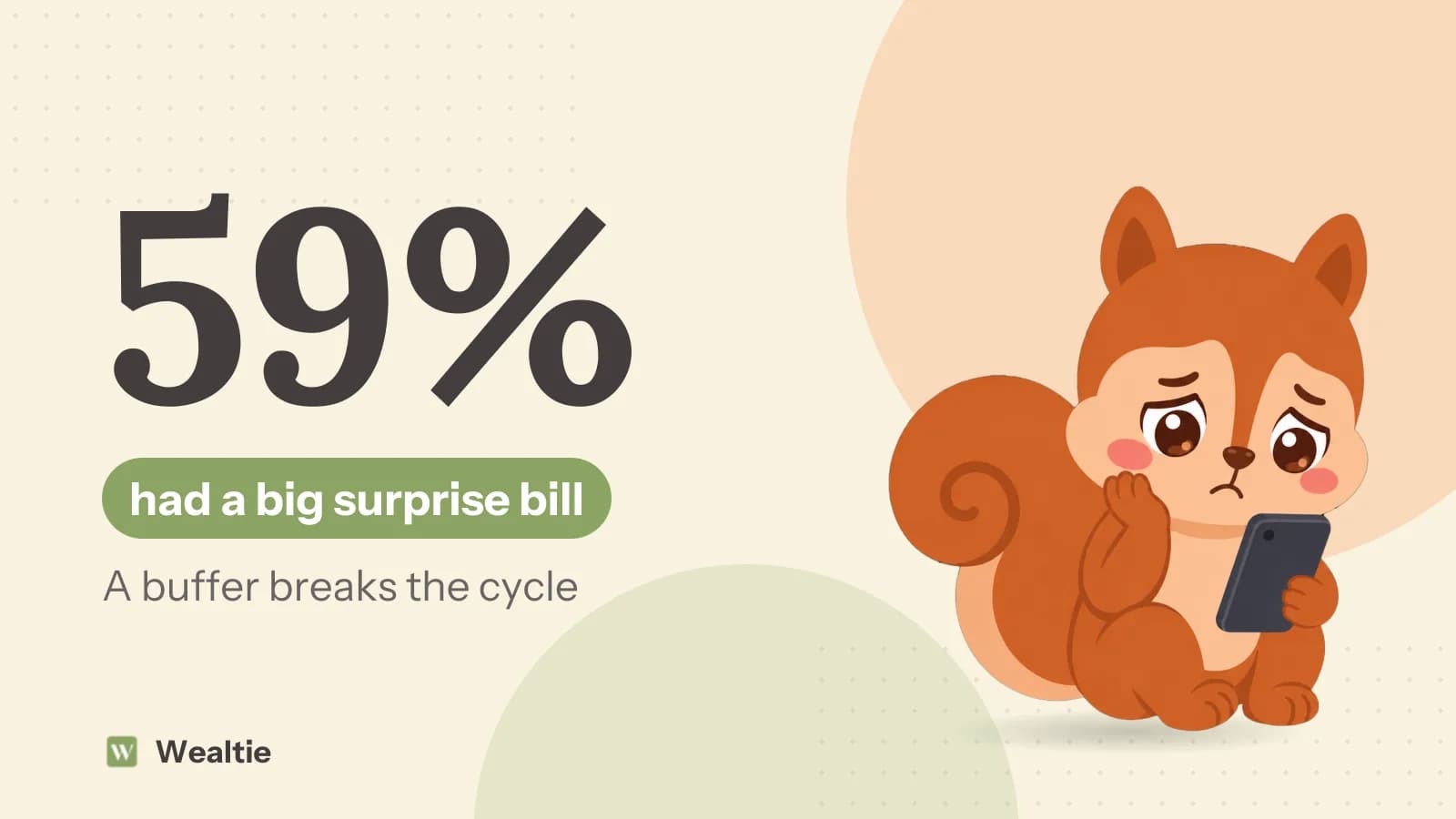
To stop living paycheck to paycheck, find the week your money runs out and why, then build a small buffer so this month's bills aren't waiting on this month's pay. In the Fed's 2025 survey, 59% of adults had a major unexpected expense in a year, so the buffer is what breaks the cycle, not a tighter budget alone.
 By Wealtie Team · 3 min read
Key takeaways
- Living paycheck to paycheck usually means bills and pay arrive at the wrong times, and one surprise wipes out the margin.
- In the Federal Reserve's 2025 survey, 59% of adults had at least one major unexpected expense in the prior year, most often a car repair.
- 16% of adults didn't pay all their bills in the prior month, in the same survey.
- A first buffer of $500, then one month of spending, turns surprises into withdrawals instead of debt.
- Moving bill due dates, cutting fees and planning for yearly costs fix most of the squeeze before any spending cuts.
How do you stop living paycheck to paycheck?
Find where the month runs short and why, build a small buffer, and fix the timing and the surprises before cutting anything else. The buffer is what breaks the cycle.
Living paycheck to paycheck means every payday is spoken for before it arrives, and one unexpected cost turns into a late bill or a card balance. It's common. In the Federal Reserve's 2025 household survey, 16% of adults hadn't paid all their bills in the prior month.
Why does the money run out before payday?
Usually one of three reasons, often all three together:
- Timing. Big bills cluster just before payday, or the first half of the month spends faster than the second can afford.
- Surprises. In the same survey, 59% of adults had at least one major unexpected expense in the prior year. The most common was a car repair or replacement (30% of adults), then a home or appliance repair (22%) and a medical bill (21%).
- No margin. Spending matches income exactly, so there's nothing to absorb either of the above.
Track one full month, payday to payday, and write down the date the account first goes near zero. That date tells you which of the three it is.
Step 1: fix the timing
Move bill due dates to just after payday, so money arrives before it leaves.
Here's a worked example in round numbers, the same in any currency. Pay of 2,800 lands on the 25th. Rent of 1,100 leaves on the 1st, the car payment on the 5th, and the card minimum on the 20th. By the 20th, the card payment meets an empty account. Moving that due date to the 28th means it's paid from fresh pay instead of the last of the old.
Most phone, card, insurance and utility providers let you change a due date. It costs nothing and often fixes the worst week of the month.
Step 2: build a $500 buffer
Then one month of spending. A buffer turns a surprise into a withdrawal instead of a late fee or a card balance.
$500 covers many common emergencies. Get there with a small fixed transfer on payday, even $10 or $20 a week, plus part of any windfall: a tax refund, overtime, a gift. Keep it in a separate savings account so it isn't spent by accident.
Once you have $500, keep going until the buffer equals a month's spending. At that point, this month's bills can be paid from last month's pay, and payday stops being a deadline. In the same Fed survey, 63% of adults said they could cover a $400 emergency with cash or its equivalent; the buffer is how you join them.
Step 3: plan for the surprises that aren't really surprises
Car repairs, dental bills, birthdays and yearly subscriptions happen every year. Only the date is a surprise.
Add up last year's irregular costs and divide by 12. Put that amount aside each month in a sinking fund. When the car needs tyres, the money is there, and the buffer stays untouched.
Step 4: cut fees before anything else
Overdraft fees, late fees, monthly account fees and interest on carried card balances are money spent on nothing. Removing them frees up cash without changing how you live.
Set payment reminders, switch to an account without a monthly fee, and pay more than the minimum on any card balance. Then look at the categories that change month to month. How to stop overspending goes through the usual leaks.
What if there's nothing left to cut?
Then the problem is income, not spending, and no budgeting method fixes that alone. Check what benefits, credits or assistance you might qualify for, look at extra hours or a pay rise, and keep the small buffer going even if it's slow. Ten a week is still 520 by the end of the year, and that's most of a car repair.
How do you see the squeeze coming?
Check your spending pace against the days left until payday, not just the end of the month.
The free payday forecast calculator shows your spending pace, projected total and the daily amount left until payday, with no sign-up. In Wealtie, your monthly budget and Budget Health warn you mid-month if your pace will take you over, early enough to slow down before the account runs dry.
Questions people ask
Find where the month runs short, build a $500 buffer, then one month of spending, so bills are paid from money you already have. Move due dates to after payday and plan for yearly costs with small monthly amounts.
Usually because big bills cluster early in the month, spending runs ahead in the first two weeks, and an irregular cost lands without a plan. Tracking one month shows which of these it is.
Start with $500, which covers many common surprises. Then build to one month of spending, so this month's bills are paid from last month's pay.
Common. In the Fed's 2025 survey, 16% of adults hadn't paid all their bills in the prior month, and 59% had a major unexpected expense in the prior year.
It's harder, and sometimes the only fix is more income. But small steps help: removing fees, matching bills to paydays, and saving even $10 a week into a buffer.
Sources
- Economic Well-Being of U.S. Households in 2025: Fact Sheet · Board of Governors of the Federal Reserve System · checked 1 November 2026
This article is general information, not financial, tax or legal advice. Your situation is your own; check the numbers that apply to you before you act on them.