Budgeting: Why most budgets fail, and the fix for each
Most budgets fail because they're written for a typical month, and typical months are rarer than they look: 59% of US adults had a major unexpected expense in the past year, and 30% had income that varied. The fix is a budget with room for both, checked while the month can still change.
 By Wealtie Team · 4 min read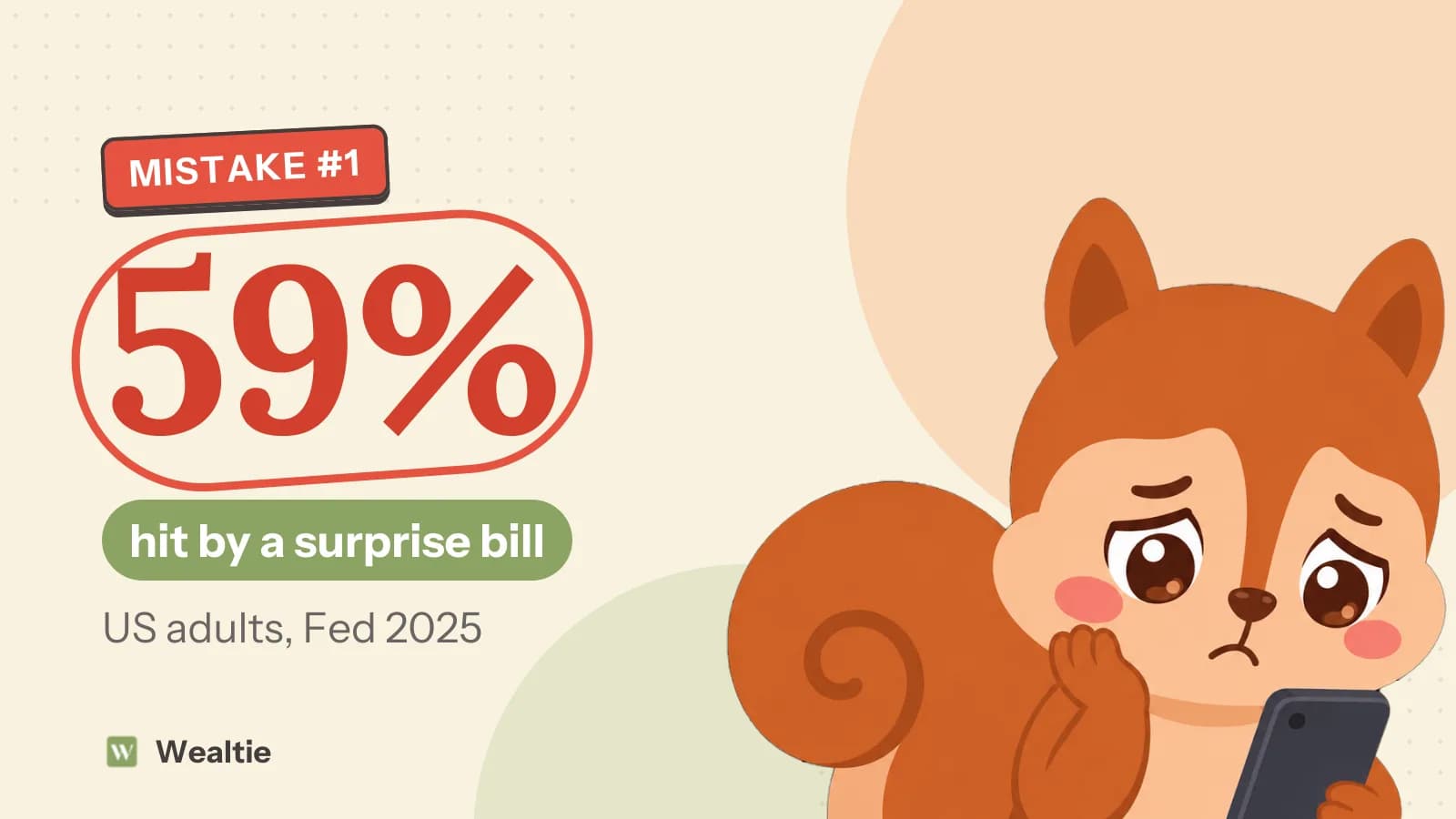
Key takeaways
- In the Federal Reserve's 2025 survey, 59% of US adults had at least one major unexpected expense in the prior 12 months, most often a vehicle repair (30%).
- The typical cost of a major car, home or medical surprise was $1,000 to $1,999, which a budget can cover at roughly 85 to 165 a month.
- 30% of US adults had income that varied at least occasionally in 2025, and 11% struggled to pay bills because of it.
- A budget checked only at the end of the month can't change anything; a mid-month check of the spending pace can.
- A month over budget is information about the number, not a reason to stop budgeting.
Why do most budgets fail?
Most budgets fail for one of five reasons, and each has a specific fix. None of them is a lack of willpower.
| Mistake | What it looks like | The fix |
|---|---|---|
| No room for surprises | A car repair wrecks the month | A monthly line for the unexpected |
| Numbers from memory | Every category runs over in week three | Start from what you spent last month |
| Checking at the end | You find out on the 31st | Check the pace mid-month |
| Assuming steady income | A slow month breaks the plan | Budget on a low month |
| Quitting after one bad month | The budget is gone by month two | Change the number, keep the habit |
Mistake 1: is there a line for things you didn't plan?
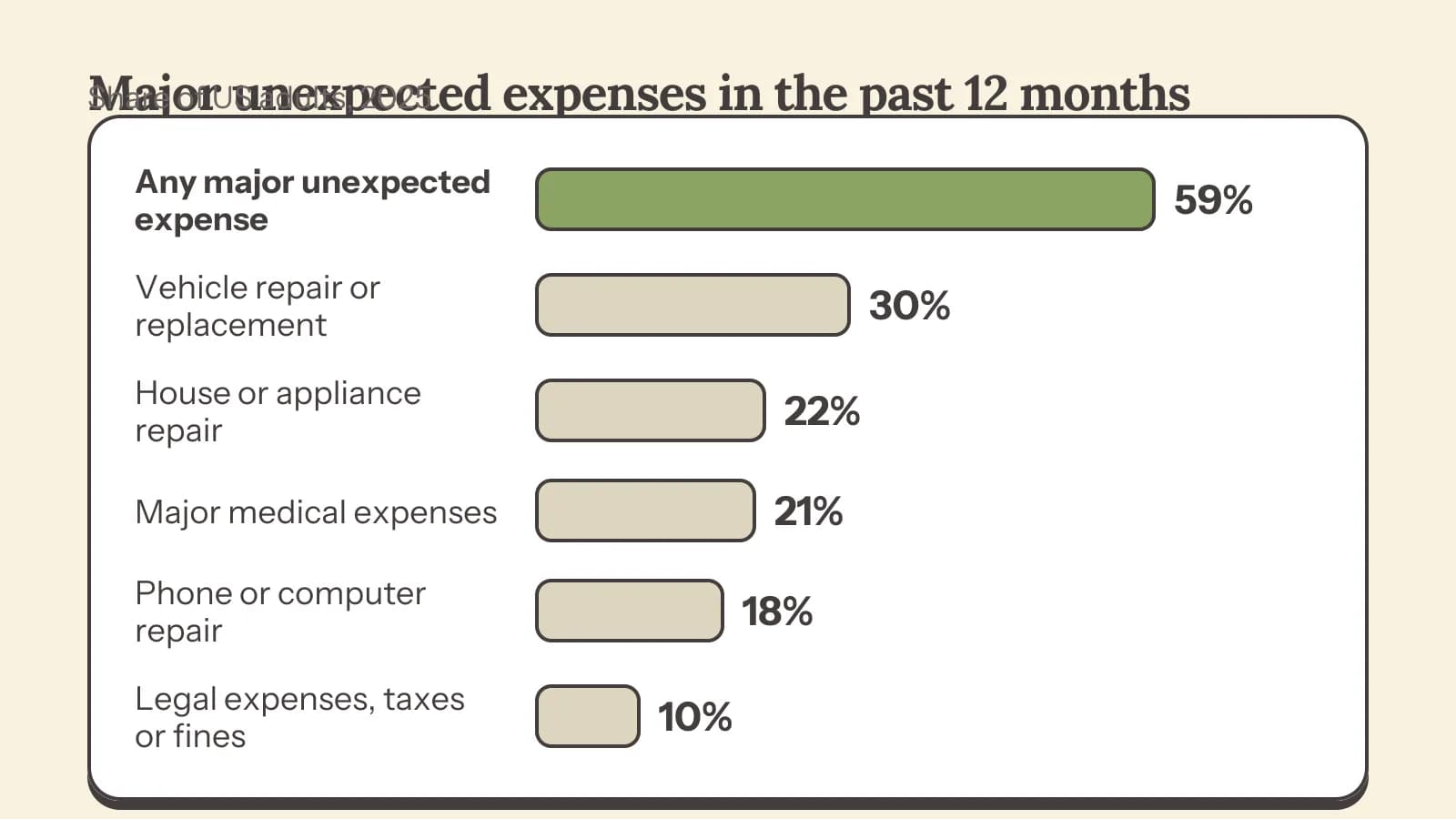
Most first budgets have no line for the unexpected, and the unexpected is common. In the Federal Reserve's survey of 2025, 59% of US adults had at least one major unexpected expense in the prior 12 months.
| Major unexpected expense, prior 12 months (2025) | Share of US adults |
|---|---|
| Any major unexpected expense | 59% |
| Vehicle repair or replacement | 30% |
| House or appliance repair | 22% |
| Major medical expenses | 21% |
| Phone or computer repair or replacement | 18% |
| Legal expenses, taxes or fines | 10% |
The car, home and medical ones had a median cost of $1,000 to $1,999. Spread over a year, one of those is about 85 to 165 a month. Without that line, the first repair of the year takes its money from groceries and rent.
The fix is two lines, not one. Bills you know about but don't pay monthly (insurance, car tax, a yearly subscription) go in a sinking fund, divided by the months until they're due. The ones you can't date go to an emergency fund, and one month of income is the first target worth hitting.
Mistake 2: did the numbers come from memory?
A budget written from memory underestimates the small, frequent spending, and that's where it breaks. Rent and the phone bill are easy to remember. Lunches, top-ups and delivery fees aren't, and they're the categories that run out by week three.
The fix is to start from what you spent, not what you think you spend. If you've logged a month, use its totals. If you haven't, log one month before you set limits; an expense tracker that takes a few seconds per entry makes that bearable. Then set each limit a little under last month's real figure, not at the figure you'd like it to be. A grocery line that was 480 last month and gets a limit of 300 will fail by the 20th. A limit of 440 has a chance.
Mistake 3: do you only check at the end of the month?
A budget checked on the 31st can only tell you what happened. By then the money that would have fixed the month has gone on something else.
Check the pace in the middle of the month instead: what you've spent, divided by the days gone, times the days in the month. On a 2,400 budget, 1,300 spent by day 15 of 30 is a pace of about 87 a day, which ends the month at 2,600. That's 200 over, and with 15 days left there's time to fix it: the remaining 1,100 needs to last at about 73 a day. The round numbers work in any currency.
The payday forecast calculator runs that sum for you. In Wealtie, the budget forecast called Budget Health does it after every expense you log and warns you mid-month if the pace will take you over.
Mistake 4: does your budget assume the same income every month?
A budget that assumes steady income breaks the first time a month comes in short. In 2025, 30% of US adults had income that varied at least occasionally, and 11% struggled to pay their bills because of it. Among the self-employed, 58% had income that varied from month to month and 22% struggled to pay bills as a result.
The fix is to budget on a low month, not an average one. Take your lowest month of the past six or twelve and build the essential spending around that; anything above it goes to the emergency fund or next month's buffer. The full method is in the guide on how to budget on irregular income.
Mistake 5: does one bad month end the budget?
Often the budget survives the month that goes over and gets dropped in the month after, when nobody restarts it.
A month over budget tells you the number was wrong, or that something from mistake 1 turned up. Look at which category ran over and by how much. If it was a one-off, keep the limit. If the same category has gone over two months running, raise its limit and lower another one, so the total still fits your income.
Then start the next month on the 1st as usual. In Wealtie, going over resets the streak and that's the only penalty; your best streak stays on record, and the next month counts from zero. The budgeting habit page explains how the count works.
Questions people ask
Most budgets fail because they plan for a typical month with no room for surprises, use numbers from memory, and only get checked at the end of the month. Income that varies and quitting after one bad month account for most of the rest.
Very common: 59% of US adults had at least one major unexpected expense in the prior 12 months, according to the Federal Reserve's 2025 survey. The most frequent was a vehicle repair or replacement, at 30% of adults.
Budget roughly a twelfth of what one major surprise costs, which is about 85 to 165 a month at the typical $1,000 to $1,999 for a car, home or medical expense. Put it in a separate account so it doesn't get spent on ordinary things.
Check it at least once in the middle of the month, when there's still half the month left to change the outcome. A weekly look is better if your spending is uneven.
Find the category that ran over and decide whether it was a one-off or a pattern. Keep the limit for a one-off, raise it and cut elsewhere if it's happened twice, and start the next month on time.
Sources
- Economic Well-Being of U.S. Households in 2025: Economic Hardships (table 23, figure 23) · Board of Governors of the Federal Reserve System · checked 17 October 2026
- Economic Well-Being of U.S. Households in 2025: Income and Expenses · Board of Governors of the Federal Reserve System · checked 17 October 2026
- Economic Well-Being of U.S. Households in 2025: Savings and Investments · Board of Governors of the Federal Reserve System · checked 17 October 2026
- Public opinions and social trends, Great Britain: May 2026 · Office for National Statistics · checked 17 October 2026
This article is general information, not financial, tax or legal advice. Your situation is your own; check the numbers that apply to you before you act on them.