Income & freelancing: How to budget as a shift worker when your hours change
To budget as a shift worker, base your budget on your lowest regular pay, save the extra from busier rotas and plan for the costs shifts bring, like travel at odd hours and food on nights. In a worked example, pay ranges from 1,800 to 2,400 a month, and the budget is built on 1,800.
 By Wealtie Team · 3 min read
Key takeaways
- To budget as a shift worker, base your budget on your lowest regular pay.
- Save the extra from busier rotas into a buffer for quieter months.
- Plan for shift costs like taxis at night and food on long shifts.
- Track pay against your rota to catch mistakes.
Why is budgeting harder with shift work?
Shift workers, from nurses and care workers to factory, retail and hospitality staff, often have pay that changes from month to month. Rotas change, overtime comes and goes, and nights or weekends may pay more. Some months bring plenty of extra hours, and others are quiet. Shifts also bring their own costs: taxis when public transport isn't running, food on long or night shifts, and sometimes childcare at unusual hours.
A budget that assumes the same pay every month will feel tight in quiet months and leave money unplanned in busy ones. Building your budget around your lowest regular pay solves both problems.
Shift work can also make it harder to keep regular money habits. When your days off move around, there's no fixed moment for a weekly check-in, and payday might fall on a day you're asleep after nights. Choosing a money routine tied to something that happens every week, like the first day off after a run of shifts, gives you a reliable time to look at your budget. Ten minutes is enough to check your balance, log your pay and move any extra into the buffer.
It helps to keep your rota and payslips together, so checking one against the other takes only a few minutes.
How do you budget with changing pay?
Here's a worked example of a shift worker's pay over four months, in round numbers that work in any currency:
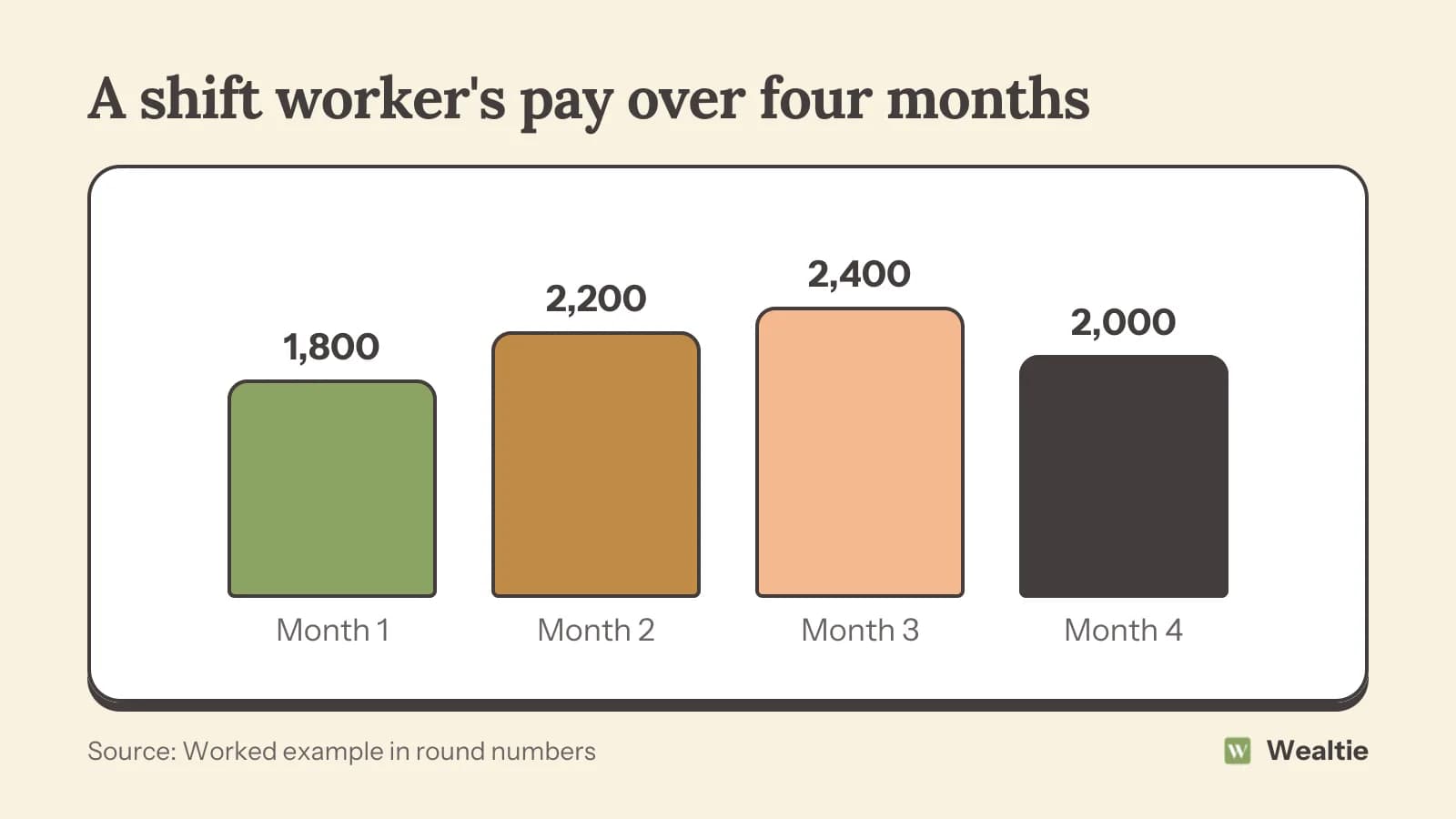
Pay ranges from 1,800 to 2,400. The budget is built on 1,800, the lowest regular month. Everything above that, 1,200 over these four months, goes into a buffer. In a quiet month, the buffer tops up pay to cover the plan. Over time, the buffer grows into an emergency fund and money for goals.
Find your baseline
Look back over the last six to twelve months of pay and find your lowest regular month. That's your baseline. If you're new to shift work, use your contracted hours without overtime.
Build the budget on the baseline
Cover essentials, savings and spending within that baseline. If it doesn't stretch, look at where to cut before relying on extra shifts.
Save the extra
When a busy month brings more pay, move the extra into a buffer straight away. Decide in advance how you'll split it, for example some to the buffer and some to a goal, so it doesn't disappear into everyday spending.
The irregular income guide covers this method in more depth.
What costs does shift work bring?
Travel at odd hours
Early starts and late finishes can mean taxis or driving instead of cheaper public transport. Budget for this, and look into car shares with colleagues on the same shifts.
Food on shift
Long shifts and nights make it tempting to buy food at work or from vending machines. Batch cooking and bringing meals saves a lot. A flask of soup or a packed dinner costs far less than a takeaway at the end of a long shift, and it's often healthier too.
Childcare
Childcare at unusual hours can cost more and be harder to arrange. Plan for it in your budget, and check whether family or friends can help on certain shifts.
Rest and recovery
Shift work can be tiring, and tiredness often leads to convenience spending, like takeaways. Planning simple meals and having a few ready in the freezer can help.
How do you keep track of shift pay?
Check each payslip against your rota. Mistakes with overtime, unsocial-hours rates and holiday pay are common, and catching them early is much easier than chasing them later. Log your pay each month so you can see patterns, like which months tend to be busy and which quiet.
Plan for holidays and quiet seasons
Some jobs have predictable quiet times, like after the holidays in retail or during summer in some services. Build up the buffer before these periods. How to budget seasonal income covers this.
If you earn tips
Many hospitality shift workers earn tips as well as wages. How to budget with tips covers handling that part of your income.
How do you budget as a shift worker in Wealtie?
Log each payslip in the income tracker to see how your pay changes month to month. Set a monthly budget based on your baseline, and keep shift costs like taxis and food in their own expense categories. Add rent and bills as recurring transactions, so they log themselves on their date.
Questions people ask
Base your budget on your lowest regular monthly pay, save the extra from busier months into a buffer and plan for shift costs like night travel and food.
A budget built on your lowest regular pay, so it works in quiet months. In a worked example, pay ranges from 1,800 to 2,400 and the budget is built on 1,800.
Travel at odd hours, food on long or night shifts, childcare at unusual times and convenience spending when you're tired.
Compare each payslip with your rota, checking overtime, unsocial-hours rates and holiday pay.
This article is general information, not financial, tax or legal advice. Your situation is your own; check the numbers that apply to you before you act on them.