Budgeting: How to save money on groceries: 9 changes and what each one saves
The quickest way to save money on groceries is to set a weekly grocery number, plan four or five dinners before you shop, and buy store brands. For a family of four, moving from USDA's moderate food plan to its thrifty one saves $365 a month on the same healthy diet.
 By Wealtie Team · 5 min read
Key takeaways
- USDA's September 2026 food plans put the gap between a moderate and a thrifty grocery budget at $365 a month for a family of four and $178 for a couple.
- A weekly grocery number, checked at the till, does more than any single coupon because it limits every shop, not one.
- US grocery prices rose 1.8% in the 12 months to September 2026, but beef rose 3.5% and eggs fell 20.6%, so what you swap matters.
- Eating out prices rose 3.5% over the same year, faster than groceries, so each meal moved from a restaurant to your kitchen saves more than it did.
- Planning four or five dinners before you shop, and using what's in the fridge first, cuts both impulse buys and food you throw away.
How much can you save on groceries?
Up to $365 a month for a family of four and $178 for a couple, going by the gap between USDA's moderate and thrifty food plans in September 2026.
The U.S. Department of Agriculture prices healthy, home-cooked grocery baskets every month at four levels. The moderate plan is ordinary supermarket shopping. The thrifty plan covers the same nutrition with more staples, fewer convenience foods and cheaper cuts. The difference between the two is a fair measure of what changing how you shop can save, without eating worse.
| Household | Moderate plan | Thrifty plan | Monthly gap | Yearly gap |
|---|---|---|---|---|
| One woman, 20–50 | $404 | $305 | $99 | $1,188 |
| One man, 20–50 | $478 | $383 | $95 | $1,140 |
| Couple, both 20–50 | $808 | $630 | $178 | $2,136 |
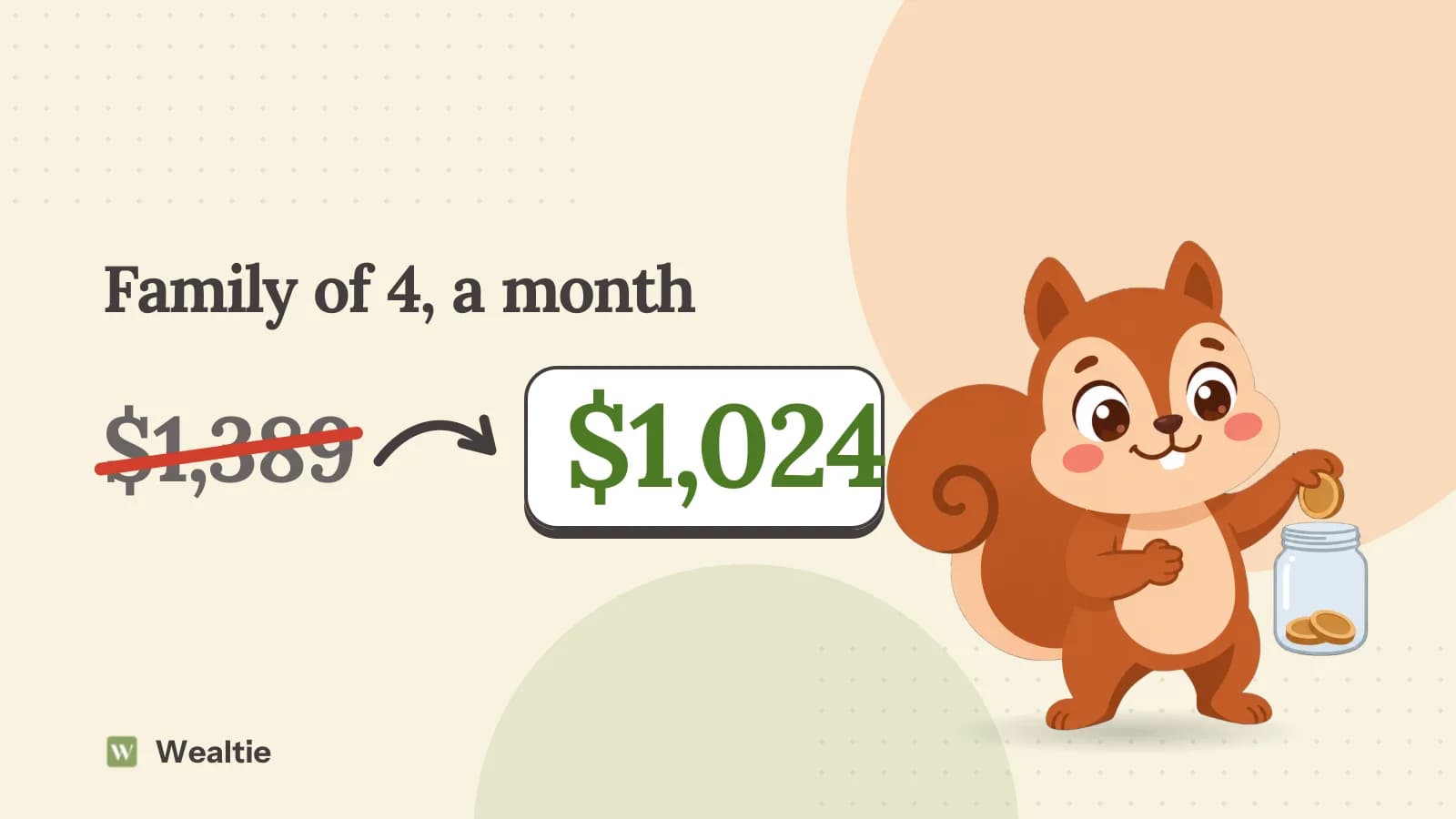
| Two adults, children of 6–8 and 9–11 | $1,389 | $1,024 | $365 | $4,380 |
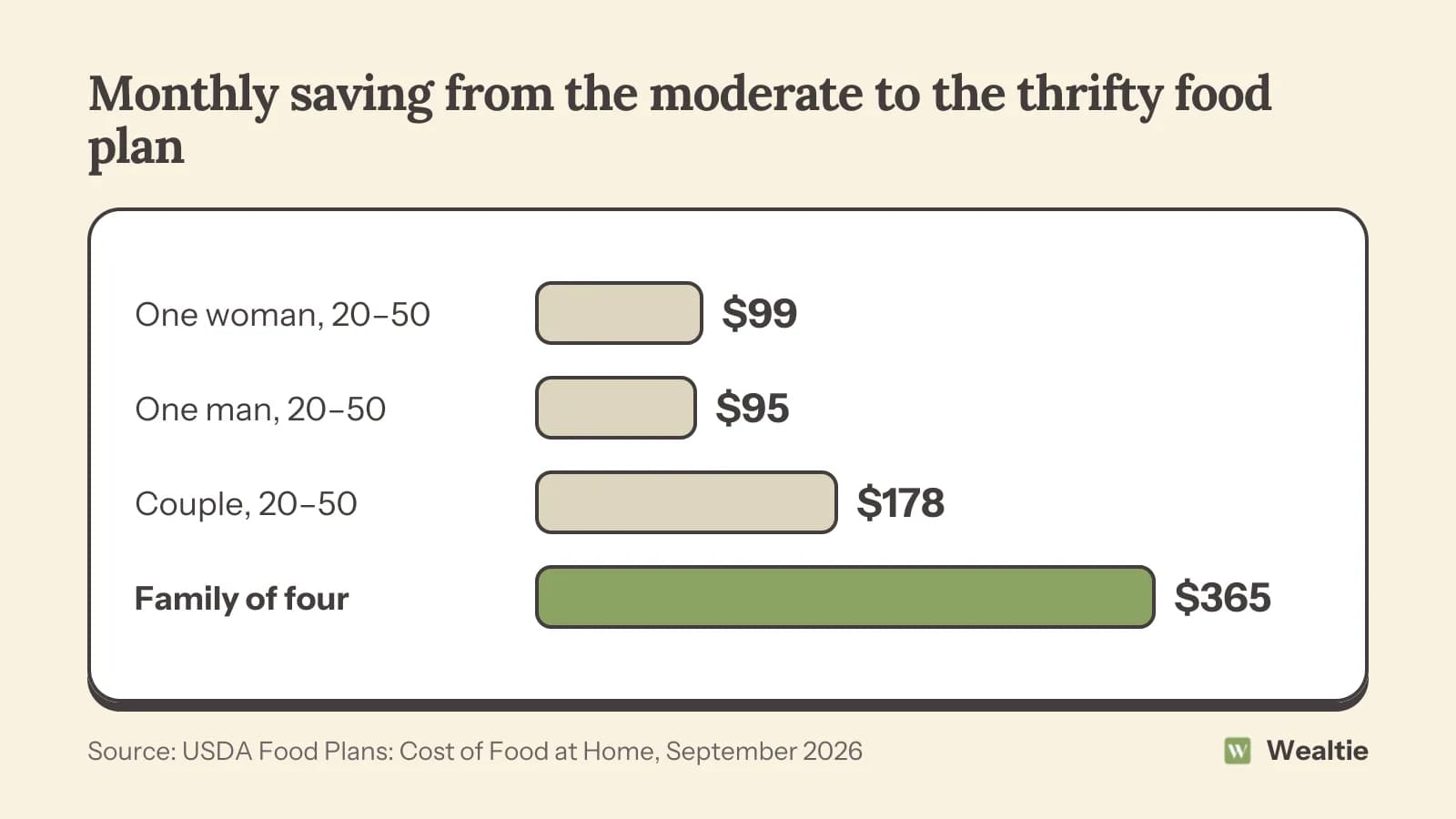
The household figures include USDA's adjustment for household size, from the moderate-cost table. You won't close the whole gap in a month, and you don't have to. Half of it, for a family of four, is about $180 a month.
How to save money on groceries: 9 changes
Start with the first two. They change every shop, and the rest are easier once you have a number to aim at.
1. Set a weekly grocery number
Pick a weekly amount and check it at every shop. It limits every trip, which no single coupon does.
Take your monthly grocery budget and divide by 4.33. If you don't have one yet, how much to spend on groceries has USDA's figures by household. At 190 a week, the second shop of the week gets what's left after the first, and you know before you reach the till.
2. Plan four or five dinners before you shop
Write down the next few dinners, check what's already in the fridge, and shop for the gaps.
Four or five is enough. A full month of meal plans is the kind of thing that lasts a week. Leave a night or two for leftovers and the one thing you'll cook on a whim. Then shop with the list. The items that aren't on it are where most grocery budgets leak.
3. Use what you have before you buy more
Cook from the fridge and freezer first, so food doesn't go off while you buy more of it.
Before each shop, look at what needs eating in the next two days and build a dinner around it. Freeze bread, meat and leftovers you won't get to. Food thrown away is money spent twice: once on the food, once on what replaces it.
4. Switch to what got cheaper this year
Prices didn't move evenly. Over the 12 months to September 2026, US grocery prices rose 1.8% overall, but some foods rose much more and some fell, according to the Bureau of Labor Statistics.
| Food group | Price change, Sep 2025 to Sep 2026 |
|---|---|
| Eggs | −20.6% |
| Dairy | −0.7% |
| All food at home | +1.8% |
| Beef and veal | +3.5% |
| Fruits and vegetables | +3.7% |
| Food away from home | +3.5% |
Eggs are a fifth cheaper than a year ago, which makes them one of the cheapest proteins on the shelf again. Beef went the other way. Swapping one or two beef dinners a week for eggs, beans, lentils or chicken thighs is the kind of change the thrifty plan is built on. For fruit and vegetables, frozen and seasonal produce cost less than out-of-season fresh, with the same nutrition.
5. Buy store brands and read the unit price
Store brands are usually cheaper, and the unit price on the shelf label tells you by how much.
The unit price is the cost per kilo, litre or 100 grams, printed small on the shelf label. It's the only fair comparison between a big pack and a small one, or a store brand and a name brand. Staples like flour, rice, pasta, tinned tomatoes, oats and frozen vegetables are where store brands save the most for the least difference.
6. Buy in bulk only what you'll use
Bulk is cheaper per unit, but only if none of it goes in the bin.
Rice, pasta, oats, dried beans, frozen vegetables and toilet paper are good bulk buys. Fresh fruit, bread and dairy usually aren't, unless you'll freeze them. A big pack of something that goes off before you finish it costs more than the small one.
7. Move one more meal a week from eating out to your kitchen
Eating out costs more than groceries and its prices are rising faster: 3.5% over the year to September 2026, against 1.8% for food at home.
The average US household spent $4,142 on food away from home in 2025, according to the BLS Consumer Expenditure Survey. You don't need to stop. Packing lunch twice a week, or cooking on the night you'd usually order in, moves money from the most expensive food category to the cheapest. Count takeaway in its own category, not groceries, so you can see which one moved.
8. Shop less often
Every trip to the shop is a chance to buy something that isn't on the list. One planned shop a week, with a small top-up for milk and bread, costs less than four unplanned ones.
If you shop online, the basket is the list. Order for the week, and look at the total before you check out, not after.
9. Track every shop for a month
You can't cut what you can't see. Log each shop for a month and the pattern shows up: the extra midweek trip, the snacks, the part of the bill that was never on the list.
Where does the grocery money go?
A month of logged shops answers it better than any list of tips. Look at which week ran over and what was in the basket that week.
Wealtie is an expense tracker where you log a shop in a few taps, cash included, with groceries as their own category in your monthly budget. On Pro, the receipt scanner reads each line of a receipt, so you can save a shop as one expense or split it line by line and see exactly where the money went. If groceries are one of several categories running over, how to stop overspending covers the rest.
Questions people ask
Set a weekly grocery number and shop against it, plan four or five dinners before you go, and switch to store brands. Those three changes work from the first shop, without coupons or extra trips.
Up to $365 a month for a family of four, going by the gap between USDA's moderate and thrifty food plans in September 2026. A couple's gap is $178 a month. Both plans are a healthy diet cooked at home.
Per unit, usually yes, but only for things you'll use before they go off. Compare the unit price on the shelf label, and buy staples like rice, pasta, oats and frozen vegetables in bulk, not fresh food.
Usually, and for staples like flour, rice, canned tomatoes and frozen vegetables the product is often similar. Check the unit price on the shelf label to compare a store brand with the name brand directly.
Cook at home from staples: beans, lentils, eggs, oats, rice, frozen vegetables and seasonal fruit. That's the basis of USDA's thrifty plan, which cost $1,024 a month for a family of four in September 2026.
Sources
- Official USDA Thrifty Food Plan: U.S. Average, September 2026 · USDA Food and Nutrition Administration · checked 1 November 2026
- Official USDA Food Plans: Cost of Food at Home at Three Levels, U.S. Average, September 2026 · USDA Food and Nutrition Administration · checked 1 November 2026
- Consumer Price Index – September 2026 (Table 2) · U.S. Bureau of Labor Statistics · checked 1 November 2026
- Consumer Expenditures – 2025 · U.S. Bureau of Labor Statistics · checked 1 November 2026
- Family spending workbook 1: detailed expenditure and trends, FYE 2025 (table A1) · Office for National Statistics · checked 1 November 2026
This article is general information, not financial, tax or legal advice. Your situation is your own; check the numbers that apply to you before you act on them.