Income & freelancing: How to budget as a landlord so the rent covers every cost
To budget as a landlord, treat the rent as income and set aside money for the mortgage, insurance, repairs, empty months and tax before you spend any of it. In a worked example, rent of 1,000 a month leaves about 200 once every cost and pot is covered.
 By Wealtie Team · 3 min read

Key takeaways
- To budget as a landlord, treat rent as income and pay every cost out of it first.
- Set aside pots for repairs, empty months and tax, since these come in lumps.
- In a worked example, rent of 1,000 a month leaves about 200 after costs and pots.
- Keep the property's money separate from your own so you can see whether it pays.
How do you budget as a landlord?
Start by treating the property like a small business. The rent is its income, and the mortgage, insurance, repairs, fees and tax are its costs. The budget's job is to make sure every cost is covered before any money comes to you. Many new landlords look at the rent and the mortgage and assume the difference is profit. It isn't, because repairs, empty months and tax arrive later, often in large amounts.
Rules for landlords, from tax to safety checks and deposits, vary a lot by country and even by city, so check what applies where your property is.
What costs does a landlord have?
The costs fall into two groups: regular ones you know in advance, and irregular ones you have to save for.
Regular costs
- Mortgage or loan payments on the property
- Landlord insurance
- Letting agent or management fees, if you use one
- Service charges or ground rent for some flats
- Any bills you've agreed to pay, like water or internet
Irregular costs
- Repairs, from a dripping tap to a new boiler
- Months when the property is empty between tenants
- Safety checks and certificates, where they're required
- Redecorating and replacing furniture or appliances
- Tax on the rental profit
The irregular costs are the ones that catch landlords out, because they can be large and they rarely arrive at a convenient time.
How much of the rent should you set aside?
Here's a worked example for a property let at 1,000 a month, in round numbers that work in any currency:
| Item | Each month |
|---|---|
| Mortgage | 450 |
| Tax pot | 120 |
| Repairs pot | 100 |
| Insurance and fees | 80 |
| Empty months pot | 50 |
| Left over | 200 |
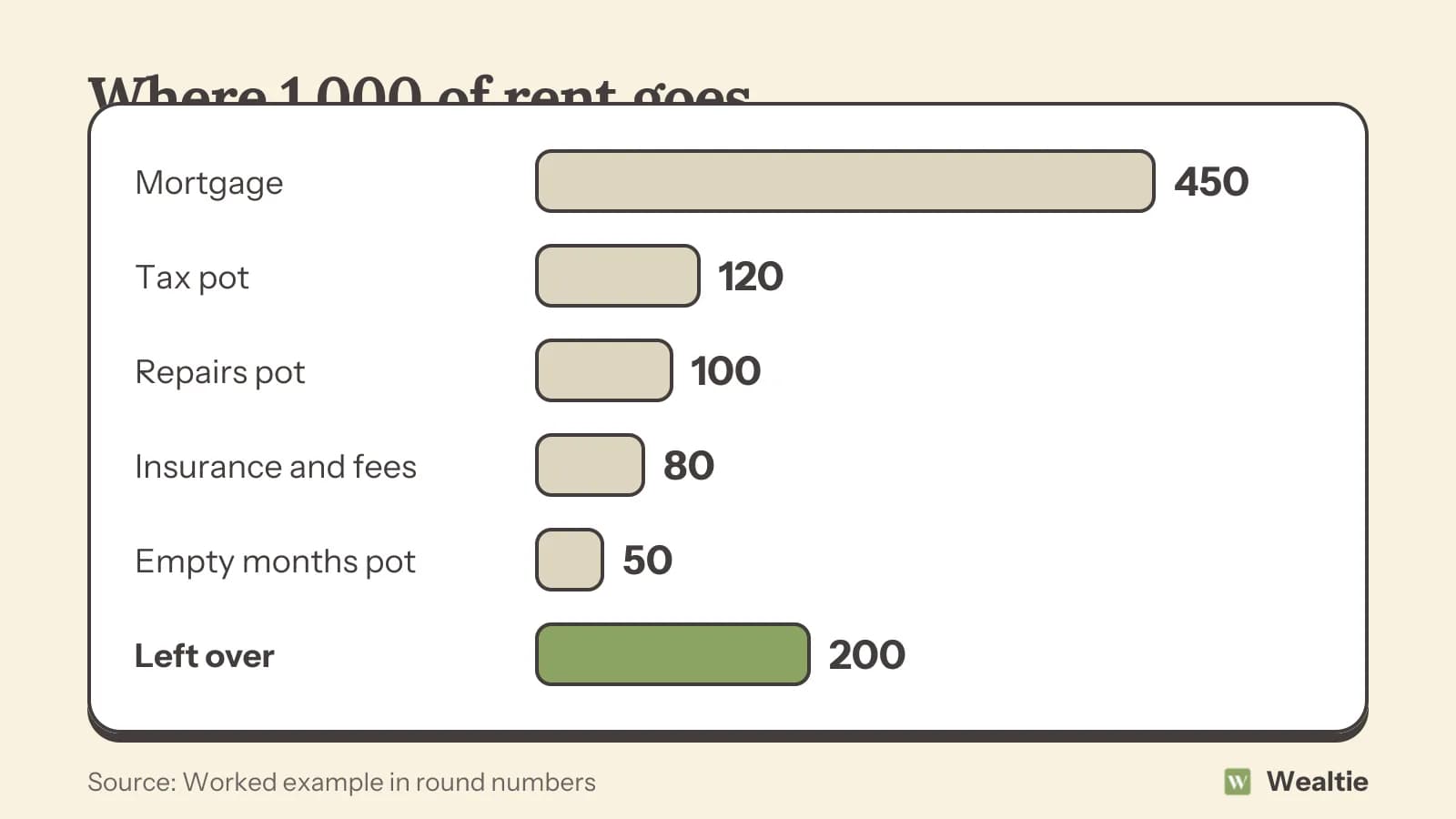
So only about a fifth of the rent is left once everything is covered. Your own split depends on your mortgage, the age of the property and local tax rules. An older property usually needs a bigger repairs pot. A property in an area where tenants move often needs a bigger empty months pot. If one month a year goes without rent, that's about 80 a month to put aside on rent of 1,000.
Why do you need savings pots?
Because big costs don't arrive on a schedule. A repairs pot of 100 a month builds to 1,200 over a year, enough for most small jobs and a start on a big one. When the boiler breaks or a tenant leaves, the money is already there, and you don't have to cover it from your own salary or a credit card.
This works like a sinking fund: a small amount set aside each month for a cost you know will come. The home maintenance budget covers how much to expect for upkeep. Keep a separate tax pot too, since a bill for a whole year's tax can be large if you haven't saved for it.
Should you keep a separate account for the property?
Yes, if you can. Paying the rent into its own account and paying the property's costs from it makes it easy to see whether the property pays for itself. It also makes tax time much simpler, because every rental payment and cost is in one place. Move only what's left over to your own account, and only once the pots are topped up.
Check the numbers each year
Once a year, add up the rent you received and every cost you paid. If the property only breaks even, or costs you money, it's worth looking at the rent, the mortgage deal and the fees you pay. A small rise in rent at renewal, or a cheaper insurance quote, can make a real difference over a year. Check the pots at the same time. If the repairs pot keeps running dry, raise the monthly amount, and if it keeps growing untouched, you can ease it back.
What if you rent out a room instead?
Renting a room in your own home is simpler, with fewer costs and often different tax rules. How to earn from renting out a room covers how to budget for it.
How do you track a rental property in Wealtie?
Add an account for the property and record transfers to and from your own account, which aren't counted as spending. Log the rent in the income tracker, add the mortgage and insurance as recurring transactions so they log themselves on their date, and put repairs and fees in their own expense categories, so you can see what the property earns after its costs.
Questions people ask
Treat the rent as income, pay the mortgage and regular costs from it, and set aside pots for repairs, empty months and tax before taking any profit.
In a worked example, 100 a month on rent of 1,000, which builds to 1,200 a year. Older properties need more.
A separate account makes it easy to see whether the property pays for itself and makes tax much simpler.
In a worked example, about 200 is left from rent of 1,000 once every cost and pot is covered. Your own figure depends on your costs.
This article is general information, not financial, tax or legal advice. Your situation is your own; check the numbers that apply to you before you act on them.