Budgeting: How much should your Christmas budget be? Averages and a method
Your Christmas budget should be what you can pay in full by January: money already set aside plus what you can free up from November's and December's budgets. For scale, Americans planned to spend an average of $1,007 on gifts in Gallup's October 2025 survey, before food and decorations.
 By Wealtie Team · 5 min read
Key takeaways
- A Christmas budget is the amount you can pay in full by the January statement: money already saved plus what you can free up from November's and December's budgets.
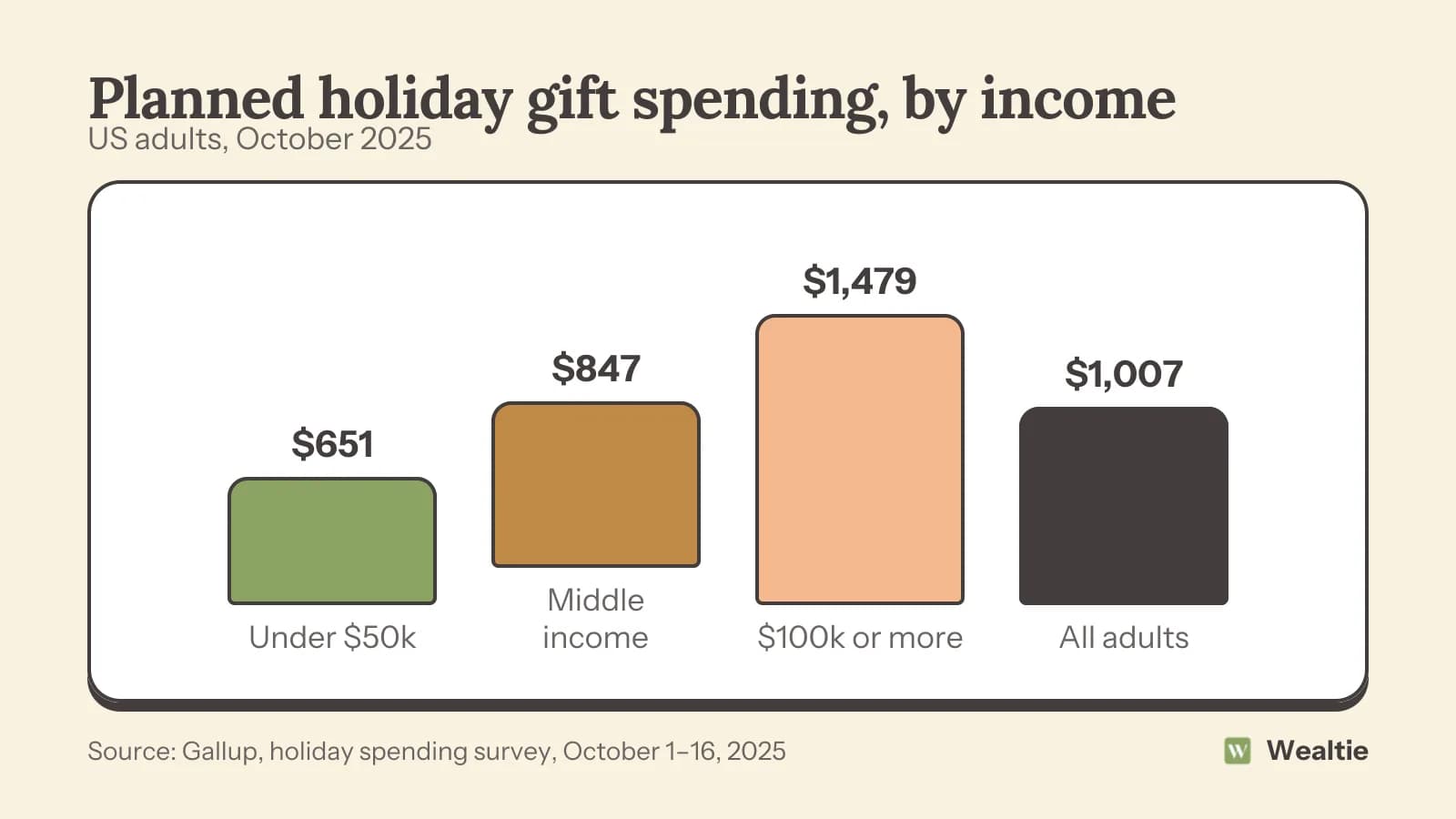
- Americans planned to spend $1,007 on holiday gifts on average in October 2025, from $651 in households under $50,000 to $1,479 at $100,000 or more.
- Food, travel, wrapping and postage come on top of gifts, so give them their own lines in the budget.
- Divide the total from the top down: the closest people first, then a family limit, a name draw or one gift per household for the rest.
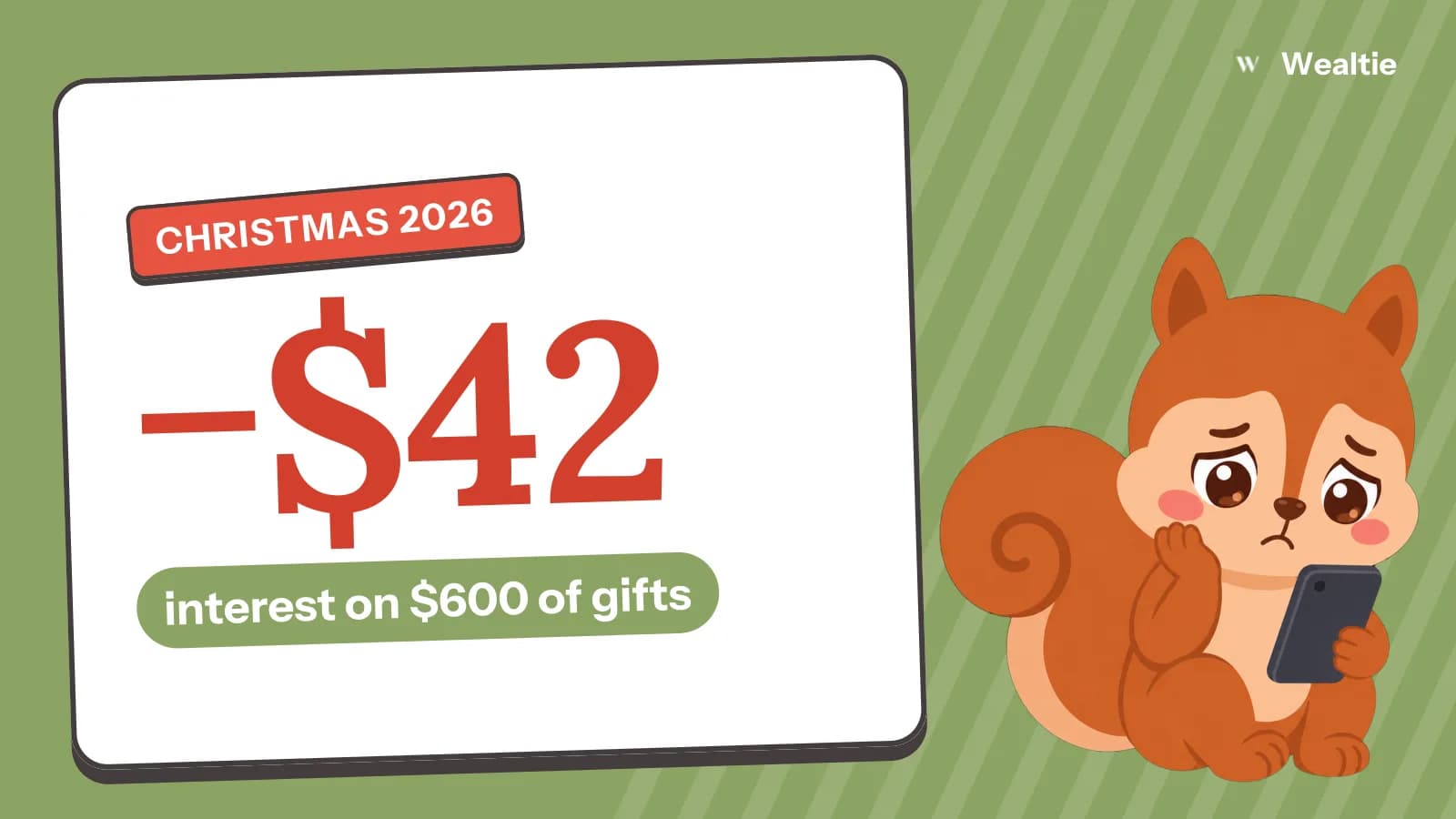
- $600 of Christmas on a credit card at 22.15% interest costs about $42 if paid off at $100 a month.
How much should your Christmas budget be?
As much as you can pay in full by the first credit card statement of January, and no more.
That number has two parts: money you've already put aside for Christmas, and what you can free up from November's and December's budgets. Add them and you have your Christmas budget. It might be $300. It might be $1,500. Whatever the national average comes to, it isn't your number, because it doesn't know your pay.
Work it out before you buy anything. Black Friday is on 27 November this year, and a deal is easier to turn down once the total is written down.
How much do people spend on Christmas?
About $1,000 on gifts alone in the US, by Americans' own estimate, and less once the season actually starts.
Every October, Gallup asks Americans how much they expect to spend on holiday gifts. In October 2025, the average was $1,007, close to the $1,014 of a year before. It depends heavily on income:
| Household income | Planned gift spending, October 2025 |
|---|---|
| Under $50,000 | $651 |
| Middle income | $847 |
| $100,000 or more | $1,479 |
| All adults | $1,007 |
By November 2025, the same question gave $778, $229 less than October's figure. Estimates move a long way within one season, which is another reason to set your number from what you have rather than from what you'd like to give.
Those figures are gifts only. Food, decorations, travel, wrapping and postage come on top. For 2026, the National Retail Federation forecasts that US retail sales in November and December will grow 4.2% to $1.013 trillion.
How do you make a Christmas budget?
Set the total first, then split it by person, then track every purchase against it.
- Set the total. Money saved for Christmas, plus what you'll take out of November's and December's budgets. On $3,000 a month of take-home pay, trimming $200 from each month is a stretch, but a normal one for two months.
- List everyone you'll buy for. Then list the costs that aren't gifts: food and hosting, travel, wrapping, cards and postage. These are the lines that break Christmas budgets, because they're easy to forget.
- Give each line a number. The numbers have to add up to the total. If they don't, cut a line rather than raise the total.
- Track each purchase as you make it. A gift bought on 3 December is easy to forget by the 20th. Write it down the same day, with the price.
- Keep a small line spare. There's always one more person: a teacher, a neighbour, the colleague who bought you something.
A Christmas budget example on $600
Here's a $600 Christmas: $200 already saved, plus $200 from November's budget and $200 from December's.
| Line | Amount |
|---|---|
| Partner | $120 |
| Two children, $90 each | $180 |
| Parents, one shared gift | $60 |
| Four nieces and nephews, $20 each | $80 |
| Work Secret Santa | $20 |
| Food and hosting | $100 |
| Wrapping, cards and postage | $40 |
| Total | $600 |
The food line is the easiest to leave out. Christmas dinner for six and the extra shopping in the week before can match a whole gift line. Put it in at the start, not when the receipt arrives.
There's no spare line here, so the $20 Secret Santa doubles as one if work skips it this year. On a bigger budget, give it its own $30 to $50.
How much should you spend per person, or per child?
Divide the total from the top down, not from each person up.
There's no right amount per child or per adult, because the right amount depends on the total you can afford. Start with the people closest to you, give them the larger lines, and see what's left for everyone else. If what's left can't cover a decent gift for each person, change who you buy for before you change the total:
- Agree a limit with family. "$25 each for the adults this year" is easier to say in October than in December.
- Draw names. A Secret Santa among eight adults turns eight gifts into one each.
- Buy for the household, not each person. One gift for your sister's family instead of four.
For children, the number that matters most is the one between siblings. Two children with $90 each will compare, so keep the amounts close even if the gifts are different.
Should you wait for Black Friday?
Only for things already on your list, at a price you've already set.
Black Friday is on 27 November 2026. A discount only saves money on something you'd have bought anyway. Before the day, write the list with a price next to each item. On the day, buy only what's on it and only at or below that price. Anything else goes on a waiting list for 48 hours. The waiting rule in how to stop overspending works the same way all year.
Count Black Friday purchases against the Christmas lines they're for. A $90 gift for a child bought in November is $90 out of that child's line, not a separate saving.
What if Christmas goes on a credit card?
Pay it off by the January statement if you can, because the interest adds up quickly at current rates.
The average interest rate on US credit card accounts that pay interest was 22.15% in the second quarter of 2026, according to the Federal Reserve. At that rate, $600 of Christmas on a card costs roughly:
| Monthly payment | Months to clear | Interest paid |
|---|---|---|
| Paid in full in January | 1 | $0 |
| $100 a month | 7 | about $42 |
| $50 a month | 14 | about $85 |
At $50 a month, this Christmas is still being paid off when the next one arrives.
The fix for next year starts in January. $600 divided by 12 months is $50 a month into a separate savings account, and next November the money's already there. That's a sinking fund, and what is a sinking fund shows how to set one up for any yearly cost.
How do you track a Christmas budget?
Give Christmas its own category, with its own share of November's and December's budgets.
Every Christmas purchase goes into that category as you make it, so you always know how much of the $600 is left. In Wealtie, you add a Christmas category among your expense categories and give it a share of the monthly budget. The rest of the budget stays as it was, so a big gift doesn't hide inside groceries. The budget tracker watches the pace: Budget Health warns you mid-month if your spending will take you over the limit, while there's still time to cut a line.
Wealtie never connects to your bank, so a gift paid in cash or with a gift card is logged the same way as one paid by card.
Questions people ask
A good Christmas budget is one you can pay in full by January without borrowing: what you've saved plus what you can take out of November's and December's budgets. For scale, Americans planned $1,007 on gifts in October 2025.
Americans planned to spend an average of $1,007 on holiday gifts in Gallup's October 2025 survey, and estimated $778 by November. Food, decorations and travel come on top of that.
Start from your total and the number of people, not from a per-child figure. In a $600 example with two children, each gets $90. Keep siblings' amounts close, because they'll compare.
Set the total first, list everyone you're buying for plus food, wrapping and postage, give each line an amount that adds up to the total, and write down every purchase the day you make it.
Divide this year's total by 12 and move that amount to a separate savings account every month from January. A $600 Christmas is $50 a month.
Sources
- U.S. Holiday Shoppers Plan to Spend Briskly (October 28, 2025) · Gallup · checked 24 October 2026
- Economic Confidence Slips; Holiday Spending Plans Plummet (December 4, 2025) · Gallup · checked 24 October 2026
- NRF Forecasts 2026 Holiday Sales Growth as Consumers Remain Resilient (October 15, 2026) · National Retail Federation · checked 24 October 2026
- Public opinions and social trends, Great Britain: November 2025 · Office for National Statistics · checked 24 October 2026
- G.19 Consumer Credit (October 7, 2026) · Board of Governors of the Federal Reserve System · checked 24 October 2026
This article is general information, not financial, tax or legal advice. Your situation is your own; check the numbers that apply to you before you act on them.