Income & freelancing: How much should a side hustle make? Work out your real hourly rate
How much should a side hustle make? Enough that your hourly rate after costs and tax beats what else you could earn, and gross pay of 400 for 30 hours can turn out to be 8 an hour.
 By Wealtie Team · 3 min read
Key takeaways
- Work out what a side hustle pays by subtracting costs and tax from what you were paid, then dividing by every hour you spent.
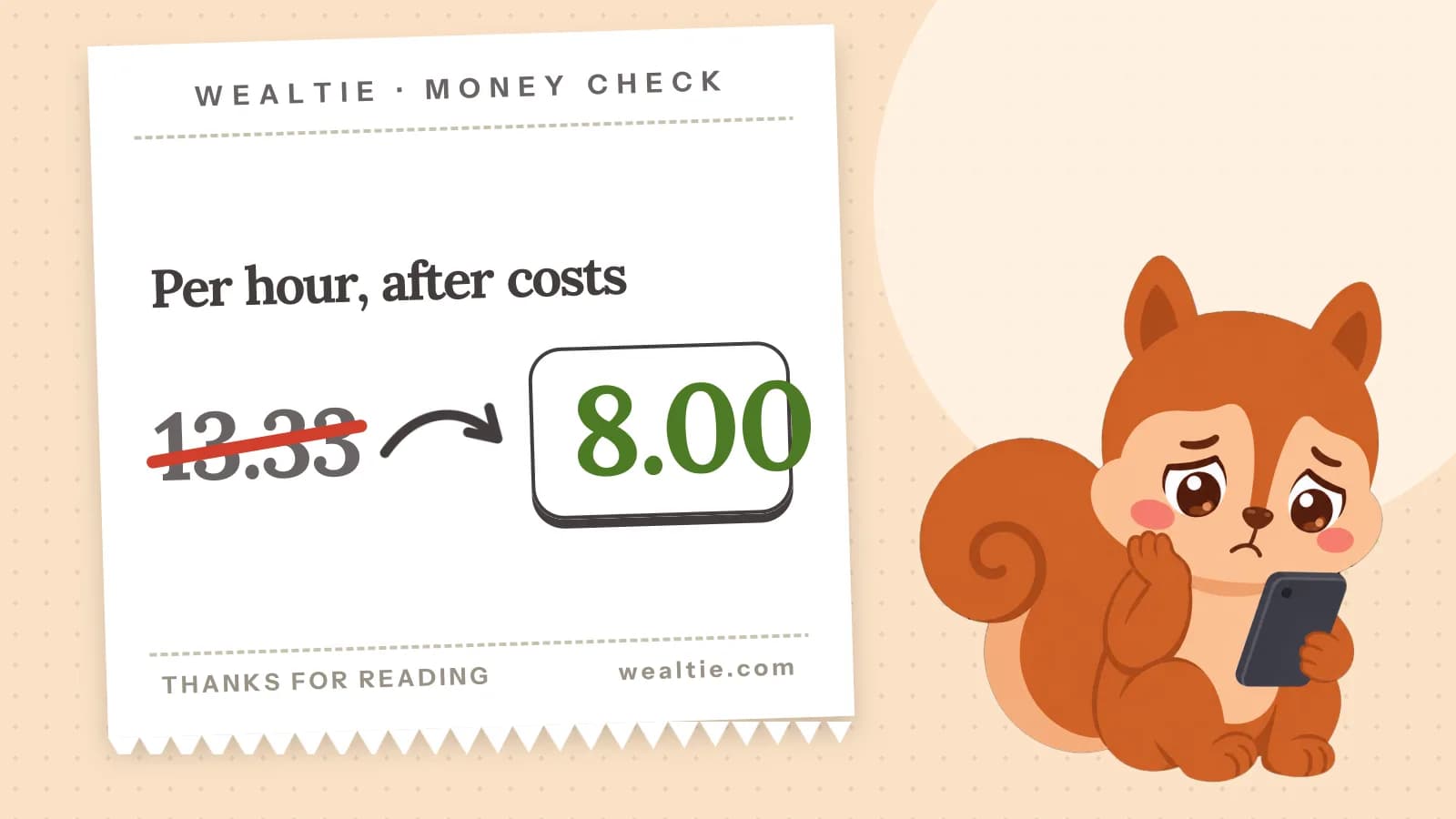
- A gig paying 400 for 30 hours is 13.33 an hour on paper, and 8 an hour after 80 of costs and 80 of tax.
- Count the unpaid hours too, like travel, admin and waiting for work.
- A side hustle can be worth it at a low rate if it's teaching you something or building toward a business.
How much should a side hustle make?
More per hour than you'd get from the next best use of your time, after costs and tax. There's no single number, since it depends on what those hours would otherwise pay you and how much you need the money.
So the useful question is what yours pays now.
How do you work out your real hourly rate?
Take what you were paid, subtract what it cost you and the tax you'll owe, and divide by the hours. Here's a month of delivery work in round numbers that work in any currency:
| Line | Amount |
|---|---|
| Paid by the platform | 400 |
| Fuel, wear on the car, phone data | −80 |
| Tax set aside on the profit | −80 |
| What you keep | 240 |
| Hours worked | 30 |
| Real hourly rate | 8.00 |
On paper it was 13.33 an hour. Once the costs are in, it's 8. That's why the headline figure on a gig app tells you very little.
Which hours should you count?
All of them. The hours you were paid for are only a part of it. Add the time spent waiting for jobs, driving to the first one, replying to customers, photographing things to sell, packing orders and going to the post office.
If that delivery work took 40 hours in total and not 30, the rate falls to 6. Track it for two or three weeks and you'll have a fair average.
Which costs do people forget?
The ones that don't feel like spending. Car wear is the big one, because it doesn't appear on a statement, and it's real money over a year. Others are:
- Platform commissions and listing fees
- Payment processing fees
- Packaging and postage
- Equipment and software you bought for it
- Tax on the profit
Tax is the one that hurts most when you've missed it. Set aside a share of each payment. Tracking side income and how much to set aside for taxes cover what you might owe.
How do you compare it with other options?
Line it up against the alternatives. Could you pick up overtime in your main job? Could you take on a part-time shift for a set wage? Could you use those hours to learn something that gets you a pay rise?
| Option | Real rate per hour, after tax |
|---|---|
| Delivery work (this example) | 8.00 |
| Overtime in your main job | Check your payslip |
| Part-time shift | Check the local wage |
| Selling things you've made | Count materials and all your time |
If your hourly rate's below your local minimum wage, a regular job would pay you better for the same hours. That doesn't automatically make it wrong, but you should know.
When is a low hourly rate still worth it?
When the money's not the only thing you're getting. A side business in its first year often pays badly because you're building customers, skills or a reputation. If the rate's rising each month, it can be worth carrying on.
Flexibility counts as well. If you can only work odd hours around children or study, a gig that fits may be worth more to you than a higher wage you can't take. What matters is knowing the number and deciding, and not finding out at the end of the year that you've worked for less than you thought.
When should you stop?
When the rate's low, it's not improving, and you're tired. Give it a set trial, like three months, and check the number at the end. Falling behind in your main job costs far more than a side hustle usually pays.
How much should you aim for?
Set a target that means something for your budget. A hundred a month on top of your salary pays a phone bill, and four hundred could clear a credit card balance within a year or two.
Work backwards from what you want. If you need 300 a month and you keep 8 an hour, that's about 38 hours. Is that realistic alongside your job, and for how long? If not, the target or the hustle needs to change.
Decide in advance where the money goes. Income that lands in your everyday account tends to vanish into ordinary spending, whereas money pointed at a debt or a goal does some work. What to do with a pay rise makes the same point about extra income.
How do you find your real rate in Wealtie?
Add a separate account for the side hustle, log what comes in as income and log the costs as expenses in their own expense categories. What's left is easy to see, and the income tracker keeps it apart from your salary. You'll need to note the hours yourself, since Wealtie tracks money and not time. On Pro, income analytics show each source and how steady it is.
Questions people ask
More than the next best use of your time, after costs and tax. If it's below your local minimum wage, a regular job would pay better for those hours.
Subtract costs and tax from what you were paid, then divide by every hour you spent, including travel and admin. Then compare that rate with your other options.
The amount varies too much for one figure to be useful, so work out your own. A worked example of 400 a month in delivery work leaves 240 after costs and tax.
Consider stopping if the hourly rate is low, isn't improving, and it's affecting your main job or your health. Give it a set trial, such as three months, and check the number at the end.
This article is general information, not financial, tax or legal advice. Your situation is your own; check the numbers that apply to you before you act on them.