Income & freelancing: How to declare side hustle income in the US and UK
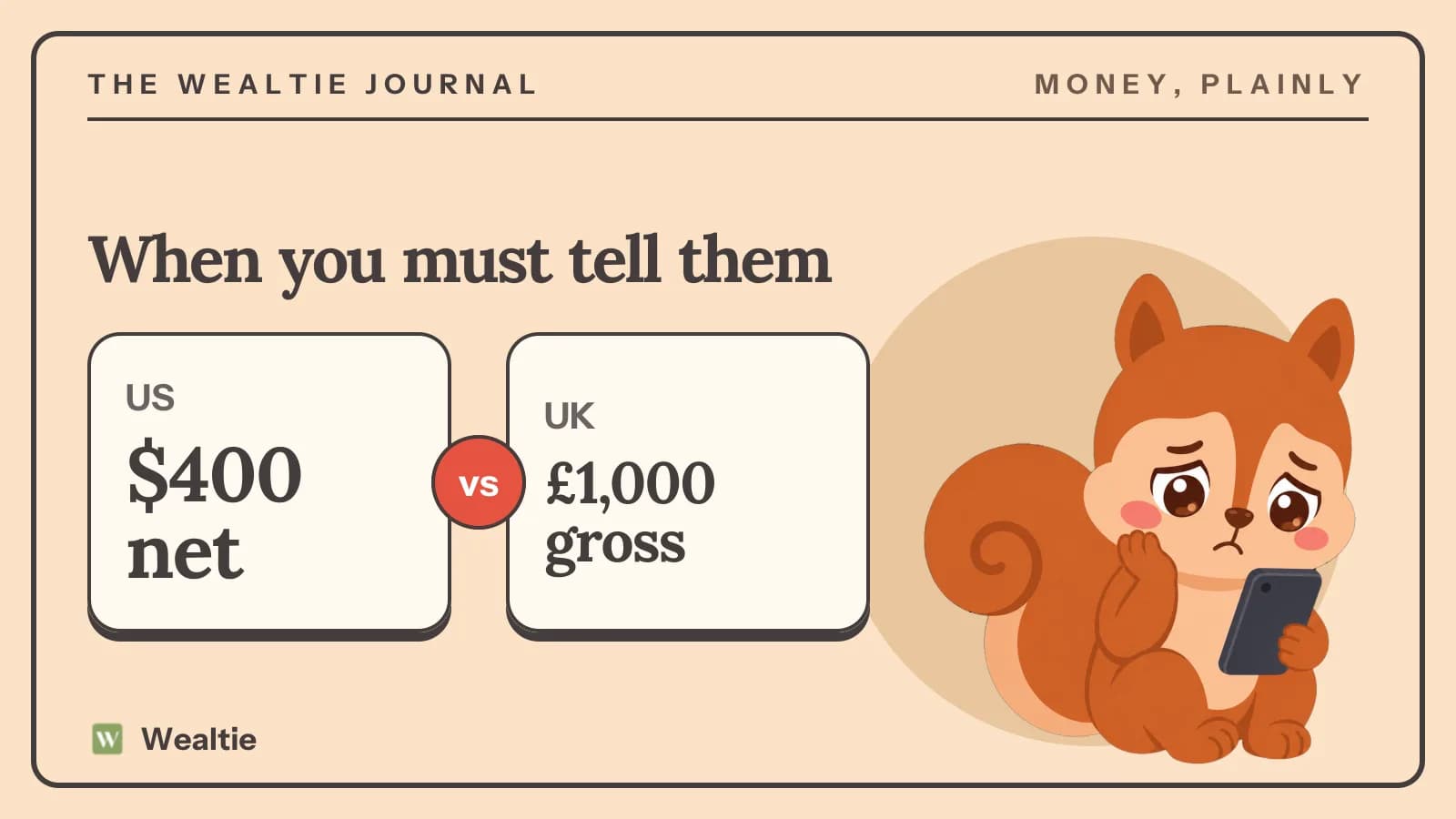
Here's how to declare side hustle income: in the US, report it on your tax return, and file if net self-employment earnings reach $400. In the UK, register for Self Assessment if your trading income is over £1,000.
 By Wealtie Team · 3 min read
Key takeaways
- In the US, the IRS says gig income must be reported even if it's part-time, paid in cash or not on a Form 1099.
- The IRS says you have to file a return if your net earnings from self-employment were $400 or more.
- In the UK, you must send a tax return if you were a sole trader and earned more than £1,000 before expenses.
- HMRC set a deadline of 5 October 2026 to register for the 2025 to 2026 tax year if you hadn't filed before.
- Set aside part of each payment as it comes in, so the tax bill doesn't arrive as a surprise.
How do you declare side hustle income in the US?
On your tax return. The IRS says you must report gig income even if it's from part-time or side work, isn't on a Form 1099-K, 1099-MISC, 1099-NEC or W-2, or was paid in cash, goods or virtual currency.
So no form in the post doesn't mean no tax. If your net earnings from self-employment were $400 or more, the IRS says you have to file a return. Below that, you may still need to file for other reasons.
Sole proprietors generally report income and costs on Schedule C, and self-employment tax on Schedule SE. Because no employer is withholding tax for you, the IRS may expect estimated payments during the year. Quarterly estimated taxes explains how those work.
How do you declare side hustle income in the UK?
Through Self Assessment, if you earned more than £1,000. GOV.UK says you must send a tax return if you were self-employed as a sole trader and earned more than £1,000 before taking off anything you can claim relief on.
Below that, the trading allowance may mean you don't have to tell HMRC, although there are exceptions, and you must still keep records. If you've never filed, you've got to register first. For the last tax year, the deadline to register was 5 October 2026, and the date moves on each year.
The two lines measure different things, and that catches people out:
| What's measured | Threshold | |
|---|---|---|
| US | Net earnings, after costs | $400 |
| UK | Gross income, before costs | £1,000 |
What about other countries?
Most have their own threshold and their own form, so check with your tax authority. If you're working for clients in another country, the rules on where you pay can get complicated, and that's a good moment to get professional advice.
What about the UK trading allowance?
Above £1,000, you can choose between deducting the allowance or claiming your real expenses. GOV.UK says that if you use the allowance you can deduct up to £1,000, but not more than your income.
Say you earned £1,800 and your actual costs were £300. Taking the £1,000 allowance leaves £800 of taxable profit, which is better than claiming £300 and leaving £1,500. If your costs had been £1,300, claiming them would have been better. HMRC's list of allowable expenses shows what counts.
Is a side hustle different from a hobby?
Sometimes, and it comes down to whether you're trying to make a profit. Selling a few old things you owned is usually different from buying stock to resell. Tax authorities look at how regular the activity is and what your intent was. If you're unsure, check your tax authority's guidance or ask an adviser before you assume it doesn't count.
What records should you keep?
Every payment in and every cost out, with dates. Platforms can show you what they paid you, but they won't know what you spent on fuel, materials or postage. GOV.UK says you must keep records even if you're under the £1,000 threshold.
Keep it simple: one list with date, amount, what it was and who paid. Keeping side income apart from your salary makes this much easier, and tracking side hustle income goes through how.
How much should you set aside for tax?
A fixed share of every payment, put aside the day it arrives. The right share depends on your other income and your country, so use your own tax rate as the guide. As an illustration, if you decide on 25 out of every 100, then a side income of 300 a month means moving 75 each time you're paid.
How much to set aside for taxes goes through the working for US and UK rates. Keep that money in a separate account, because it was never yours to spend.
What if you haven't declared side income in earlier years?
Tell your tax authority yourself, and do it soon. Coming forward is usually treated better than being found out, and both the IRS and HMRC have processes for correcting past returns or disclosing income. An accountant or a tax adviser can help you work out what's owed.
Don't wait until it's a larger problem. Interest and penalties tend to grow the longer it's left. Platforms increasingly report what they pay to tax authorities, so it's safest to assume your income isn't invisible.
How do you keep side income separate in Wealtie?
Add a separate account for it and log each payment as income. The income tracker shows what's come in. Then move your tax share to a savings account as a transfer, so it isn't counted as spending and your budget tracker stays clean. The Free plan includes two accounts and a monthly income goal. Wealtie isn't tax software, so you'll still need to work out what you owe.
Questions people ask
Usually, yes. The IRS requires gig income to be reported even if it's not on a form, and in the UK you must send a tax return if your sole trader income was over £1,000.
Up to £1,000 a tax year under the trading allowance, although there are exceptions and you must still keep records. Other income can affect what you owe.
You may. The $400 line is about net self-employment earnings that require you to file. The IRS says gig income has to be reported, and you may need to file for other reasons.
You may owe the tax plus interest and penalties, so it's better to come forward yourself. Both the IRS and HMRC have ways to correct earlier returns.
Sources
- Gig economy tax center · Internal Revenue Service · checked 9 November 2026
- Self-employed individuals tax center · Internal Revenue Service · checked 9 November 2026
- Who must send a tax return · HM Revenue & Customs · checked 9 November 2026
- Tax-free allowances on property and trading income · HM Revenue & Customs · checked 9 November 2026
- Expenses if you're self-employed · HM Revenue & Customs · checked 9 November 2026
- Check how to register for Self Assessment · HM Revenue & Customs · checked 9 November 2026
This article is general information, not financial, tax or legal advice. Your situation is your own; check the numbers that apply to you before you act on them.