Multi-currency & travel: How to budget for a trip abroad, before and while you're there
To budget for a trip abroad, add up what you pay before you leave, give yourself one daily spending number for everything on the ground, and convert that number into the local currency before you land. Add a buffer of about 10% and check your card's foreign fees. A 10-day example is below.
 By Wealtie Team · 4 min read
Key takeaways
- A trip budget has two halves: costs you pay before you leave (flights, accommodation, insurance) and a daily amount for everything you spend once you're there.
- Convert the daily amount into the local currency once, before you go, and track spending against that local number while you travel.
- When a card machine or ATM abroad offers to charge you in your home currency, choosing the local currency avoids the merchant's conversion mark-up.
- In the US, a card's foreign transaction fee can stack a network fee and a bank fee; Regulation Z's own example is 1% plus 2%, or 3% of every purchase.
- UK residents spent an estimated £78.7 billion on 94.6 million visits abroad in 2024, about £830 a visit, according to the ONS.
What goes into a travel budget?
Two things: the costs you pay before you leave, and a daily amount for everything you spend once you're there. Keeping them apart is what makes the budget usable on the trip.
- Before you go: flights or train tickets, accommodation, travel insurance, visas, and anything you book ahead, such as a tour or a rental car.
- While you're there: food, local transport, entry tickets, small shopping and tips. This is the part that goes over, so it gets a daily number.
- A buffer: about 10% of the total, for the taxi you didn't plan, the lost charger, the day it rained and you ate out three times.
The prepaid half is usually settled weeks before you travel, so by the time you land it's history. The daily half is the one you manage.
How much should you budget for a trip abroad?
As much as the trip costs at your daily rate, plus the prepaid costs and a buffer. There's no right figure, but there is a useful benchmark: UK residents made an estimated 94.6 million visits abroad in 2024 and spent an estimated £78.7 billion, according to the Office for National Statistics. That's about £830 a visit, across short city breaks and long holidays alike.
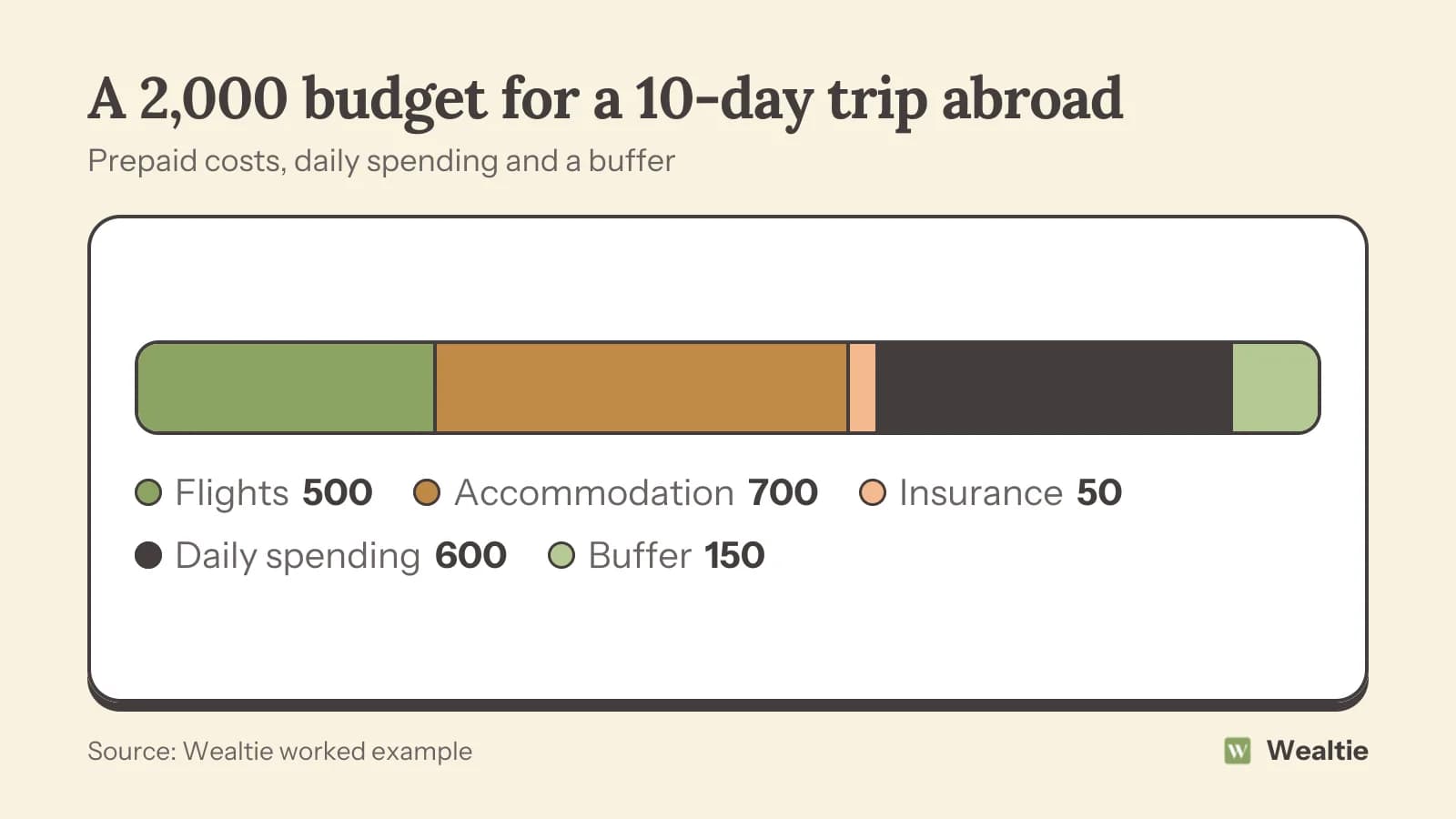
Here's a 10-day trip worked through. The numbers are round and work in any currency.
| Part of the budget | How it's worked out | Amount |
|---|---|---|
| Flights | Return, booked ahead | 500 |
| Accommodation | 10 nights × 70 | 700 |
| Travel insurance | One trip | 50 |
| Before you go | 1,250 | |
| Daily spending | 10 days × 60 | 600 |
| Buffer | About 10% of the rest, rounded | 150 |
| Total | 2,000 |
The daily figure is the one to get right. Look up what a cheap meal, a coffee and a metro ticket cost where you're going, build a day out of them, and round up.
If you're saving for the trip, divide the total by the months until you leave and move that amount aside each month. A sinking fund is the same idea with a name.
How do you set a daily budget in another currency?
Convert the daily amount into the local currency once, before you go, and use only the local number while you're there. Thinking in your home currency at every till is slow and you'll get it wrong when you're tired.
Say 1 unit of your currency buys 25 of the local one (a round rate, for the example). Your 60 a day becomes 1,500 local a day, and the 150 buffer becomes 3,750. A 900 dinner is then plainly more than half the day, without any arithmetic.
Write the daily number down, or keep it on your phone's home screen, and check your spending against it each evening. If day three goes 400 over, days four and five absorb it. A day under budget carries forward.
Your card won't convert at exactly the rate you looked up. The European Central Bank's reference rates, which many apps and websites quote, are published around 16:00 CET each working day for information only, and the ECB discourages using them for transactions. Expect your card's rate to differ a little, plus any fee.
Should you pay in your currency or the local currency?
Pay in the local currency. When a card machine or ATM abroad offers to charge you in your home currency, the conversion is done by the shop or the machine's operator at their own rate, usually with a mark-up on top.
In the EU, Regulation 2019/518 requires anyone offering that conversion at a till or ATM to show the total charge as a percentage mark-up over the latest ECB reference rate before you pay, and to tell you that you can pay in the local currency instead. The mark-up is printed on the screen; compare it before you tap.
In the US, the rules on card disclosures cover the bank and the card network, not the shop. Under Regulation Z, a card issuer doesn't have to disclose a fee a merchant adds when the merchant does the conversion itself. Choosing the local currency keeps the conversion with your card, where its fee is at least written down.
How much do card fees add?
On a card with a foreign transaction fee, a few percent of everything you spend abroad. Regulation Z's own illustration is a card network charging 1% and the bank adding 2%, for a 3% fee in total.
At 3%, the 600 of daily spending in the example costs 618, and a 3,000 trip's spending costs 90 more. It's not a disaster, but it comes out of the buffer before anything has gone wrong.
- Check your card's terms for a "foreign transaction fee" or "non-sterling transaction fee" before you leave.
- Some cards and accounts charge none. If yours does, use it for spending on the ground and keep the other card as a backup.
- ATM withdrawals can carry a separate fee from your bank and another from the machine's operator. One larger withdrawal costs less than several small ones.
How do you track spending while you travel?
Log each expense in the local currency as you spend it, and look at the day's total each evening. A receipt in your pocket isn't tracked.
A multi-currency budget app saves the conversion step. In Wealtie, each account keeps its own currency, so a travel card or a wallet of local cash can be its own account, and totals are converted into your display currency at each day's rate. All 68 currencies are on the Free plan. On Pro, the budget tracker can also run daily or weekly, so the trip's daily number can be the budget itself.
Cash counts the same as a card. Log a cash withdrawal as a transfer into a cash account, then log what you buy from it; the withdrawal itself isn't spending, the meals are.
When you're back, the trip's real total is worth comparing against the plan. The gap, in one direction or the other, is your daily number for the next one. If you've never made a budget for normal months, start with how to make a budget.
Questions people ask
A good daily budget is what a cheap meal, a mid-range meal, local transport and one paid sight cost at your destination, rounded up. Build one typical day from local prices and multiply it by the number of days.
Pay in the local currency. When you choose your home currency, the shop or ATM operator does the conversion at its own rate, usually with a mark-up; in the EU, that mark-up must be shown to you as a percentage before you pay.
It means the card doesn't add a percentage charge when you pay in a foreign currency or with a merchant abroad. You still get the card network's exchange rate, and ATM operators can still charge their own fees.
Add about 10% of the trip's total. It covers small surprises, like a taxi you didn't plan or a card fee, without having to cut the daily budget for the rest of the trip.
For UK residents, about £830 a visit in 2024, based on ONS estimates of £78.7 billion spent on 94.6 million visits abroad. That average covers everything from weekend city breaks to long holidays.
Sources
- Travel trends: 2024 · Office for National Statistics · checked 13 October 2026
- Regulation (EU) 2019/518 amending Regulation (EC) No 924/2009 as regards certain charges on cross-border payments in the Union and currency conversion charges · European Union (EUR-Lex) · checked 13 October 2026
- Euro foreign exchange reference rates · European Central Bank · checked 13 October 2026
- Official interpretation of §1026.4, Finance charge (Regulation Z) · Consumer Financial Protection Bureau · checked 13 October 2026
This article is general information, not financial, tax or legal advice. Your situation is your own; check the numbers that apply to you before you act on them.