Budgeting: How much to give for a graduation gift, and how to budget for it
How much to give for a graduation gift depends mostly on how close you are to the graduate. In a worked example, a gift of 25 to 50 suits most friends and wider family, while close family often give more, and a yearly gift budget keeps a busy graduation season affordable.
 By Wealtie Team · 3 min read
Key takeaways
- How much to give for a graduation gift depends mostly on how close you are to the graduate.
- In a worked example, 25 to 50 suits most friends and wider family, with close family often giving more.
- A thoughtful card or a small useful gift is enough when money's tight.
- Listing the season's graduations in advance and setting a yearly gift budget avoids a costly few weeks.
How much should you give for a graduation gift?
Give what fits your relationship with the graduate and your own budget. A graduation is a proud moment, and a gift is a way of marking it, but there's no fixed amount you're expected to spend. Customs vary between families and countries, and what matters most to the graduate is usually that you noticed and celebrated with them.
The closer you are, the more people tend to give. A grandparent or parent might give a larger gift to help with the next step, while a neighbour or a colleague's child might receive a card with a small amount or a modest present.
What's a sensible amount by relationship?
Here's a worked example in round numbers that work in any currency:
| Relationship | Typical gift |
|---|---|
| Colleague's or neighbour's child | 20 |
| Friend or wider family | 25 to 50 |
| Close family | 100 or more |
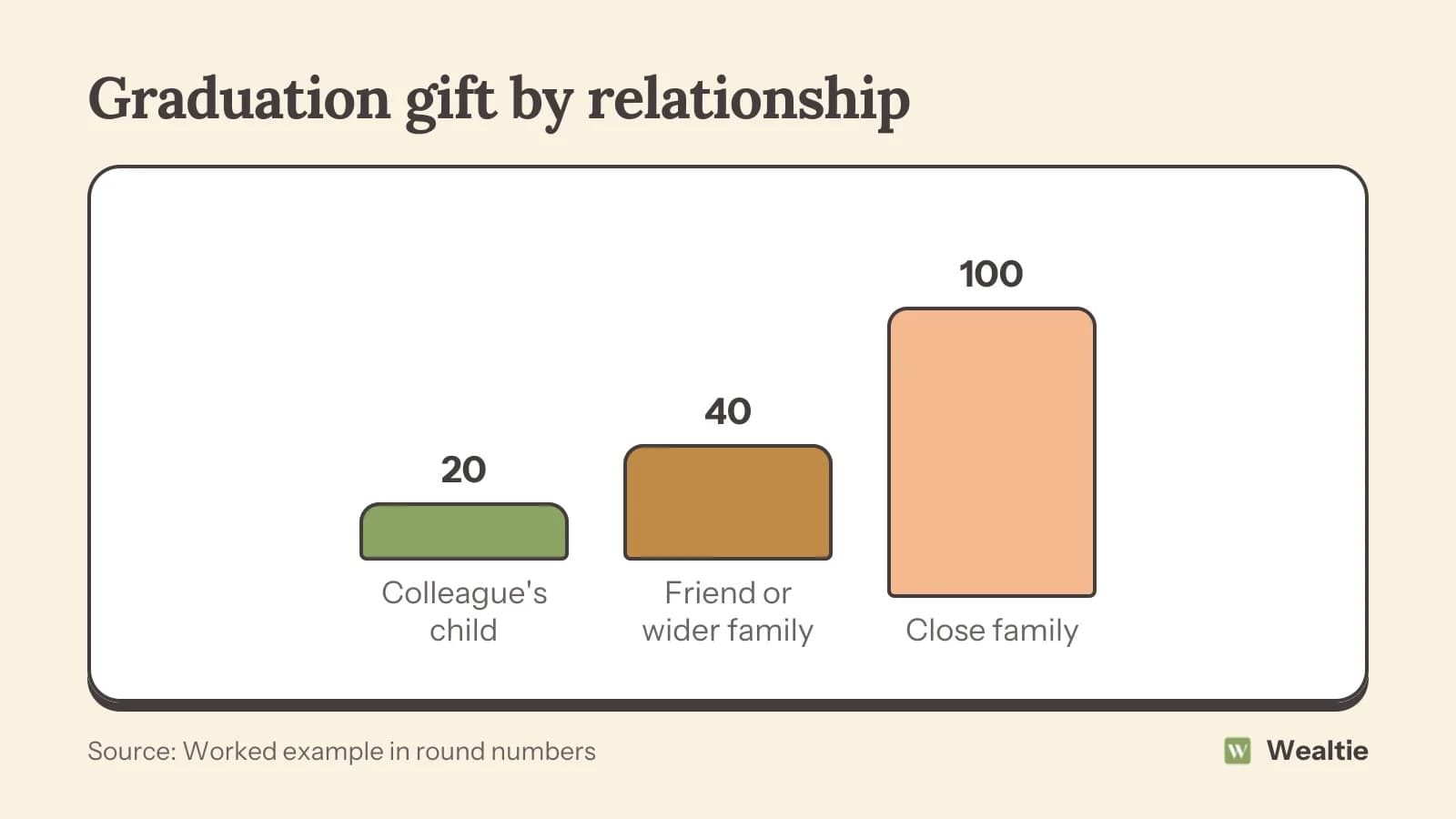
These are a starting point, not a rule. If money's tight, a smaller gift with a heartfelt card is just as appropriate. If you're particularly close, or the graduate is starting something expensive, like university or a first job in a new city, you might choose to give more.
The level of graduation can also matter. Many people give a little more for a university degree than for finishing school, but that's a personal choice rather than an expectation.
Should you give money or a present?
Both are welcome, and money is a common choice at graduation. Graduates are often facing new costs: moving, a deposit on a first flat, books for the next course, or clothes for interviews and work. Money lets them spend on what they need most. If you give money, a card saying what you hope it helps with, like the first month's travel to a new job, makes it feel personal.
If you'd rather give something to keep, think about what comes next. Useful ideas include:
- A good bag or backpack for work or study
- Kitchen basics for a first home
- A book by someone in their chosen field
- A framed photo from the graduation day
- An experience, like a meal out to celebrate
Combining a small present with a card and some money works well too.
Giving as a group
If several relatives or friends want to give, pooling money into one larger gift can be more useful than several small ones. A shared contribution towards a laptop, a deposit or travel can make a real difference, and each person gives what suits them.
How do you handle a busy graduation season?
Plan ahead. Graduations tend to cluster in the same few weeks, and if you have several in one year, the cost can surprise you. At the start of the year, list the graduations you know about and set an amount for each.
For example, three graduations at 40 each and one close family graduation at 100 comes to 220. Knowing that early means you can save a little each month instead of finding the money all at once. A sinking fund works well for gifts you know are coming.
What about the graduation party?
If you're invited to a graduation party, your gift covers the occasion, so there's no need to give twice. If you're travelling to a ceremony, the cost of getting there is already part of your contribution, and some families take that into account when choosing a gift.
Gifts when you can't attend
If you can't make the ceremony or the party, a card with a gift sent by post, or a message and a small transfer, still marks the moment. Graduates often remember who got in touch, whatever the amount. If you're far away, a short video message or a call on the day can mean as much as the gift itself, and it costs nothing.
If you're hosting a party for your own graduate, set a budget for food and drinks first, then decide on the guest list. How to host dinner on a budget has ideas for feeding a group without overspending.
How does this compare to other gifts?
Graduation gifts often sit between a birthday gift and a wedding gift in size, since they mark a milestone rather than an everyday occasion. How much to spend on a birthday gift and how much to spend on a wedding gift cover the other big gift moments, so you can plan them together.
How do you track gifts in Wealtie?
Give gifts their own line in your expense categories, so you can see what a year of celebrations costs. If you save for gifts ahead, keep the money in a separate account and move it across as a transfer, which isn't counted as spending. A monthly limit in the budget tracker warns you if a busy month is running ahead of the plan.
Questions people ask
Most people give 25 to 50 to friends and wider family, and more to close family. Choose an amount that fits your relationship and your budget.
Yes. Graduates often face new costs, like moving, a first home or work clothes, and money lets them spend on what they need most.
A card with a gift is customary, but one gift covers both the graduation and the party.
List them at the start of the year, set an amount for each and save a little each month.
This article is general information, not financial, tax or legal advice. Your situation is your own; check the numbers that apply to you before you act on them.