Budgeting: Debt-to-income ratio: how to calculate it and what yours says
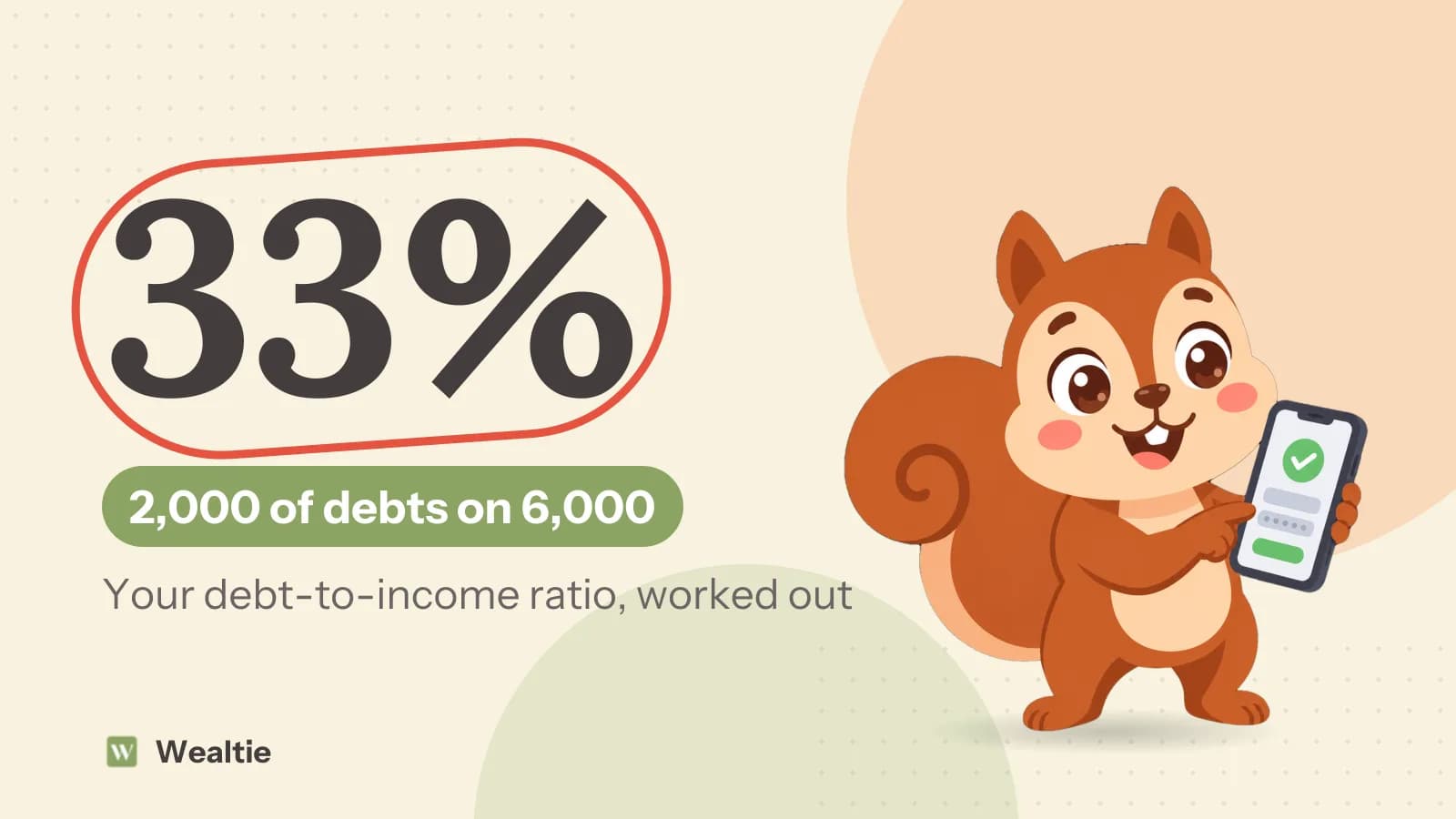
Your debt-to-income ratio is your monthly debt payments divided by your gross monthly income, as the CFPB defines it. On 2,000 of payments and 6,000 of income, it's 33%. Lenders use it to judge whether you can take on another payment, and each sets its own limit.
 By Wealtie Team · 3 min read
Key takeaways
- Debt-to-income ratio (DTI) is all your monthly debt payments divided by your gross monthly income, before tax, according to the Consumer Financial Protection Bureau.
- On 2,000 of monthly debt payments and 6,000 of gross monthly income, your DTI is 33%.
- Different lenders and loan products set different DTI limits, so there's no single number that qualifies everyone.
- Among US families with debt, the median share of income going to debt payments was 15.4% in 2025, up 2 percentage points since 2022, in the Fed's Survey of Consumer Finances.
- 8.6% of families spent more than 40% of their income on debt payments in 2025, the highest share since 2013.
What is a debt-to-income ratio?
Your monthly debt payments divided by your gross monthly income. The Consumer Financial Protection Bureau describes it as one way lenders measure your ability to manage the payments on money you plan to borrow.
Gross income means what you earn before tax and other deductions. Monthly debt payments are what you pay each month on debts: a mortgage, car loan, student loan, personal loan and the minimum on credit cards. Everyday bills like groceries or electricity usually aren't counted.
The ratio is usually called DTI. It's a single percentage that answers one question: how much of your income is already promised to lenders before you spend anything?
How do you calculate your debt-to-income ratio?
Add up your monthly debt payments, divide by your gross monthly income, and multiply by 100.
The CFPB's own example: a $1,500 mortgage payment, a $100 car loan payment and $400 for other debts come to $2,000 a month. On a gross monthly income of $6,000, the debt-to-income ratio is 33%.
| Monthly debt payment | Amount |
|---|---|
| Mortgage | 1,500 |
| Car loan | 100 |
| Other debts (cards, student loan) | 400 |
| Total debt payments | 2,000 |
| Gross monthly income | 6,000 |
| Debt-to-income ratio | 33% |
Use the minimum payment for credit cards, not the balance. If your income changes month to month, lenders usually look at an average over a longer period; use your typical month.
What is a good debt-to-income ratio?
Lower is better, and there's no single cut-off. The CFPB notes that different loan products and lenders have different DTI limits, so the ratio that qualifies you for one loan may not for another. Ask the lender what it uses before you apply.
For your own budget, the more useful comparison is with take-home pay. Because DTI uses gross income, it understates how much of the money you actually receive goes to debts. In the example, if 6,000 of gross pay is about 4,600 after tax, the same 2,000 of payments takes about 43% of take-home pay. That's the number that decides how tight the month feels. The budget calculator shows what's left for everything else on your own take-home pay.
What do US families' debt ratios look like?
Rising. In the Federal Reserve's 2025 Survey of Consumer Finances, the median family with debt spent 15.4% of its income on debt payments, up 2 percentage points since 2022. The Fed links the rise to higher interest rates on mortgages and consumer loans.
At the top end, 8.6% of families spent more than 40% of their income on debt payments in 2025, up from 6.5% in 2022 and the highest share since 2013. Those are the families most likely to struggle if income dips or a rate resets.
The survey measures this a little differently from a lender, so treat it as a picture of households, not a lending threshold.
How do you lower your debt-to-income ratio?
Reduce the monthly payments, raise income, or both. Paying a debt off entirely helps most, because the whole payment disappears from the ratio.
- Clear one debt completely. In the example, paying off a $350 car loan cuts the ratio from 33% to about 28%, even though other balances haven't moved.
- Pay down high-payment debts first if you're about to apply for a loan, and avoid new borrowing in the months before.
- Stop carrying card balances. Minimum payments count, and they shrink only slowly. How long to pay off a credit card with minimum payments shows why a fixed payment clears them years sooner.
- Choose an order. Debt snowball vs avalanche compares paying the smallest balance first with paying the highest rate first.
- Raise income. A pay rise or extra work lowers the ratio without touching the debts.
Should you work out DTI before a big purchase?
Yes. Before taking on a car loan or a mortgage, add the new payment to your current debts and divide by income. If the result is well above what you pay now, the new payment will squeeze everything else. How much car can I afford runs the same check for a car.
How do you keep track of debt payments?
List every debt with its monthly payment, and give the payments their own line in your budget.
In Wealtie, set each regular debt payment as a recurring transaction that logs itself on its due date, and include the total in your monthly budget. Budget Health warns you mid-month if spending elsewhere is heading over, which is often the moment that would otherwise go on a card and push the ratio up again.
Questions people ask
Add up all your monthly debt payments and divide by your gross monthly income, before tax. On 2,000 of payments and 6,000 of income, your debt-to-income ratio is 33%.
Lower is better, and each lender sets its own limit for each loan. The CFPB says different loan products and lenders have different DTI limits, so check the lender's requirement before you apply.
Monthly payments on debts: mortgage or rent payments if the lender counts them, car loans, student loans, personal loans and minimum credit card payments. Bills like utilities and groceries usually don't count.
Gross. The CFPB describes gross monthly income as what you earn before taxes and other deductions are taken out. That makes DTI look lower than the share of take-home pay your debts actually take.
Pay down debts, especially ones with high monthly payments, avoid new borrowing before you apply for a loan, and raise income if you can. Paying off a car loan entirely removes its whole payment from the ratio.
Sources
- What is a debt-to-income ratio? · Consumer Financial Protection Bureau · checked 6 November 2026
- Changes in U.S. Family Finances from 2022 to 2025: Evidence from the Survey of Consumer Finances · Board of Governors of the Federal Reserve System · checked 6 November 2026
This article is general information, not financial, tax or legal advice. Your situation is your own; check the numbers that apply to you before you act on them.