Budgeting: How to budget your paycheck, bill by bill, every two weeks
To budget your paycheck, list your bills by due date, give each one to the paycheck that lands before it, and split what's left of each check into spending and savings. If you're paid every two weeks, budget on two paychecks a month and plan the two extra ones each year separately.
 By Wealtie Team · 4 min read
Key takeaways
- A paycheck budget assigns every bill to the paycheck that arrives before its due date, so no single check has to cover rent and everything else.
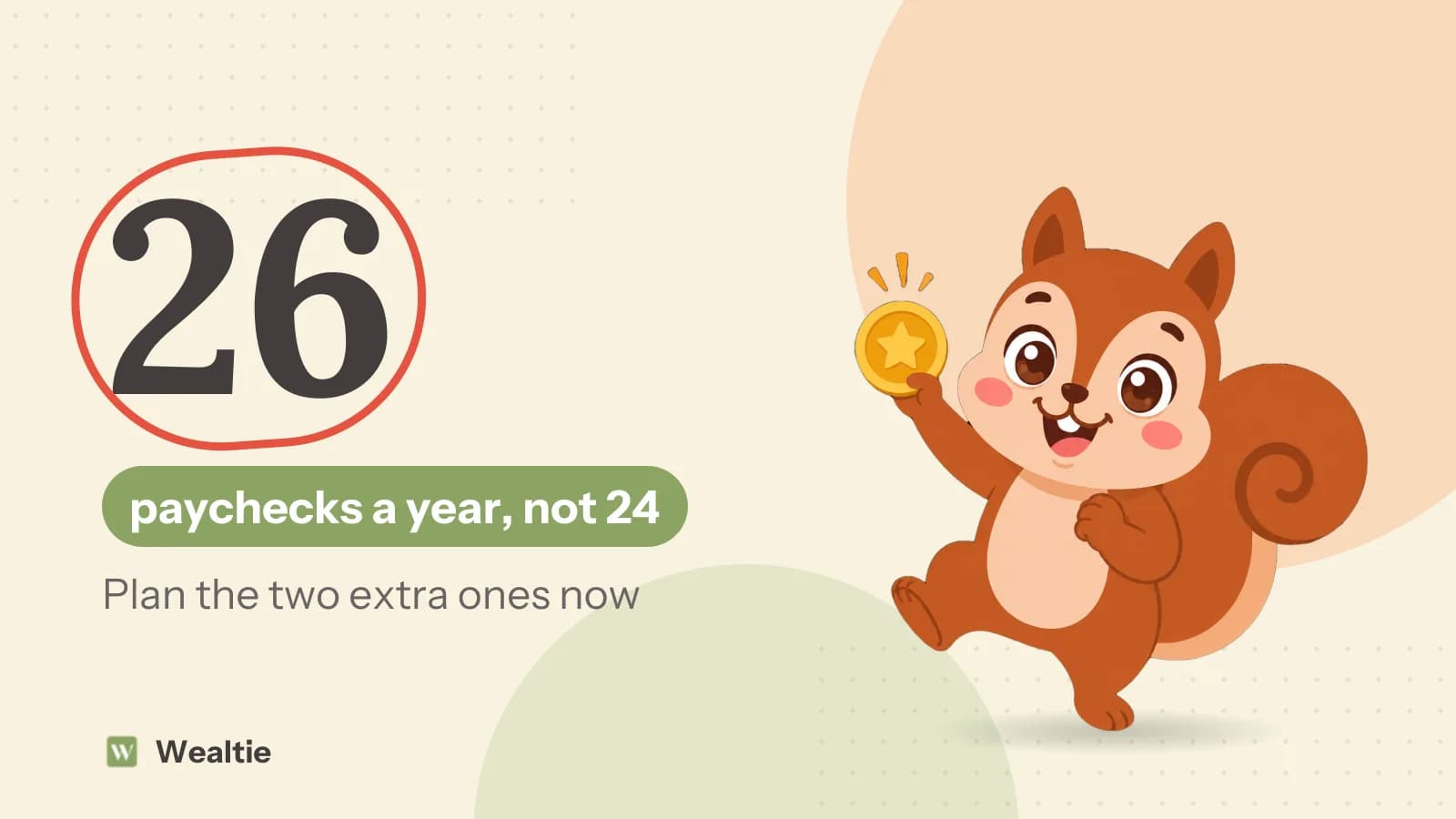
- Paid every two weeks, you get 26 paychecks a year: two a month, plus two months that have a third.
- Budget the month on two paychecks and decide in advance what the two extra paychecks are for.
- On 1,500 every two weeks, the year's take-home is 39,000, an average of 3,250 a month, but a two-paycheck month brings in only 3,000.
- If a check runs short, move a due date before you move money: many billers will change it if you ask.
How do you budget your paycheck?
List your bills by due date, give each to the paycheck that arrives before it, and split whatever's left of each check into spending and savings.
A monthly budget assumes all your money arrives on one day. If you're paid every two weeks, it doesn't. Rent due on the 1st comes out of a check that landed on the 26th of the previous month, and the electricity bill on the 18th comes out of the next one. A paycheck budget is a monthly budget sliced to match when money arrives.
It takes four steps:
- Write down your take-home pay per check. What reaches your account, after tax and deductions.
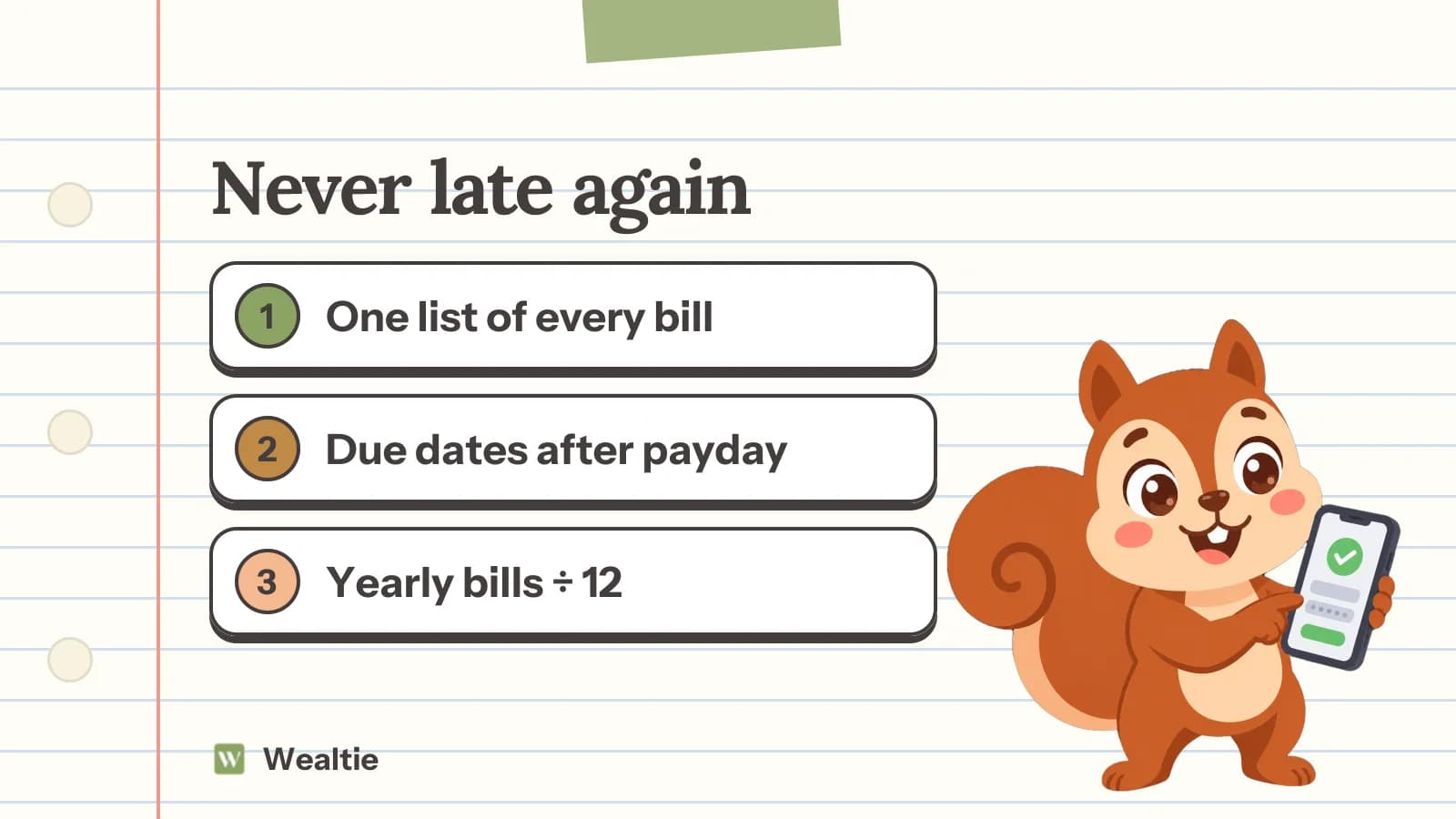
- List every bill with its due date and amount. Rent, utilities, phone, insurance, minimum debt payments, subscriptions.
- Give each bill to a paycheck. The paycheck that lands before the due date, with a few days' margin.
- Split what's left of each check. Groceries, transport, eating out, personal spending and savings.
What does a paycheck budget look like?
Here's a worked example in round numbers, the same in any currency. Take-home pay is 1,500 every two weeks. Paycheck 1 lands around the 1st and paycheck 2 around the 15th.
| Paycheck 1 (around the 1st) | Paycheck 2 (around the 15th) | |
|---|---|---|
| Rent | 1,100 | |
| Utilities and internet | 180 | |
| Phone | 60 | |
| Insurance | 150 | |
| Minimum debt payment | 100 | |
| Savings transfer | 300 | |
| Groceries | 220 | 220 |
| Fuel and transport | 90 | 90 |
| Eating out | 120 | |
| Personal spending | 90 | 90 |
| Irregular costs (gifts, repairs) | 190 | |
| Total | 1,500 | 1,500 |
Rent takes most of the first check, so the first two weeks are lean: groceries, fuel and a little personal spending. The second check carries the smaller bills, the savings and the eating-out money. Every line adds up to the check it comes from, so nothing is paid from money that hasn't arrived.
Groceries, fuel and personal spending appear in both columns because you spend on them every week. Bills appear once, in the column before they're due.
What if one paycheck can't cover its bills?
Move a due date before you move money. Many billers will change a due date if you ask, and it's usually a phone call or a setting in your account.
In the example, rent alone takes 73% of paycheck 1. If yours takes all of it, ask your phone, insurance or card provider to move their dates into the second half of the month. Rent is the hardest to move, so move the others around it.
If that's not enough, hold back part of paycheck 2 for the next rent. Put 200 aside from each second check and the first check gets 200 of breathing room. Over a few months, that becomes a buffer.
What happens in months with three paychecks?
You get an extra paycheck. Paid every two weeks, you get 26 a year: two a month, plus two months that have a third.
That's why budgeting on "a monthly average" goes wrong. On 1,500 every two weeks, the year brings in 39,000, which averages 3,250 a month. But ten months of the year bring in 3,000. Budget on 3,250 and you're short 250 in those ten months.
So budget the month on two paychecks, 3,000 here, and decide what the third paycheck is for before it arrives. Good uses:
- One month's spending in a buffer account, so this month's bills come from last month's money.
- A sinking fund for the yearly bills: car insurance, a subscription renewal, holiday costs.
- The first month of an emergency fund. How much should be in an emergency fund explains why one month's pay is the first target.
- Extra debt payments, on the debt with the highest interest rate.
Check your pay calendar now and mark the two months. A third check you know is coming gets used. One that surprises you gets spent.
How should you split each paycheck?
Bills first, then savings, then everything else. If you'd like a guide for the proportions, the 50/30/20 rule splits take-home pay into 50% needs, 30% wants and 20% savings and extra debt payments.
On 1,500 a check, that's 750 for needs, 450 for wants and 300 for savings. In practice, rent pushes paycheck 1 well over 50% on needs and paycheck 2 under it. Judge the split across the month, not per check. The budget calculator does the arithmetic for your own pay.
Move the savings on payday, before anything else. Money that sits in your current account until the end of the month has a way of not being there at the end of the month.
How do you keep a paycheck budget on track?
Check the spending categories against how many days are left until the next payday, not until the end of the month.
The payday forecast calculator does exactly that: give it what you've spent and when you're next paid, and it shows your spending pace and the daily amount left until payday. It's free and needs no sign-up.
In Wealtie, set a monthly budget for the two-paycheck total and split it by category. Budget Health warns you mid-month if your spending pace will take you over, which on a two-paycheck month is about when the first check runs out. If you're paid weekly, weekly budgets are on Pro. And if your pay changes from check to check, how to budget on irregular income is the better starting point.
Questions people ask
List your bills by due date and give each one to the paycheck that arrives before it. Split what's left of each check into groceries, transport, personal spending and savings. Budget the month on two paychecks and plan the third-paycheck months separately.
26. That's two a month, plus two months a year with three paydays. Every 11 years or so, depending on the calendar, there are 27.
Use it for something you'd otherwise struggle to fund: an emergency fund, a sinking fund for yearly bills, or extra debt payments. Decide before it arrives, or it gets absorbed into spending.
A common guide is about 30% of gross pay. The 50/30/20 rule puts rent, bills and groceries together at 50% of take-home pay. If rent alone takes half your take-home, the other categories have to shrink.
Build a buffer of one month's spending so this month's bills are paid from last month's pay. Start with whatever you can move on each payday, and add the third paychecks to it.
This article is general information, not financial, tax or legal advice. Your situation is your own; check the numbers that apply to you before you act on them.