Budgeting: How to budget for a baby: one-off costs, monthly costs and leave
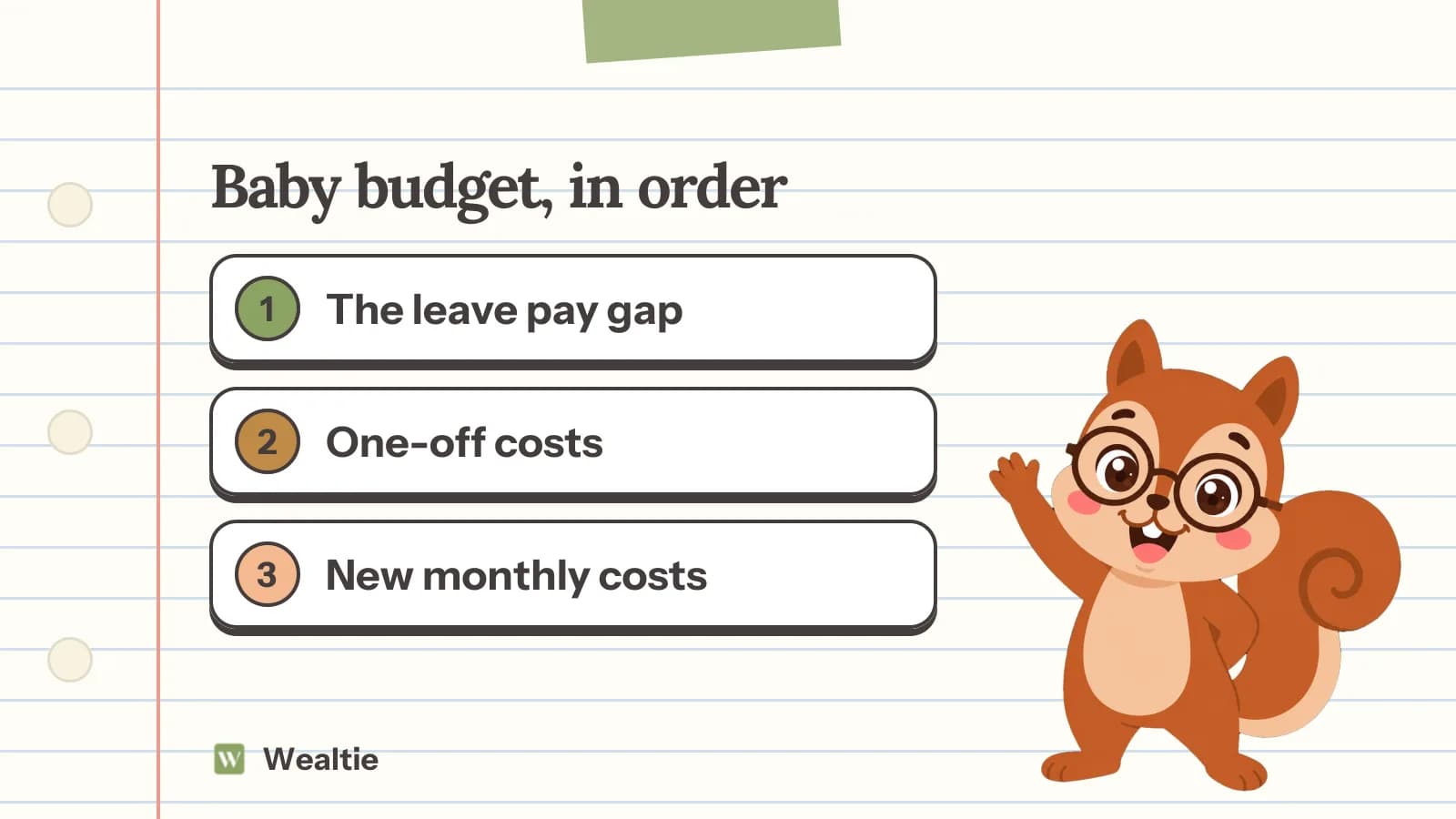
To budget for a baby, plan three things separately: one-off costs before the birth, new monthly costs once the baby arrives, and any drop in income during parental leave. The income drop is usually the biggest, so work it out first, then save for the one-off costs and test the new monthly budget before the due date.
 By Wealtie Team · 3 min read
Key takeaways
- A baby budget has three parts: one-off costs, new monthly costs and the change in income during leave.
- The income drop during parental leave is often bigger than all the baby costs combined, so it comes first.
- Childcare, if you'll use it, is usually the largest new monthly cost; get real quotes early.
- Live on the post-baby budget for two or three months before the due date and save the difference.
- Second-hand and borrowed items cut one-off costs a lot; car seats and cot mattresses are the usual exceptions to buy new.
How do you budget for a baby?
In three parts: what you'll spend once before the birth, what you'll spend every month after it, and how your income changes during parental leave. Plan each separately, starting with income.
Most baby checklists start with prams and cots. Those matter, but for many families they're not the biggest number. A few months of reduced pay during leave, and childcare after it, usually cost more than everything on the shopping list.
Part 1: how will your income change during leave?
Work out your take-home pay during leave, compare it with your normal take-home, and multiply the gap by the months you'll be off.
Leave pay depends on your employer and your country: some pay in full for a while, some pay part, some pay only what the government provides, and some pay nothing. Check the policy in writing, and check whether pay drops after a set number of weeks. If both parents take leave, do the sum for each, and check when each person's pay changes.
Here's a worked example in round numbers, the same in any currency. One parent normally takes home 2,500 a month. During six months of leave, they'll receive 1,500. The gap is 1,000 a month, 6,000 in total. That's the first savings target.
Part 2: what are the one-off costs?
Equipment, clothes and things for the house, mostly bought before the birth.
| One-off cost | Example |
|---|---|
| Car seat (buy new) | 300 |
| Cot and new mattress | 250 |
| Pram or pushchair | 400 |
| Clothes and blankets | 200 |
| Changing and bathing | 150 |
| Feeding equipment | 300 |
| Other bits and buffer | 200 |
| Total | 1,800 |
Second-hand and borrowed items cut this a lot. Clothes, a pram, a cot frame, a baby bath and toys are fine used. A car seat and a cot mattress are the usual exceptions: buy those new.
Don't buy everything in advance. You'll be given a lot, and you won't know what you need until the baby's here. A short list of the essentials for the first two weeks is enough; the rest can wait.
Part 3: what are the new monthly costs?
Nappies, wipes, clothes as the baby grows, possibly formula, and later childcare.
| New monthly cost | Example |
|---|---|
| Nappies and wipes | 60 |
| Clothes (growing fast) | 40 |
| Toiletries and health | 40 |
| Extra household (laundry, heating) | 60 |
| Total | 200 |
Formula, if you use it, adds to this. Childcare, if you'll use it after leave, is usually the largest monthly cost of all. Get real quotes from local providers early, because waiting lists and prices vary hugely.
Some lines shrink: eating out, travel, nights out. Count those too, so the new budget is honest both ways.
How much should you save before the baby arrives?
The income gap, plus the one-off costs, plus a buffer of about one month's household spending.
In the example: 6,000 + 1,800 + 3,000 = 10,800, so about 11,000. Divide by the months until the due date for a monthly target. With seven months to go, that's a little over 1,500 a month, which is a lot. If it doesn't fit, extend the saving period, cut the one-off list, or plan a shorter or partly paid leave.
A sinking fund for each part keeps the money separate, so the leave money isn't spent on the pram.
How do you test the new budget before the birth?
Live on it for two or three months before the due date. Pay yourself only the leave-pay amount, add the new baby costs, and save everything else.
It shows you early whether the leave budget is realistic, and every month you practise it adds to the savings. If it's too tight, you'll know while there's still time to change the plan. How to make a budget helps if you're building one from scratch.
How do you track the costs once the baby is here?
Give the baby its own categories and log spending as it happens, even in the blur of the first months.
In Wealtie, add categories for baby essentials and childcare to your monthly budget, and Budget Health warns you mid-month if your spending pace will take you over. Logging takes a few taps, which matters when you have one hand free. If you share costs with a partner, shared accounts let both of you see and log the same spending.
Questions people ask
Enough to cover the one-off costs, the gap in income during parental leave, and a buffer of one month's spending. In this post's worked example, that's about 11,000, but your leave pay and childcare plans decide the number.
Usually lost income during parental leave and, afterwards, childcare. Nappies, formula, clothes and equipment add up too, but they're smaller and easier to cut with second-hand items.
Work out your take-home pay during leave from your employer's policy and any government pay, subtract it from your normal pay, and multiply by the months of leave. That gap is the main thing to save for.
A car seat, because you can't be sure a used one hasn't been in a crash, and a new mattress for the cot. Most other things, like clothes, a pram, a cot frame and toys, are fine second-hand.
New lines appear for nappies, wipes, clothes, possibly formula and, later, childcare. Some lines shrink, like eating out and travel. Draft the new budget before the birth and try living on it.
This article is general information, not financial, tax or legal advice. Your situation is your own; check the numbers that apply to you before you act on them.