Money as a couple: How to split rent with roommates when the rooms aren't equal
The fairest way to split rent with roommates is usually to share the cost of the common space equally, divide the bedroom part by room size and add a premium for extras like a private bathroom. If the rooms are about the same, split it equally. Here's how to split rent with roommates on $2,400 for three.
 By Wealtie Team · 5 min read

Key takeaways
- When the rooms differ, split the shared-space part of the rent equally and the bedroom part by each room's floor area.
- On $2,400 for three, with bedrooms of 160, 130 and 110 square feet and 60% shared space, the rents come to $864, $792 and $744.
- Extras like a private bathroom get an agreed monthly premium, added to that room and taken off the others equally.
- A couple sharing one room should pay the shared part per person, because two people use the kitchen and living room.
- If everyone is on one lease, the landlord can usually ask any of the tenants for the whole rent, so write down the split you agree.
What's the fairest way to split rent with roommates?
Split the shared space equally and the bedrooms by size, then adjust for extras like a private bathroom.
Everyone uses the kitchen, the living room and the hallway the same amount, so that part of the rent splits evenly. The bedrooms are what differ, so that part follows the floor area. If the rooms are within a few square feet of each other, skip the maths and split it equally.
The worked example below uses one flat throughout:
- Rent of $2,400 a month for three people.
- 1,000 square feet in total.
- Bedrooms of 160, 130 and 110 square feet, so 400 square feet of bedrooms and 600 of shared space.
- The 160 square foot room has its own bathroom.
The numbers work the same in pounds, euros or square metres.
How do you split rent by room size?
Work out what share of the flat is shared space, split that part of the rent equally, and divide the rest by each bedroom's floor area.
- Measure the bedrooms. Length times width, with a tape measure. A room 16 by 10 feet is 160 square feet. The listing or floor plan usually gives the total.
- Find the shared share. Shared space divided by the total: 600 of 1,000 square feet is 60%.
- Split the shared part equally. 60% of $2,400 is $1,440, or $480 each.
- Split the bedroom part by size. The other $960 covers 400 square feet of bedrooms, which is $2.40 a square foot.
- Add the two together for each room.
| Room | Size | Shared part | Bedroom part | Rent |
|---|---|---|---|---|
| Big room | 160 sq ft | $480 | $384 | $864 |
| Middle room | 130 sq ft | $480 | $312 | $792 |
| Small room | 110 sq ft | $480 | $264 | $744 |
| Total | 400 sq ft | $1,440 | $960 | $2,400 |
Check the total before anyone agrees to anything. If the rents don't add up to the rent you pay, someone made a rounding error, and it'll be the person collecting the money who covers it.
Don't split the whole rent by bedroom size. At $6 a square foot across the board, the big room pays $960 and the small room $660, as if the person in the small room never used the kitchen.
How much more should the master bedroom pay?
The size difference, plus an agreed premium for anything the other rooms don't get.
Size is already in the numbers above. Extras aren't: a private bathroom, a balcony, a parking space, a built-in wardrobe. Agree a monthly figure for each one, add it to that room's rent and take it off the others equally.
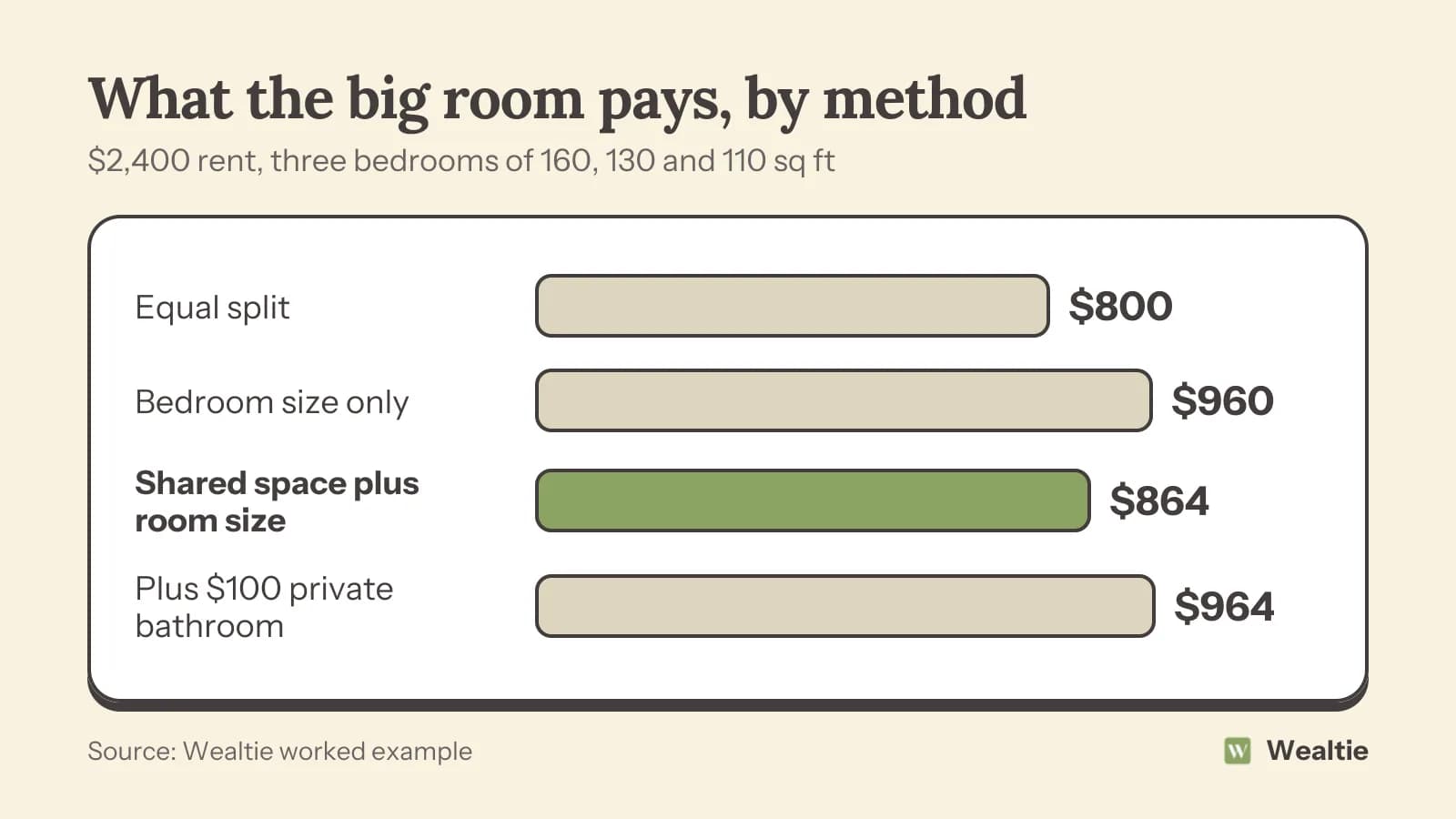
Here's the same flat with a $100 premium for the big room's bathroom:
| Method | Big room | Middle room | Small room |
|---|---|---|---|
| Equal split | $800 | $800 | $800 |
| Bedroom size only | $960 | $780 | $660 |
| Shared space plus room size | $864 | $792 | $744 |
| Plus $100 for the private bathroom | $964 | $742 | $694 |
How big should the premium be? Ask what the extra is worth to the person who gets it. $100 a month is about $3.30 a day for a bathroom nobody else queues for. A room next to the kitchen, or one with no window, can take a discount the same way.
What if you can't agree on the prices?
Let the prices move until each person wants a different room.
Start from the size-based prices. Each person says which room they'd take at those prices. If two people want the big room, raise its rent by $20, lower the other two by $10 each, and ask again. Keep going until every room has exactly one taker. Nobody can then say the split is unfair, because each person picked their room at the price on it.
There's maths behind this. In a 1999 paper called "Rental Harmony", the mathematician Francis Su showed that, under mild conditions, a set of room prices like this always exists: one where everybody prefers a different room.
How do you split rent when a couple shares a room?
Split the shared part per person instead of per room, so the couple pays for two people's use of the kitchen and living room.
With a couple in the big room there are four people. The shared $1,440 becomes $360 each, and the bedroom part stays by size:
| Room | People | Shared part | Bedroom part | Rent |
|---|---|---|---|---|
| Big room | 2 | $720 | $384 | $1,104 |
| Middle room | 1 | $360 | $312 | $672 |
| Small room | 1 | $360 | $264 | $624 |
| Total | 4 | $1,440 | $960 | $2,400 |
The couple then splits their $1,104 however suits them. How to split bills as a couple compares 50/50, by income and pooled.
How do you split utilities and other shared bills?
Per person, not per room, because the water, heating and internet don't care who has the bigger bedroom.
If the bills come to $240 a month, three people pay $80 each. With the couple, four people pay $60 each, so the big room pays $120. Groceries are a choice: separate shopping, or a weekly kitty for the things everyone uses, like milk and washing-up liquid.
The hard part is keeping track once the bills land on different people's cards. One roommate pays the internet, another the electricity, a third buys the cleaning stuff, and three months later nobody knows who's up. The usual fix is a shared record everyone adds to as they pay.
In Wealtie, that's a shared account. It's the same feature that makes Wealtie a budget app for couples, and it works for three roommates. The owner invites the others as editors or viewers, and the account can keep a balance per person, so it shows how much of it is whose. Each expense is split by the account's shares or by a custom amount per person, to the cent. Rent and fixed bills can be recurring transactions that log themselves on the due date; the bill tracker page shows how. Free includes one recurring transaction and Pro has no limit.
Inviting people needs Pro, and only the owner pays for it. Everyone who accepts joins on whatever plan they have, including Free.
What happens if a roommate doesn't pay their share?
If you're all on one lease, the landlord can usually ask any of you for the whole rent, whatever you agreed between yourselves.
GOV.UK's guide to tenancy agreements says that when more than one tenant signs the same agreement it's a joint tenancy, and "you and all other joint tenants will be responsible for the rent". Many US leases say the same thing in the words "jointly and severally liable". Read your lease for that phrase before you sign it.
Your split is a deal between roommates, so write it down. One page covers it:
- Each room's rent and each person's share of the bills.
- Who pays the landlord, and the date everyone pays them.
- How much notice someone gives before moving out, and who finds the replacement.
- How the deposit gets split when someone leaves.
Questions people ask
Split the shared space equally and the bedrooms by size. On $2,400 for three, with bedrooms of 160, 130 and 110 square feet, that's $864, $792 and $744. If the rooms are about the same size, split it equally.
The master bedroom pays for its extra size plus an agreed premium for extras like a private bathroom. In the worked example it pays $864 on size alone and $964 with a $100 bathroom premium, against $800 in an equal split.
Divide it by three if the rooms match: $2,400 is $800 each. If they don't, split the shared-space part three ways and the bedroom part by each room's floor area.
Yes, usually. Two people use the kitchen, bathroom and living room, so split the shared part per person and the bedroom part per room. In the example the couple pays $1,104 and the two single roommates $672 and $624.
Split utilities per person, not per room, because water, heating and internet don't depend on bedroom size. $240 of monthly bills between three people is $80 each.
If you're all on the same lease, the landlord can usually ask any of you for the full rent. GOV.UK says all joint tenants are responsible for the rent, and many US leases say 'jointly and severally liable'.
Sources
- Rental Harmony (Math Fun Facts) · Francis Su, Harvey Mudd College · checked 24 October 2026
- Private renting: tenancy agreements · GOV.UK · checked 24 October 2026
This article is general information, not financial, tax or legal advice. Your situation is your own; check the numbers that apply to you before you act on them.