Multi-currency & travel: How to send money abroad cheaply: compare what arrives
To send money abroad cheaply, compare how much arrives at the other end, since that includes the fee and the exchange rate margin together. On 500 euros sent as dollars, the gap between the best and worst option was about 30 dollars in a worked example.
 By Wealtie Team · 3 min read
Key takeaways
- Compare transfers by how much arrives, because a "no fee" transfer can hide its cost in the exchange rate.
- At the ECB's 9 November 2026 rate of 1.1193, 500 euros was worth 559.65 dollars before any costs.
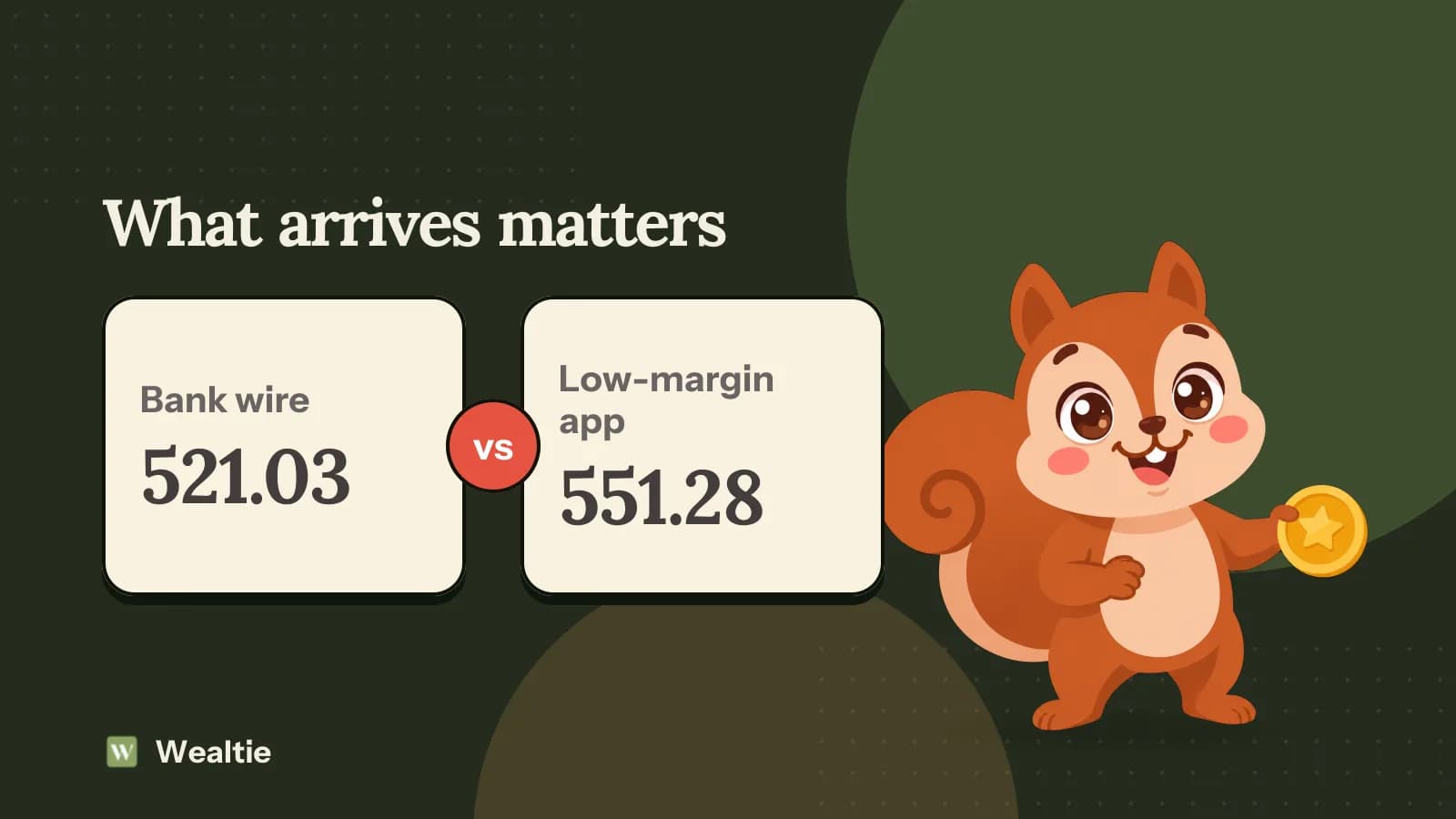
- In a worked example, a transfer with a small fee and a low margin delivered 551.28 dollars, against 521.03 for a bank wire.
- Sending larger amounts less often usually costs less, because fixed fees are paid once.
How do you send money abroad cheaply?
Compare the amount that arrives. Every transfer has two costs: a fee you can see and a margin on the exchange rate you often can't. The amount received includes both, so it's the only fair way to line options up.
How do fees and margins compare?
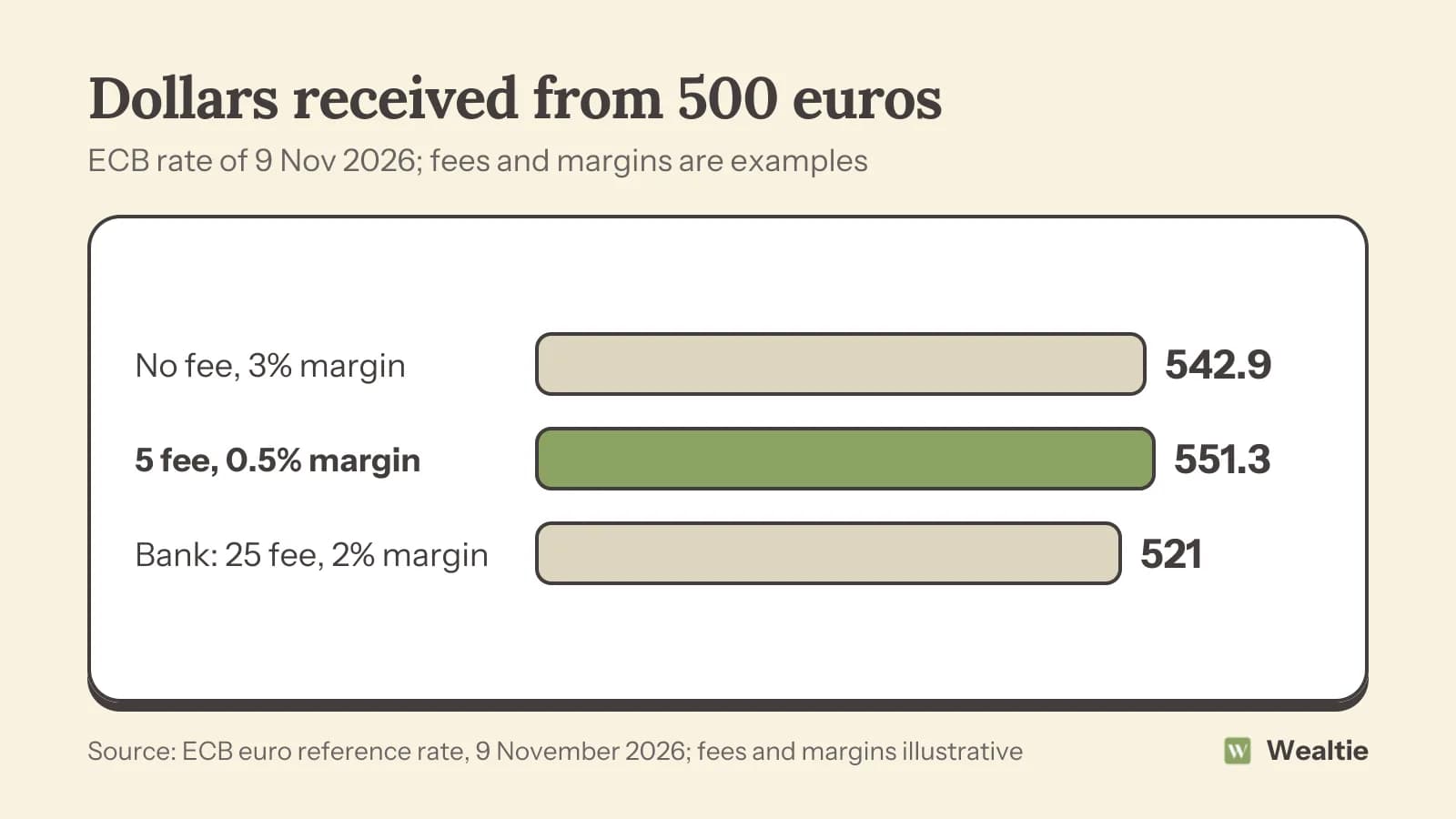
Here's 500 euros sent as dollars three ways. On 9 November 2026, the ECB reference rate was 1.1193, so 500 euros was worth 559.65 dollars before anyone took a cut. The fees and margins below are examples.
| Option | Fee | Rate margin | Dollars received |
|---|---|---|---|
| Service advertising "no fee" | 0 | 3% | 542.86 |
| Service with a small fee | 5 | 0.5% | 551.28 |
| Bank wire | 25 | 2% | 521.03 |
The same comparison works for any pair of currencies. Ask each provider for a quote on the exact amount you'll send, on the day you'll send it, because rates move.
The "no fee" option isn't the cheapest. A small fee with a rate close to the reference delivered more. The bank wire, with a fee and a margin, delivered about 30 dollars less than the best option.
How do you spot the margin?
Compare the rate you're offered with a reference rate on the same day. If the reference is 1.1193 and you're offered 1.0857, the gap is your margin, here about 3%. The bigger the gap, the more you're paying, whatever the fee says.
Some providers show the rate before fees and some after, so look at the final amount received on the confirmation screen. That's the figure to compare.
In the EU, a payment provider offering currency conversion on an online transfer must tell you the estimated conversion charges before you send it, under Regulation 2021/1230. Elsewhere, look for the rate and amount received on the confirmation screen before you pay.
What else affects the cost?
How much you send, how you pay and how it's collected:
- Amount: fixed fees matter more on small transfers, so sending 500 once is usually cheaper than 100 five times
- Paying by card: often costs more than a bank transfer to the service
- Cash collection: usually costs more than paying into a bank account
- Receiving bank fees: some banks charge to receive an international payment, which takes from what arrives
- Speed: instant transfers sometimes cost more than ones that take a day or two
Ask the person you're sending to whether their bank charges for incoming payments, so you can compare properly.
Is it safe to use a transfer app?
Check that the provider is authorised by the financial regulator in your country before you send. Most regulators have a public register you can search. Be wary of rates that look far better than everyone else's.
Keep the confirmation and reference number until the money's arrived and the person has confirmed it. If something goes wrong, the provider will need them. Double-check the recipient's details before you confirm, since a transfer to the wrong account can be hard to reverse. Never send money to someone you've only met online, or because of an unexpected message asking for urgent help, even if it seems to come from someone you know.
How do you budget for regular transfers home?
Treat them as a fixed bill. Small differences add up over a year. Sending 500 a month, a gap of 30 per transfer comes to about 360 a year, which makes an hour of comparison worth it.
If you send 300 a month to family, put it in your budget alongside rent, set it up for the day after payday, and compare providers once or twice a year, since rates and fees change.
If the amount's in another currency, decide whether you're sending a fixed amount in your currency or a fixed amount that arrives. With a fixed amount arriving, your cost moves with the exchange rate, so leave a small margin in your budget. Is a higher exchange rate better explains which way the rate works for you.
How do you track transfers abroad in Wealtie?
Log money you send to someone else as an expense, in its own category, so you can see what you send over a year. Each account in Wealtie keeps its own currency, and the multi-currency budget app supports 68 currencies on the Free plan. If you move money between two of your own accounts in different currencies, record it as a transfer, which shows both amounts and isn't counted as spending. The expense tracker covers logging.
Questions people ask
The option that delivers the most at the other end once fees and the exchange rate margin are both counted. In a worked example, a small fee with a rate close to the reference beat a "no fee" transfer.
The cost is built into the exchange rate. Compare the rate you're offered with a reference rate on the same day to see the margin.
Often an app, because banks may charge both a fee and a wider margin. Compare the amount received for your specific transfer.
Usually, because fixed fees are paid once per transfer. Sending one larger amount instead of several small ones can save money.
Sources
- Euro foreign exchange reference rates · European Central Bank · checked 9 November 2026
- Regulation (EU) 2021/1230 on cross-border payments in the Union · European Union (EUR-Lex) · checked 9 November 2026
This article is general information, not financial, tax or legal advice. Your situation is your own; check the numbers that apply to you before you act on them.