Budgeting: No spend challenge: rules, a 30-day plan and what to do after
A no spend challenge is a set period, often a weekend, a week or 30 days, when you buy nothing beyond essentials agreed in advance: bills, groceries, transport and medicine. The rules decide whether it works, and the money saved only stays saved if you move it out on the last day.
 By Wealtie Team · 3 min read
Key takeaways
- A no spend challenge stops optional spending for a set period; bills, groceries, transport and medicine carry on as normal.
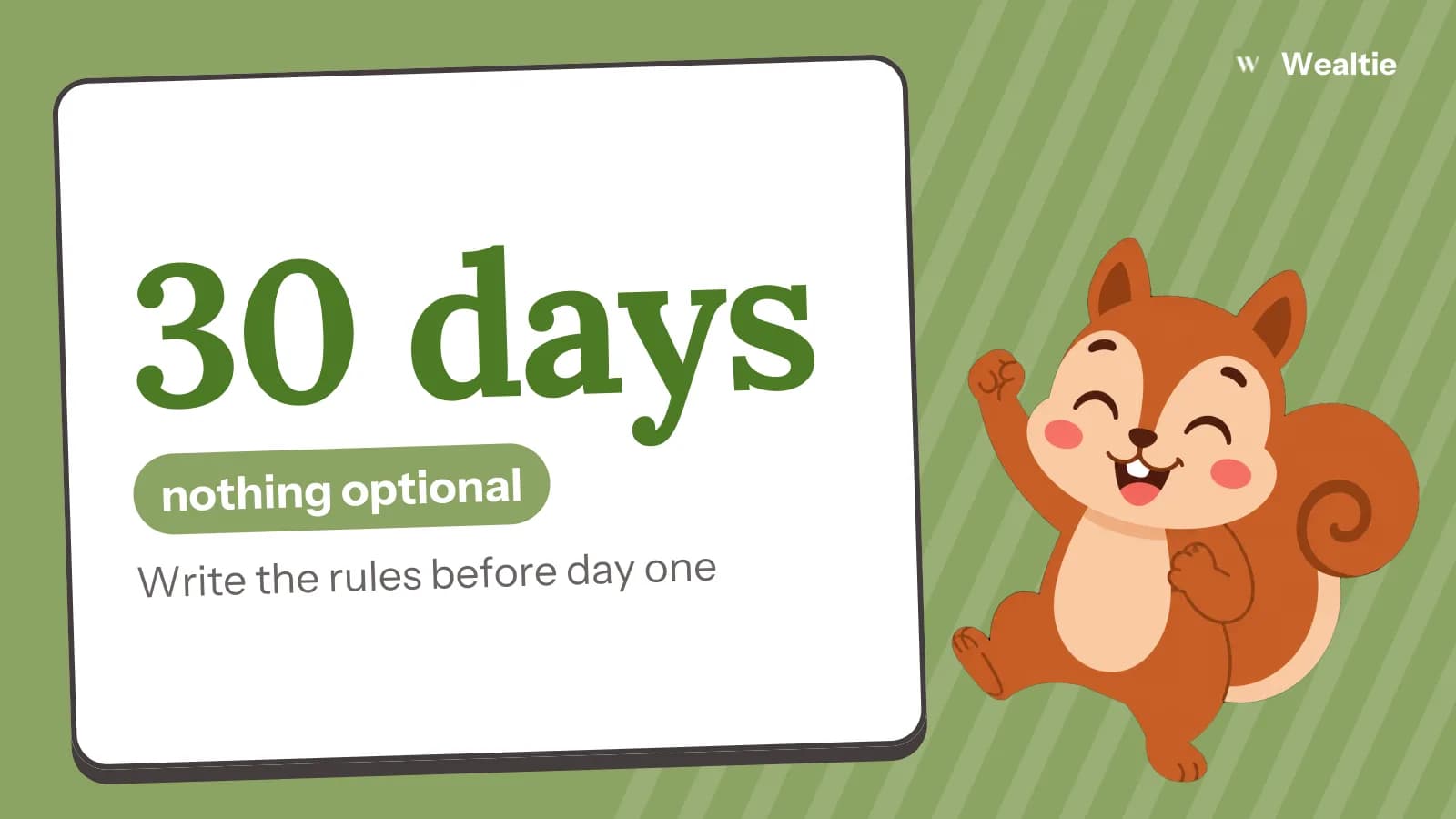
- Write the rules down before day one: what counts as essential, what you'll do about invitations, and what happens if you slip.
- Start with a weekend or a week before trying a month; a challenge you finish teaches more than one you abandon.
- Move the money you didn't spend into savings on the last day, or it gets absorbed into next month.
- The useful result isn't the saving, it's the list of purchases you missed, which shows what to budget for and what to drop.
What is a no spend challenge?
A set period when you buy nothing beyond the essentials you've agreed in advance. Bills get paid, groceries get bought, you still get to work. Everything optional waits.
The usual lengths are a weekend, a week or 30 days. The point isn't suffering for a month. It's seeing which purchases you miss and which you don't notice, and having a lump of unspent money at the end to put somewhere useful.
What counts as essential in a no spend challenge?
Whatever you decide before day one. Write it down, because day 12 is not the time to argue with yourself about whether a takeaway counts as food.
| Usually allowed | Usually paused |
|---|---|
| Rent, bills and debt payments | Eating out and takeaway |
| Groceries, within a weekly amount | Coffee and snacks out |
| Transport to work and school | Clothes and shoes |
| Medicine and health costs | Online shopping |
| Petrol or fares you need | Entertainment and new subscriptions |
| Gifts already planned and budgeted | Home decor and hobbies |
Two rules to settle in advance: what you'll do when a friend invites you out (suggest something free, or allow one planned exception), and what happens if something breaks (a real repair is fine; an upgrade isn't).
How do you do a 30-day no spend challenge?
Prepare for a few days, then run it in four weeks, each with its own job.
- Before you start: write the rules, cancel or pause subscriptions you'll be tempted by, unsubscribe from sale emails, and remove saved cards from shopping sites.
- Week 1, use what you have: cook from the cupboard and freezer, read what's on the shelf, wear what's in the wardrobe.
- Week 2, notice the urges: keep a list of everything you'd have bought and when. Don't buy it; just write it down.
- Week 3, replace the habit: the walk instead of the café, the library instead of the bookshop, a meal at home with friends instead of a restaurant.
- Week 4, plan the after: look at the list and decide which items you'll buy, which you'll budget for, and which you've stopped wanting.
If 30 days feels like too much, start with a no spend weekend. Then a week. A challenge you finish teaches more than one you abandon on day nine.
How much can a no spend challenge save?
Whatever you'd normally spend on the categories you pause. Here's a worked example in round numbers, the same in any currency.
| Paused category | Usual month |
|---|---|
| Eating out and takeaway | 120 |
| Coffee and snacks | 90 |
| Clothes and online shopping | 110 |
| Entertainment | 80 |
| Total | 400 |
A month without those is up to 400 unspent. In practice a few planned exceptions bring it down a little, and a lower grocery bill from cooking what's in the cupboard often brings it back up.
What do you do with the money you saved?
Move it on the last day, before the next month starts. Unspent money left in your everyday account gets absorbed into the following month without anyone deciding to spend it.
Give it a job: the emergency fund, a debt with a high interest rate, or a sinking fund for a cost you know is coming. Pick one before the challenge starts, so the 400 has somewhere to go.
What if you break the no spend challenge?
Write down what you bought and why, then carry on. One coffee on day 14 doesn't cancel the other 29 days.
The note is the useful part. If it's always the same category, that category needs a realistic line in your normal budget, not more willpower. If it's always the same time of day or the same mood, that's the habit to change. How to stop overspending goes through what works once the challenge is over.
How do you make the savings last after the challenge?
Turn the list from week 2 into next month's budget. Keep the things you missed, with a real amount each. Drop the things you didn't.
Wealtie's budget streaks count every month you stay within your budget, which is the long version of a no spend challenge: a habit that keeps going rather than a one-month sprint. Going over resets the streak and nothing else. Set the paused categories low in your monthly budget for the challenge month, and Budget Health warns you if spending is creeping back before the month is out. On Pro, a weekly budget fits a no spend week.
Questions people ask
A set period, often a weekend, a week or 30 days, when you buy nothing except essentials you've listed in advance, like bills, groceries, transport and medicine. Everything optional waits until it's over.
You set them. Most people allow bills, debt payments, a grocery budget, transport and medical costs, and stop takeaway, eating out, clothes, entertainment and online shopping. Write the rules down before you start.
Usually yes, within a set weekly amount. Many people also try to cook from what's already in the cupboard for the first week, which lowers the grocery bill too.
Write down what you bought and why, then carry on. One purchase doesn't cancel the other 29 days. The note tells you which category needs a realistic line in your budget.
Whatever you'd normally spend on the categories you pause. If eating out, takeaway and shopping usually come to 400 a month, a no spend month can save most of that 400.
This article is general information, not financial, tax or legal advice. Your situation is your own; check the numbers that apply to you before you act on them.