Income & freelancing: Budgeting on commission: plan on the base, bank the rest
Budgeting with commission income works best when your monthly budget runs on base pay alone and every commission check goes to a separate holding account first. From there you cover tax, fill a buffer for slow months, and pay yourself a fixed top-up, so a big quarter doesn't set spending a slow one can't keep.
 By Wealtie Team · 3 min read

Key takeaways
- Build your monthly budget on base pay alone; commission is money you can't promise yourself until it lands.
- Send every commission payment to a separate holding account before you spend any of it.
- Check that enough tax was withheld; commission is often taxed differently from regular pay, and a big check can leave a gap.
- Use commission in a fixed order: tax gap, a buffer of three months of the shortfall, then goals, then a fixed monthly top-up.
- On commission-only pay, use your lowest normal month from the last year as the base instead.
Budgeting with commission income: how does it work?
Build your monthly budget on base pay alone, send every commission payment to a separate holding account, and use it in a fixed order: tax, buffer, goals, then a fixed top-up for yourself.
Commission feels like income, but you can't promise it to your landlord. A great quarter followed by a slow one is how people on commission end up with a spending level set by their best month and a credit card bill from their worst. The fix is to treat base pay as your salary and commission as a bonus with a job to do.
Why should you budget on base pay?
Because it's the only part of your pay you can count on. Rent, bills, groceries and minimum debt payments should all fit inside it.
If they don't, that's the first problem to solve, before anything about commission. Look at the biggest fixed costs and see what can come down, or plan a fixed top-up from commission (see below) to cover the gap, backed by a buffer.
Here's a worked example in round numbers, the same in any currency. Base take-home pay is 2,400 a month. Monthly spending comes to 2,800. The gap is 400 a month, and commission has to cover it reliably.
Where should commission go when it lands?
Into a separate holding account, every time, before you spend any of it.
A second account, even a basic free one, keeps commission from mixing with your everyday money. When a check arrives, move the net amount there the same day. Seeing it sit in its own account makes the next decisions deliberate instead of automatic. It also gives you a clean record of what commission actually came to over the year, which is the number you need for next year's plan.
In what order should you use commission?
Four steps, in this order:
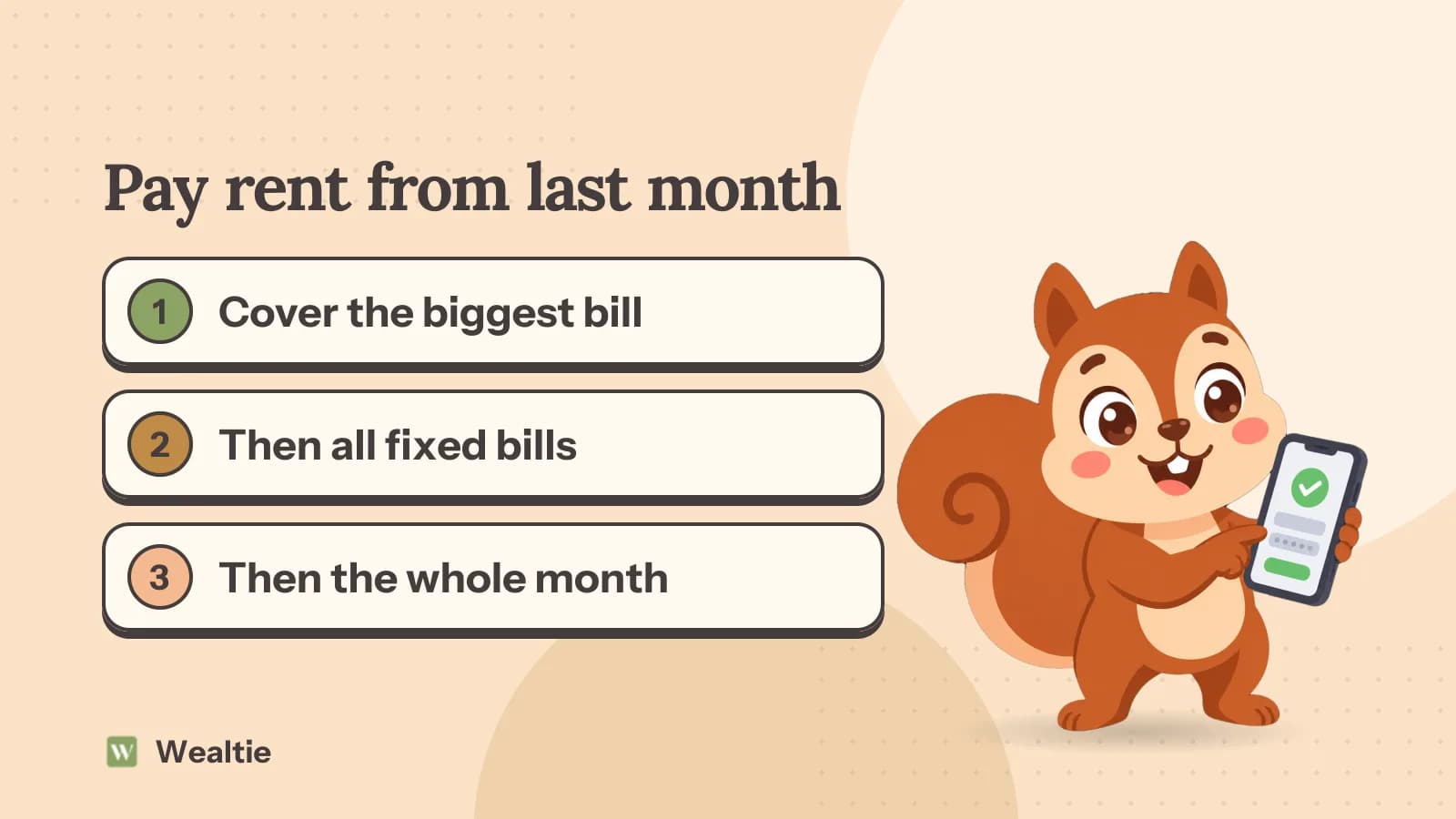
- Tax gap. In the US, employers may withhold on commission as supplemental wages, sometimes at a flat rate rather than your usual one. Check the payslip. If withholding looks low for your bracket, set some aside now rather than finding out in April.
- Buffer. Fill a buffer equal to three months of your monthly gap. In the example, that's 3 × 400 = 1,200. It covers the top-up through a slow quarter.
- Goals. Emergency fund, debt above the minimum, a deposit, a holiday.
- Fixed top-up. A set amount moved to your everyday account each month. In the example, 400.
Once the buffer is full, commission goes to goals and the top-up. If the buffer drops, refill it first.
What does a commission quarter look like?
Continuing the example, here's a quarter with an uneven run of commission: nothing in month one, 1,500 in month two, 600 in month three. The buffer starts full at 1,200.
| Month | Commission in | Top-up out | Buffer after | To goals |
|---|---|---|---|---|
| 1 | 0 | 400 | 800 | 0 |
| 2 | 1,500 | 400 | 1,200 | 700 |
| 3 | 600 | 400 | 1,200 | 200 |
The everyday account got 2,800 every month: 2,400 of base plus the 400 top-up. Month one was covered by the buffer. Month two refilled it and sent 700 to goals. Spending never changed, even though commission went from nothing to 1,500 and back down.
What if your income is commission only?
Use your lowest normal month from the last year as your base. Not the worst month ever, which may have been unusual, but the low end of a typical year.
Send every payment to the holding account and pay yourself that base amount on the 1st. Surplus in good months fills a bigger buffer, at least three months of spending, because there's no base pay underneath. This is the same approach as how to budget on irregular income, which goes through it step by step, and how to pay yourself a salary when self-employed covers the fixed-salary side.
How do you know if your commission is steady enough?
Look at a year of it month by month. If the spread between good and bad months is wide, keep the top-up low and the buffer big.
Wealtie's income tracker on Pro shows income by source, so base pay and commission sit on separate lines, plus a stability score and a projection of the months ahead. On the Free plan, two accounts hold your everyday money and your commission holding account side by side, and a monthly income goal next to your budget shows whether base plus top-up still covers what you spend.
Questions people ask
Budget your month on base pay alone. Send commission to a separate account, cover any tax gap and a buffer for slow months first, then pay yourself a fixed monthly top-up from what's left.
Find your lowest normal month of take-home pay from the last year and budget on that. Send every payment to a holding account and pay yourself that amount each month from it, saving the surplus.
Enough to cover any tax gap, then enough to fill a buffer of three months of the difference between your budget and your base pay. After that, split what's left between goals and a fixed top-up.
Often, yes. In the US, employers may withhold on commission as supplemental wages, which can be a flat rate rather than your usual rate. Check your payslip, and set aside more if the withholding looks low.
Nothing changes if your budget runs on base pay. If you've been paying yourself a top-up, take it from the buffer, and lower the top-up if slow months come more often than you planned.
This article is general information, not financial, tax or legal advice. Your situation is your own; check the numbers that apply to you before you act on them.