Budgeting: How to save money on gas when prices are up $1.23 a gallon
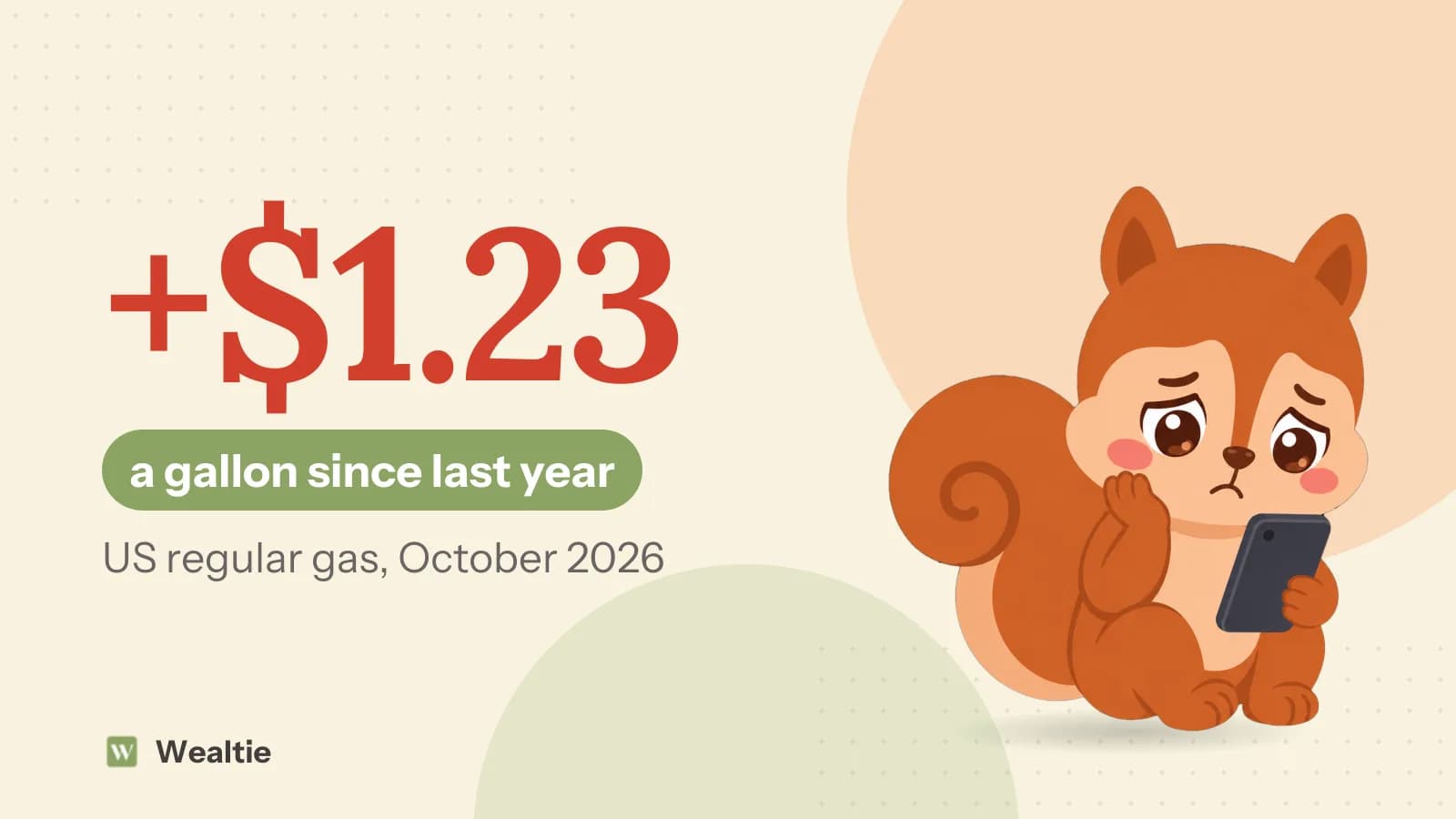
The quickest ways to save money on gas are to drive more smoothly, slow down on the highway and cut idling: aggressive driving can lower mileage by 15% to 30% at highway speeds, says the DOE. With gas at $4.27 a gallon in late October 2026, $1.23 more than a year earlier, each habit is worth more.
 By Wealtie Team · 3 min read
Key takeaways
- Regular gasoline averaged $4.269 a gallon in the US in the week of 26 October 2026, $1.234 more than a year earlier, according to the EIA.
- Speeding, hard acceleration and hard braking can cut gas mileage by roughly 15% to 30% at highway speeds and 10% to 40% in stop-and-go traffic.
- Each 5 mph over 50 mph is like paying an extra $0.30 a gallon, according to fueleconomy.gov.
- Idling burns a quarter to half a gallon an hour, and a large roof box can cut highway mileage by 6% to 17%.
- At 1,000 miles a month and 25 mpg, today's price means $171 a month on gas, against $121 at last year's price.
How much is gas right now?
Regular gasoline averaged $4.269 a gallon in the US in the week of 26 October 2026, $1.234 more than a year earlier, according to the Energy Information Administration.
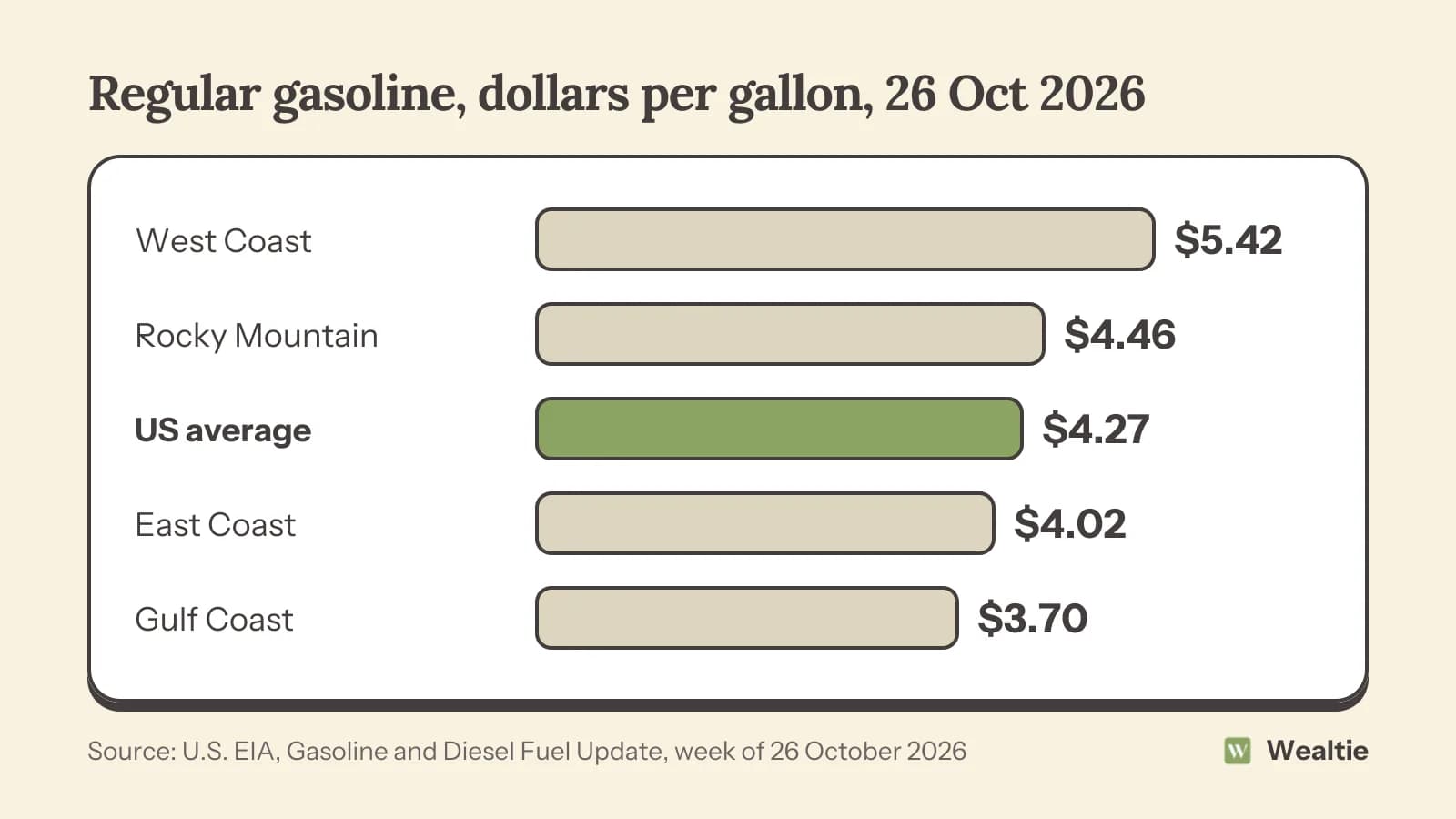
Where you fill up matters as much as how you drive:
| Region | Regular, per gallon (26 Oct 2026) |
|---|---|
| West Coast | $5.417 |
| Rocky Mountain | $4.458 |
| Midwest | $4.269 |
| US average | $4.269 |
| East Coast | $4.022 |
| Gulf Coast | $3.702 |
Here's what the rise means in a worked example: a car doing 25 miles per gallon and 1,000 miles a month uses 40 gallons. At $4.269 that's about $171 a month. At last year's price of about $3.04, it was $121. Same driving, $50 more.
What's the best way to save money on gas?
Drive more smoothly. Speeding, rapid acceleration and hard braking can lower your mileage by roughly 15% to 30% at highway speeds and 10% to 40% in stop-and-go traffic, according to fueleconomy.gov, run by the Department of Energy and the EPA.
On the $171 a month above, 15% to 30% is $26 to $51. That's the biggest single saving on this page, and it costs nothing. Accelerate gently, look further ahead so you brake less, and let the car slow down on its own when the light ahead is red.
Does driving slower save gas?
Yes, on the highway. Each 5 mph you drive over 50 mph is like paying an extra $0.30 a gallon, according to fueleconomy.gov.
Driving at 65 instead of 75 mph is two steps of 5, or about $0.60 a gallon. If most of your miles are highway miles, that's like filling up at $3.67 instead of $4.27. It adds a few minutes to a long trip and nothing to a short one.
What else uses more gas than it should?
Idling, extra weight and anything strapped to the roof.
- Idling uses a quarter to half a gallon of fuel an hour, depending on the engine and the air conditioning. Ten minutes a day waiting outside a school or a shop is five hours a month: 1.25 to 2.5 gallons, or about $5 to $11.
- Extra weight: an extra 100 pounds can cut mileage by about 1%. The golf clubs and the bags of salt from last winter can come out of the trunk.
- Roof boxes and racks: a large roof-top cargo box can cut fuel economy by 2% to 8% in town, 6% to 17% on the highway and 10% to 25% at 65 to 75 mph. Take it off when the trip's over.
How do you pay less per gallon?
Compare prices before you fill up, and plan errands so you drive less.
Prices can vary a lot between stations in the same area. A price-comparison app or your map app's fuel prices show the cheapest nearby. Don't drive far to save a few cents: at 25 mpg, a 10-mile detour uses 0.4 gallons, about $1.70, so it's worth it only if you save more than that on the fill-up.
Some stations charge less for cash or debit than for credit, and warehouse clubs and supermarket loyalty schemes often discount fuel. Combine short trips into one, since a cold engine uses more fuel for the first few miles.
How do you budget for gas when prices keep moving?
Work out your monthly gallons once, then multiply by the current price each month.
Monthly miles ÷ miles per gallon = gallons. 1,000 ÷ 25 = 40 gallons. Multiply by the local price, $4.27 here, and you have a budget of about $171. When the price moves by 50 cents, your budget moves by $20. Recalculate at the start of each month instead of using last year's number.
Log every fill-up for a month and the real figure appears, including the trips you'd forgotten. Wealtie is an expense tracker where you log a fill-up in a few taps, cash or card, and transport gets its own category in your monthly budget. Budget Health warns you mid-month if your spending pace will take you over, so a run of expensive fill-ups shows up before the month ends. If fuel is one of several costs pushing you over, how to stop overspending covers the rest.
Questions people ask
Drive more smoothly and slow down on the highway. Aggressive driving can cut mileage by 15% to 30% at highway speeds, and each 5 mph over 50 is like paying $0.30 more per gallon, according to fueleconomy.gov.
Regular gasoline averaged $4.269 a gallon in the US in the week of 26 October 2026, according to the EIA. That's $1.234 more than a year earlier, and prices ranged from $3.70 on the Gulf Coast to $5.42 on the West Coast.
Yes, on the highway. Fueleconomy.gov says each 5 mph you drive over 50 mph is like paying an extra $0.30 a gallon. Driving at 65 instead of 75 saves the equivalent of about $0.60 a gallon.
Yes. Idling uses a quarter to half a gallon of fuel an hour, depending on the engine and air conditioning. Ten minutes of idling a day adds up to five hours a month.
Divide your monthly miles by your car's mpg and multiply by the local price. At 1,000 miles, 25 mpg and $4.27 a gallon, that's about $171 a month. Recalculate when prices move.
Sources
- Gasoline and Diesel Fuel Update (week of 26 October 2026) · U.S. Energy Information Administration · checked 1 November 2026
- Driving More Efficiently · U.S. Department of Energy and EPA, fueleconomy.gov · checked 1 November 2026
- Weekly road fuel prices (CSV, 2018 onwards) · Department for Energy Security and Net Zero · checked 1 November 2026
This article is general information, not financial, tax or legal advice. Your situation is your own; check the numbers that apply to you before you act on them.